More GREVILLEA and the SURFACE OF WATER

Late Spring is the season for the most spectacular of the Grevilleas (G. robusta. see: http://en.wikipedia.org/wiki/Grevillea_robusta). I saw this one in the Domain Gardens in Melbourne and was delighted to be able to take a close-up of the flowers on a low hanging branch.


As you can see this particular Grevillea grows into a substantial tree. The one we planted in our garden has a long way to go!


This week my teacher set a revision exercise from book two of the Sogetsu curriculum. 'Variation five', in this case 'upright'. I have used Magnolia Grandiflora from the garden of my office and two Strelitzia flowers from our garden. The suiban is larger than it looks in the photo and the forward movement of the left and right hand sides of the work is lost with foreshortening. Because the suiban is large this arrangement allows space between the two groups of the material and on the righthand side to show the surface of the water.


Greetings from Christopher 

25th December 2012

MISSING WATER

Today I was delighted to see the first flower on a Grevillia I had planted about three years ago. Because of the poor water holding capacity of our soil its growth has been rather slow and as you can see in the second picture the plant is still quite small. Eventually it should reach two metres or so.


Recently my teacher set an exercise of making ikebana using roses with leaves, grass or reeds. I used three New Zealand flax leaves from the garden and a single red rose. 


The rose didn't last well so I re-worked the arrangement with a single Strelitzia. I think the balance was a bit more successful the second time. However, I have lost impact of the surface of the water in this deeper suiban.


 If you scroll down to last week you will be able to see the names of the ikebanists with the works shown that I added after I first posted the entry.

Greetings from Christopher 
18th November 2012

WORKSHOP IN SYDNEY

This weekend I came up to Sydney as the guest of the New South Wales Branch of the Sogetsu Teachers Association to give a workshop and a presentation about the time I spent in Japan last year as the recipient of the Norman and Mary Sparnon Endowment Scholarship. 
On Saturday afternoon we had afternoon tea with my sister-in-law on the terrace of the Museum of Contemporary Art with the opera house in the background. In this picture are Laurie, me and Julie, Laurie's youngest sister.


Australia's most famous building.


The theme of the workshop was 'Having in Mind Water'. I asked the attendees to think about how they might make ikebana with this theme. Such ikebana can show the surface of the water, show its translucence in a glass vase, imply water by using water associated plants or try to indicate the movement of water. Therefore some of these works may not actually show the water. 

Here are two of my examples. First, ripples on a pond.


Second, splashing rain.


Below are nine ikebana works created by some of the attendees. I was not able to photograph all of the works, here is a selection of them. I hope you can see and feel the intention of the ikebanists. They are by:


 Jorgen Rasmussen.


                        ********************* 

Ann Smith


                        *********************

Masae Ako


                        *********************
Evelyn Lines


                        ********************* 

Joan Perkins


                        ********************* 

Margaret Hall


                        *********************
Sandra Cottee


                        *********************
Kevin Walpole


                        *********************
Shirley Ma


Greetings from Christopher, in Sydney,
11th November 2012.


TWO ARUM LILY LEAVES and XANTHORRHOEA IN BUSHLAND

The pictures below were taken on a rather cold over-cast day a couple of weeks ago in the bushland about 10 minutes drive from our house. I wanted to show this splendid flowering Xanthorrhoea in its natural setting.


My ikebana this week uses two arum lily leaves in a black vase by Alistair Whyte.


This last week our TV and newspapers have shown images of the terrible ravages resulting from the converging hurricane and storms in the east of north America. My thoughts go particularly to friends in the USA and Canada who share our joy in ikebana and who may have suffered losses.

Greetings from Christopher 
4th November 2012

AN ARRANGEMENT OUTSIDE THE VASE

I was in the Melbourne Botanic Gardens last week and came across this small Gymea lily (Doryanthes excelsa, native of Queensland and New South Wales ) and thought it worth a photo as I was able to get up close to the flower. As it was a relatively young plant, it was only about 1.7 metres high. Gymea flower stems can reach five-six metres and have much larger composite flower heads than this one. When you look closely perhaps the most striking thing is the bright green pollen pads on the ends of the stamens.( For more information you may click on: Doryanthes excelsa)


To give some sense of scale I held my hand beside the flower head.


The two plants in the background here were over two metres.


Last week my teacher set the exercise of making an arrangement 'outside' the vessel. She referred to notes by her first teacher, the late  Norman Sparnon. These would have predated the new Sogetsu Curriculum exercise of '...Paying attention to the container and to the place where the arrangement will be put.'. I couldn't get the vine I had originally intended for the exercise so, in this work I re-used material (black willow) from a fortnight ago and two roses bought from my local florist. 


Greetings from Christopher 
27th October 2012


MORE AGAVE ( and Xanthorrhoea)

Last week Leonora from Ottawa admired the photos of the Australian native flowers I posted, which she commented are so different from the spring flowers in Canada. Here are some more from our garden. The first is an off-white creamy-green callistemon with an upright growth.


Here is a close-up of the same bush.


This is one of many red callistemons and has a weeping growth. As you can see the upper flower is just beginning to open.


Below is a spectacular xanthorrhoea I noticed recently growing in a garden near to our house. The flower spikes must be three meters high. I have never seen one flowering like this in a private garden before as they are notoriously slow growing plants. However they are common in the bush land in our district. 


I took this close-up of some flower spikes I took in the bush to show the tiny white flowers that make up each spike.


As I promised last week I made another ikebana from the agave I took to the workshop last week. I have created a simple form using the natural lines of the material.


This turned out to be a work that can be 'seen from all around'. I really like the surface texture and the beautiful subtle colours that are revealed.


Greetings from Christopher
21st October 2012


REPEATING SHAPES

Spring weather has brought out a number of native flowers in our garden, here are two. A richly orange coloured banksia... 


..and a pink calistemon. 


The new growth on this eucalypt is also a beautiful rich pink.


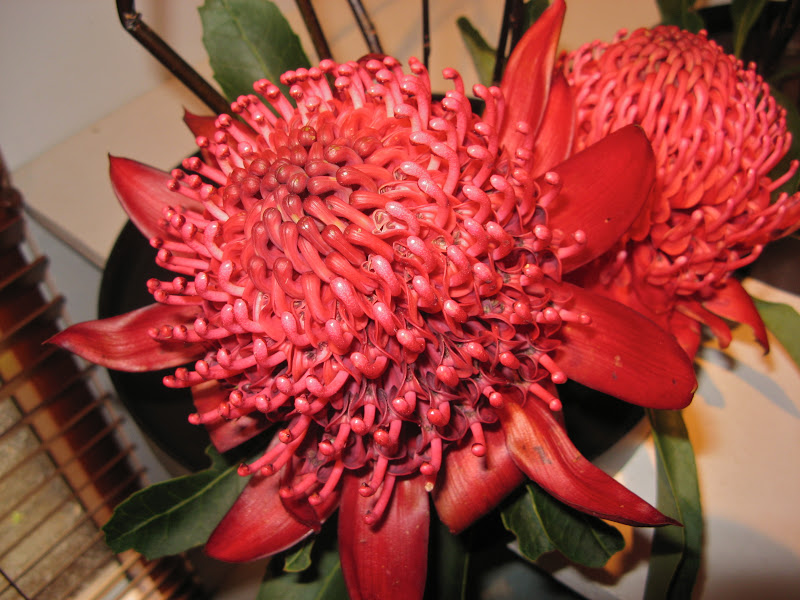
I bought some red Waratahs this week and have taken a close-up picture so that you can see each head is composed of many small flowers, surrounded by a row of bracts of the same colour. The Waratah is the state floral emblem of New South Wales. It is a really beautiful flower and lasts well when cut. (see: http://en.wikipedia.org/wiki/Waratah)


The exercise my teacher set was: using two or more containers make a work that incorporates repeated shapes. I have used 'black willow' to create some narrow triangles. There are two flowers in the front suiban, a smaller one behind and to the right, but only leaves in the suiban at the back. The surface of the water is a strong feature of the arrangement.


Yesterday I attended a workshop of the Sogetsu Branch Victoria. The theme was ‘Ways with Agave’ taken by Mrs Toula Karanikolopoulos. She focussed on techniques of working with Agave and other succulent materials. I was impressed with the variety of techniques and in particular Toula’s insight regarding the working of nature on the material over time. Next week I will include an example of an ikebana I created after the workshop. You can see images of the workshop on the Sogetsu website under the ‘News’ page, or clicking on:   http://www.weebly.com/weebly/main.php .

Greetings from Christopher
14th October 2012

2012 IKEBANA at QDOS: SMALLER WORKS


This weeks pictures are of the 'domestic' scale works at this years exhibition at Qdos Gallery. The first work is by Helen Quarrell. She has arranged short lengths of copper tubing, some of which have touches of verdigris on them, and glass test tubes wrapped with fine red wire in the cone shapes that make up the vessel. Her original intention was to place some small flowers in the test tubes. However, they were too small and looked weak against the visual strength of the ceramic vessel, which is about 60 cms long. The vessel is made of a number of small irregularly sized ceramic cones fuzed together looking like oversized coral.


In this next work Christine Denmead has used a single dark magnolia leaf and a branch of weeping elm in a tall vessel. She has carefully pruned the branch to emphasise the curving lines and accentuate the vessel.


I made this work using a branch from our apricot tree with its spring leaves opening, two arum lilies and have contrasted them with a lichen covered branch on the opposite side of this free-form vessel. So one side of the work has fresh and the other side dried materials. The upper part of the branch on the right extends well toward rear of the work and the apricot branch extends forward. 


The vessel below is a smaller version of the one in which Helen Quarrell arranged the test tubes. Here she has arranged gypsophila to create a cloud of white floating above the work.


I have arranged some lichen encrusted box-thorn around this unique vessel. Because the box-thorn is dry material it does not need to be placed in the hole at the top of the vessel. The material complements the vase well; both have two distinctly different sides. In this image the yellowish lichen contrasts with the mostly blue surface on this side of the vessel.


On the reverse side the lichen is mostly a coppery green and the predominant colour of the vessel is terracotta. This surface of the vessel is more varied with beautiful subtle colourings. 


The vessel stood on a pedestal in the middle of the lower gallery and so was able to be viewed from all angles.

Greetings from Christopher
6th September 2012