DRIFTWOOD AND DRYING LEAVES

At the end of November last year I posted the photo, shown below, of an ikebana work using a succulent and 'unconventional material' created by Joan Norbury.


This week at the class with our teacher she showed me the photo below. She said the succulent arrangement had '...remained in that position (since the class) under a very wide eave and without the succulent receiving any water whatsoever…yet (it) continued developing and produced flower.'   


Here is the arrangement re-photographed last week, three months later without water. Some plants are amazingly resilient!


During the week I attended the first meeting of Ikebana International in Melbourne for this year. The theme for our exercise was 'Red Hot Tuesday', (click this link to the Ikebana International blog). In my interpretation of the theme I imagined the 45 degree Celsius, hot dry air of a couple of weeks ago that caused these Gymea leaves to burn. I have added a branch of driftwood from the beach and two orange flowers of Crocosmia Montbretia, an image of which can be seen on the lower right of the wikipedia page. The arrangement looks a bit odd as it is viewed from above. The vase is by Tom Cockram a ceramic artist from central Victoria.


Greetings from Christopher
16th February 2014


A BASKET OF SUMMER GRASSES

Our house backs on to an intermittent creek, pictured below, that at the moment is just a series of small pools and muddy bogs. 


This week has continued to be sunny, hot and dry. Because of the weather I decided to set my students the exercise of 'an arrangement of summer grasses in a basket'. I collected seven different grasses from the creek. Below is a native grass with a tight seed head and behind it fennel that has escaped from a nearby garden.


Here is some dock growing among bullrushes (called cattail in some countries), which are shown in the following photo. 


This photo shows sedge and in the lower part of the photo the green seed head of Down's nut grass.


Lastly the wiry bracken fern.


I have arranged the above photos in the sequence of their use from top to bottom in the naturalistic basket arrangement below.


Greetings from Christopher
8th February 2014

SUMMER HEAT

To continue last weeks floral theme, below is a photo of a bright orange corymbia in our neighbours garden that looked luminous in the bright sunshine yesterday.


We have had some very hot weather this summer with a week of days over 40 degrees Celsius a couple of weeks ago. Today it is 35 degrees C (95 Fahrenheit) in our garden. Below are two photos that I took yesterday afternoon of the near-by beach.


The summer in this part of Australia is hot and dry. So it is common for our gardens to look desiccated and wilted after such weather. Therefore it requires the growing of hardy plants as well as the use of mulch and appropriate watering for the garden to survive and look well.

This week I have tried to capture the feeling of the hot dry weather in my ikebana. I have used a piece of sun-bleached driftwood, some pale orange succulent flowers and a small amount of a hardy native cushion bush, leucophyta brownii that has beautiful silvery stems. If you look carefully at the bottom of the photo above you and see some growing on the cliff-face. 

Here it is growing in our garden.


"Summer days"


The cylindrical vase is by Jane Robertson from SouthAustralia.

Greetings from Christopher

2nd February 2014

FRESH AND DRIED MATERIALS

My attention was caught this week by the spectacular blossoms of a corymbia ficifolia, a native of south western Western Australia. This is a popular evergreen street tree and garden ornamental because of the intensity of its flower's colour. These range through cream, pink, red and orange. 


Below is a vibrant orange-flowering corymbia that is in the street opposite our house.


I have made an arrangement in a black ceramic vase, of 'fresh and dried' materials, using the corymbia blossom, agapanthus flowers and the dried stems of agapanthus from last summer.


Greetings from Christopher
25th January 2014


SUCCULENTS

Three weeks ago I posted some images of visitors to our garden. Last evening we were surprised to see the echidna again while we were having our dinner. I had seen it earlier drinking from the saucer under one of the flower-pots, so may be we will be visited more regularly in the hot dry weather of summer.


A couple of days ago in the garden I noticed some aloe (it is similar to a.spinossima) that I had dug up several weeks earlier was turning a rich orange-pink and thought the leaves would be an interesting ikebana subject. I have added the flower of another succulent that has large lobed grey leaves and arranged them in a ceramic bowl by Phil Elson that has a black outer surface.


Later I added some pink geraniums. 


Greetings from Christopher  
19th January 2014


;shdf;kjsd

PINCUSHION FLOWERS

I was in the Royal Melbourne Botanical Gardens in mid-December and this Jacaranda caught my eye with its amazing carpet of fallen flowers. The house in the background was built in 1856 as the original official residence of the Director of the Gardens. It is now used as an event space. Notice there is another Jacaranda to the left of the house. 


Staying with blue, this small multi-headed 'blue pincushion flower' (brunonia australis) was growing in a local nature reserve near our house. I came across it on a sunny day also in mid-December.


In my posting two weeks ago I included a photo of this clump of Scabiosa growing in our garden. Like the flower above, it has a similar pincushion appearance with the flowerhead made of a cluster of smaller flowers. 


I thought the scabiosa went well with the colours of the acanthus flower spikes, also from our garden, and have arranged them in an informal summer arrangement in a small basket. In addition I have added foliage of acacia baileyana which is a soft blue grey. 


Greetings from Christopher
12th January 2014

A NEW YEAR GREETING

Over the past week I have been enjoying postings by Lennart Persson on his Nordic Lotus blog and highly recommend them. He has managed to find a number of ikebana films on-line that are really interesting. You will need to scroll down to find them or click on the highlighted text below. The first (posted on 27th December), Art and the meaning of Ikebana made in 1973, is a general overview of the historical development of ikebana up to that time. The second, Ikebana (1956) features Sofu Teshigahara and will be of particular interest to Australians as Norman Sparnon is one of the students in a classroom scene about 8 1/2 minutes into the film. The third Ikebana: Flower Arrangement  features Kasumi Teshigahara. I really appreciate Lennart's thorough research and bringing this material to our attention.

This week's ikebana is a New Year arrangement using only Australian native flora from our garden. 


Banksia integrifolia, bursaria spinosa and meleluca hypericifolia. The ceramic vase is by Greg Daly.

With best wishes for a healthy and fulfilling New Year.
Christopher
4th January 2014
VISITORS TO THE GARDEN

Here in the southern hemisphere the weather is becoming summery so things are flourishing in the garden. There are more insects including butterflies like the one on this pincushion flower(scabiosa atropurpurea).


The insects have brought the return of our old friend the echidna who we haven't seen for a while. Our neighbour took this photo while the echidna was eating ants by the side of the garden path.


I was surprised yesterday to notice this straw-necked ibis scratching for insects among the leaf litter. It is only the second time I have seen one in the garden. In this photo you can make out the iridescence in the dark feathers of its wings.


Summer is further evident in these photos of a New Zealand Christmas Bush on the foreshore at Torquay. The flowers looked like they were glowing in the afternoon sun.


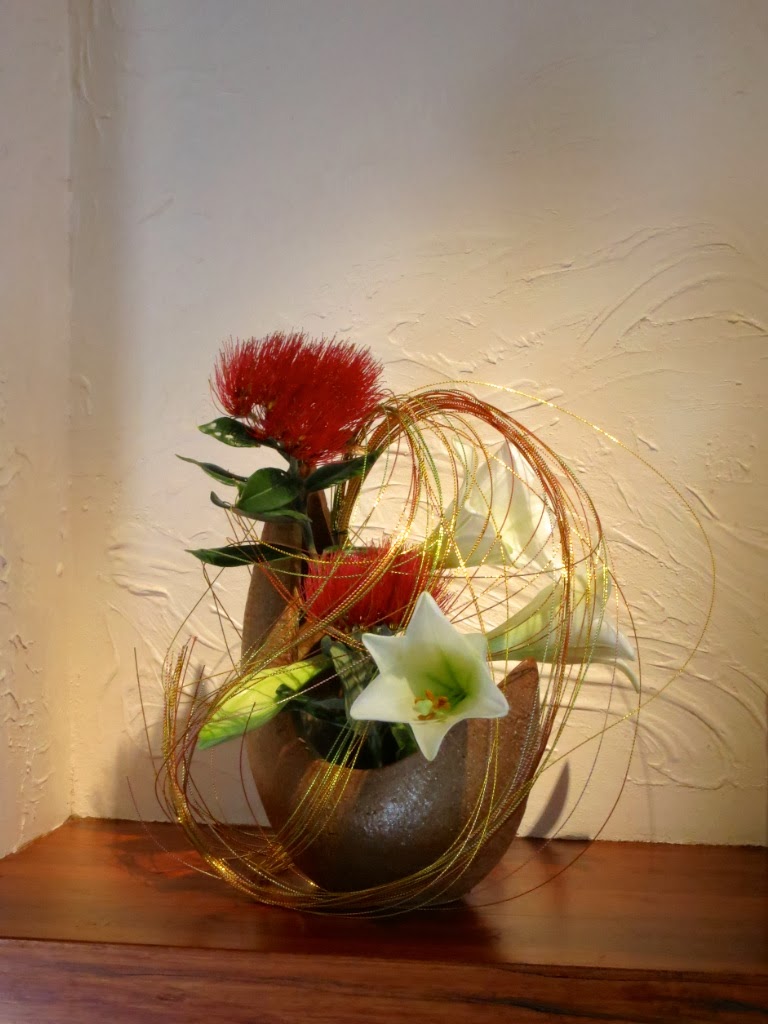
I decided they were just what I needed for my small Christmas arrangement, so I picked some from a neighbours garden to add to the fragrant white lilies I had bought from the florist. Some golden mizuhiki provided the Christmas sparkle. The crescent-shaped ceramic vase is from Japan.


Belated Christmas Greetings from Christopher
28th December 2013