SUMMER CONTINUES

I have been doing some internet research following an enquiry by Gail, who lives in New York State, about the seed heads I used in my 'Memories of Summer' arrangement last week. To my amazement have discovered it is an indigenous plant, spinifex sericeus *, and not marram grass at all. These two grasses look very similar to the untrained eye and share many adaptation features for growing on the harsh environment of sand-dunes. One of their most noticable differences is that the spinifex has the beautiful seed heads I showed last week. In my journey of discovery I also learnt that the nearby town of Barwon Heads, east of Torquay, has a voluntary conservation group that has an excellent website that focusses on a coastal headland and the adjacent marine environment. Check their website: 'Friends of The Bluff' *.


In keeping with the summer theme of last week, the ikebana above also features driftwood and some unidentified fresh flowers I bought. The stems of the  flowers looked a bit like dianthus, however the flowers reminded me of poppies.


I also created this arrangement of nandina domestica leaves, from the garden, in a circular glass and metal vase. I was pleased that I managed to reseal this leaking vase by painting the joins with PVA wood glue the night before. A major advantage of the glue is that it dries clear. I was fascinated by the red edge that developed on the leaves and pleased to have two of them above the water surface.

Greetings from Christopher.
21st February 2015

* click on the blue text for further information.

MEMORIES of SUMMER


This week I attended the first meeting of Ikebana International (Melbourne) for 2015. Members are encouraged to create ikebana at the meetings, according to a particular theme. February's theme was 'Memories of Summer Holidays'. I have lived in the seaside town of Torquay, Victoria since childhood and so the first thing that springs to my mind of summer holidays is the beach. However, I learnt a long time ago that a beach is more than sand, water and sunshine. On the exposed cliff tops are wonderful works of nature as you can see below.


In this photo, above, at the edge of the low cliff is a clump of silver-grey cushion bush * (leucophyta brownii). 


On the sand dunes is found marram grass *(Ammophila), a species from the coasts of the North Atlantic Ocean, that has now naturalised in many parts of the world where it has been used to 'stabilise' sand dunes. I took the photo above on the east coast of Tasmania in 2011.


Also on the cliff face are found Moona trees (Melaleuca lanceoleta), a low growing tree that develops remarkably twisting branches in the prevailing winds that are a climatic feature of this region.

At the I. I. meeting I was given the task of explaining my interpretation of the theme and demonstrating how I created my ikebana to express my ideas about the theme. First I had to create a support fixture so that a Moona branch 'floated' across the top of the vase. In this instance I used a single length of dowel at a 45 degree angle into the vase that rested on the lip of the opening and which I inserted into the branch. Then I added carefully bundled groups of Cushion Bush, followed by the seed heads of Marram Grass that I had wired together.

                         
A photo of me at the end of the demonstration. Here is a link to more images on the Ikebana International Melbourne * blog.


Above is my first version of this ikebana that I made at home to ensure that the 'mechanics' would hold up and that my ideas were appropriately expressed. The vase is wood-fired ceramic with a shino glaze made by Sergio Sill, a New South Wales potter. The red colour of the glaze has a hot dry, Australian summer feel.

Greetings from Christopher

14th February 2015

*
Click on the coloured text for further information

WARM WEATHER: EMPHASISING WATER

This week marks the beginning of the academic year and children have returned to school after the long summer holidays. It is often the case that the first month of the school year is the hottest. January has been reasonably mild on the south coast, but today we are expecting 35 C. Because of the anticipated heat we took an early morning walk on the beaches west of Torquay and I caught these reflections of the sky in some rock pools.


This reminded me of the theme of the class I gave the evening before, it was: an arrangement 'Emphasising water'. Always an appropriate theme for this time of year. Below are some examples of the students work.


Maureen created both works above. The first with long lines in a suiban leaving a large open water surface and the second in clear glass bowls using green materials only.


Christine also used a suiban arranging berries drooping down toward the water surface that also reflected the lines.


Her second work was a single leaf carefully suspended in a glass vase filled to the top with water.


Ellie arranged these materials both above and below the water and added a single sunflower petal to create a small colour accent.


In her second work she arranged two sunflower heads in a glass bowl and added two stems projecting to the rear to give the work depth.


Vivien, a second year student, created a variation number 3. This is said to be the most 'western' looking of the early curriculum lessons, as the materials are centrally placed in the suiban with the flower projecting forward. 


Above is my work, two stems of Japonica with two fruit attached, arranged in a glass cylinder. 

Greetings from Christopher
7th February 2015

REFLECTIONS


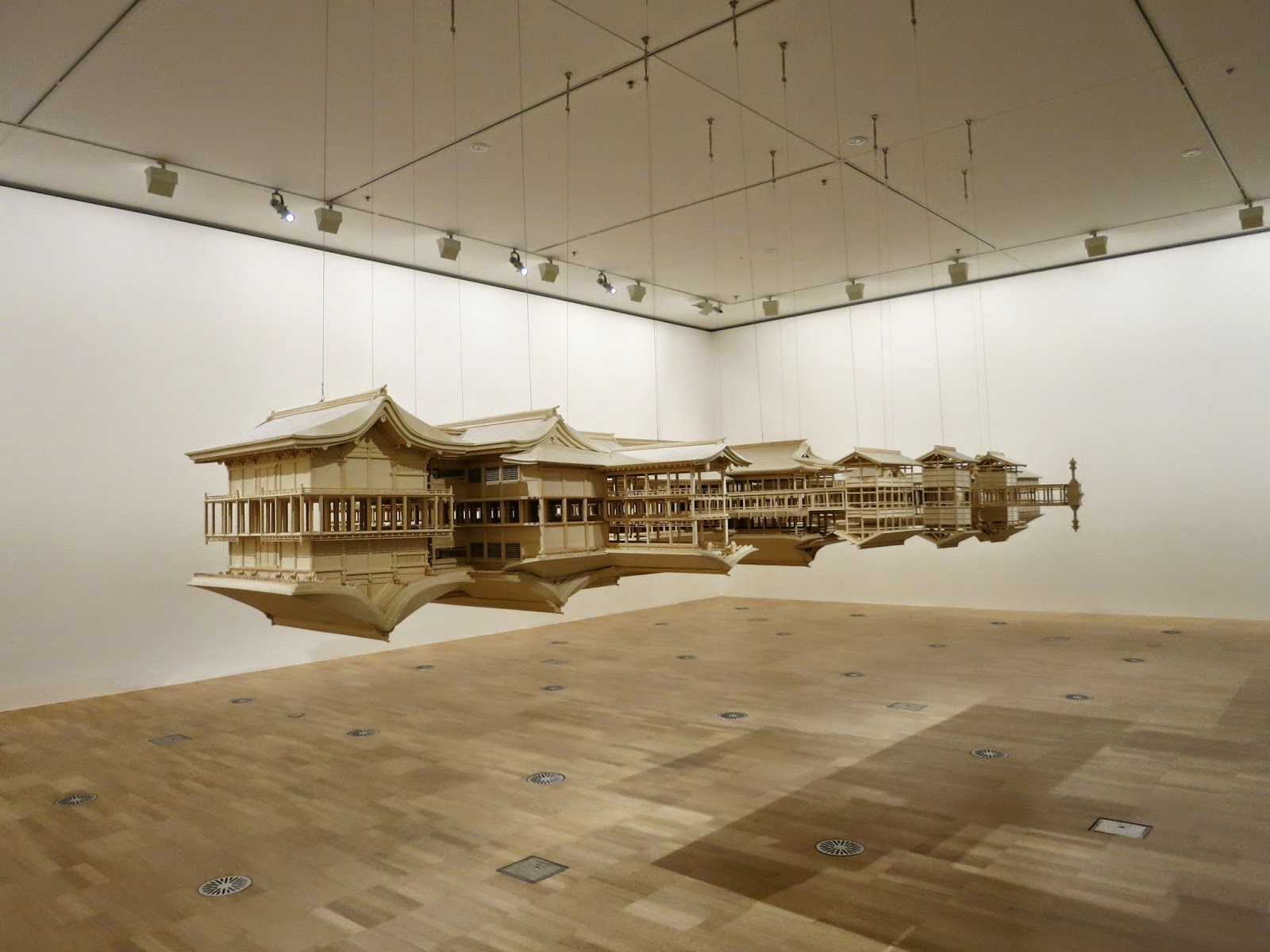
On Thursday evening I attended a viewing in the Rio Tinto Gallery, temporary exhibition hall, of the Asian Art Department at the National Gallery of Victoria. The subject of the viewing was a sculpture, newly commissioned by the NGV, created by the Japanese artist Takahiro Iwasaki *. It is called 'Reflection Model (Itsukushima)'. The sculpture is of the Shinto Shrine at the island of Miyajima in Japan's Inland Sea. Wayne Crothers, curator of Asian Art, has written an excellent essay about the work which is on the NGV website *  and spoke about the work at the event. The large sculpture floats suspended in the gallery space, revealing the shrine and its own reflection like some etherial object from another dimension.


This first photo shows the whole of the sculpture including the iconic Torii gate through which, in the past, pilgrims approached the shrine by boat. I really love the way the sculpture inhabits the space. Because it is not attached to anything, it is as though it there and not there at the same time, as though it could suddenly disappear leaving a shrine shaped void.


I visited Miyajima Island when I was in Japan in 2011 as the recipient of the Norman and Mary Sparnon Endowment Scholarship. Below are a night time and early morning photo I took of the Torii.


Next, some more general views of the shrine.


The last photo is of the reflection of part of the shrine on that day.

             *      *      *      *      *      *      *

This week's ikebana does not involve reflections. However, the space between the two vases and the line of the flower stem defines the relationship of the two elements of the ikebana. 


Two blue glass vases with pink, double flowers and leaves, of Oleander  * (nerium oleander).

Greetings from Christopher
31st January 2015

* Click on the coloured text for further information.

'RED IS THE COLOUR...'

The photo below is a Corymbia ficifolia * , growing in the street near our house. These are very popular ornamental trees because they are quite hardy and because of the intense colour of the flowers that are borne in clusters at the end of its branches. Their colour varies from rich red through orange and pink to white.


Above is a close-up photo that shows the flowers have no petals and are made up of hundreds of brightly coloured stamens. I think their colour is intensified by the sunlight passing through the stamens.


This shows the flower buds with their caps still covering the stamens.


Here you can clearly see the cap lifting. 

I associate these flowers with summer and so thought I should arrange some while I had the opportunity. I have used a spherical ceramic vase I bought from an Adelaide gallery in about 1972; I still clearly remember being drawn to it from across the room when I went into the gallery for the first time.  It was made by very skilled ceramic artist, Don Jones, who was working in Adelaide when I lived there. 


This first photo is 'viewed from above', one of the Sogetsu School curriculum exercises.


This second photo shows the flower cluster on the longer stem balancing against the mass of the vase. I have removed most of the thick leaves and carefully rotated the flower heads so that the flowers are not drooping.


Over the last couple of weeks Lennart Persson who writes the, Nordic Lotus Blog, has shown images of ikebana he has created in a collaborative exhibition with some ceramic artists in Oslo. I think his work beautifully complements the ceramics. Here is a link: Nordic Lotus * .

Greetings from Christopher
24th January 2014

* Click on the blue text from further information.

FLOWERS AFTER RAIN

This last week has seen some unusual, very welcome, drenching summer rain that persisted for a day and a half and really refreshed the garden. The rain was especially welcome because spring had been unusually dry. This evening, as I watered the garden from our rainwater tank, I was surprised to see some plants had flowered following the recent rain. 


I was particularly surprised to find an out of season Hellebore flower.


This sweet little rose grows on a wire fence. The flowers buds are usually eaten, before they get a chance to open, by possums walking along the fence. 


It occurred to me while I was in the garden that many northern hemisphere readers of this blog may have never seen the flowers of New Zealand flax (above). They are not large, however they do grow along very long stems.


This photo shows some seed pods that, as the season progresses, will become black - as does the stem. The stems with their seed pods make very striking ikebana material.

I made this week's ikebana in Florida back in October last year. It was an experiment using a vessel from my friend Michael's ceramic collection. The vase being particularly tall and having a narrow base is not very stable. 


So I thought one solution to using it would be to place material outside it in such a way that the material would provide additional support. My choice of material was not good as it was too flexible. I should have used a stiff branch. The material was a large philodendron leaf which I stripped leaving the veins only. I drew the ends of the veins together creating a circular shape. I then added a small sunflower as an accent, shown in the photo below.


Thanks to Michael for the materials and the loan of the very striking vessel.

Greetings from Christopher
17th January 2015


FLOWERING BRANCHES


This week two friends living through the depths of winter in North America have written to me following my posting last week; Lynn commenting that it was lovely to see '...growing things and bright sunshine!...' and Leonora that '...at the moment (it is) too cold to even buy flowers, they would freeze instantly!...'. I must admit to being a little shocked at the thought that flowers from the florist would freeze. The possibility had never occurred to me. It was minus 20 degrees Celsius in Ottawa at the time ( - 4 Fahrenheit). I 'take my hat off' to ikebanists who keep their passion alive under such circumstances.

Leonora sent the photo below of the view through her window. It shows another kind of natural beauty being revealed.


Through the ice crystals on the window, 
on the right is the tortuous willow in her front garden, and in the centre of the photo, a spruce in the garden of the house opposite. Here in the south of Australia we are being blessed with rain following a week of extreme heat, with serious bushfires near Adelaide in South Australia.

One of the indigenous plants blossoming here at the moment is a small tree, Bursaria
 * , which has clusters of small creamy-white flowers at the end of it's branches. I really like the odd angles that often occur in the branches that make it a good material for ikebana.


Above is a small bush I photographed this morning that is in full flower.


This next photo shows a larger tree that finished flowering a couple of weeks ago. I used some of this material to make a free standing 'no kenzan' arrangement in a shallow suiban.


To emphasise the asymmetry of the work I have used fresh, flowering, branches on one side and a bare branch opposite. This has also contributed to the open space within the arrangement.

Greetings from Christopher
10th January 2015

* click on the blue text for further information.

HAPPY NEW YEAR FROM THE SOUTH COAST OF VICTORIA

On New Year's Day I walked along the clifftop track to Bell's Beach, about 4 kms west of Torquay.


This photo is looking toward Bell's Beach and shows the heathland of low growing shrubs and grasses on the left-hand side above the clifftops. Flowers in this landscape are mostly small and only look spectacular when they flower en masse in spring. However, I had some fun taking some photos including trying to take some close-up images.


These are the fruiting bodies of the Prickly Tea-tree * (Leptospermum continentale). Although they are quite small there are so many of them the branches seem covered in the rich red berries.


A long time ago my friend Fermi identified this sweet little flower, which was growing along side the path, as Centaurium erythraea * . When I discussed it with him recently he pointed out that it is, in fact, an introduced species that has naturalised. However, he pointed out that it is not a particularly invasive weed and can fairly easily be removed. 


This prostrate Banksia marginata * was also growing beside the path. In this very exposed situation, where it is subject to strong and salty southwestly winds, it only grows as a small dense shrub. Inland it may grow to tree height.


The small stems remind me of cherry tree bark because of their colouring and shiny surface.


Another favourite is this Spyridium (S. vexilliferum) that is known locally as Propeller Plant. It is interesting to note that the silvery white 'propellers' are actually new leaves, in the centre of which is the multiple flower head.


 In the photo above a minute yellowish flower can be seen in the red circle. 

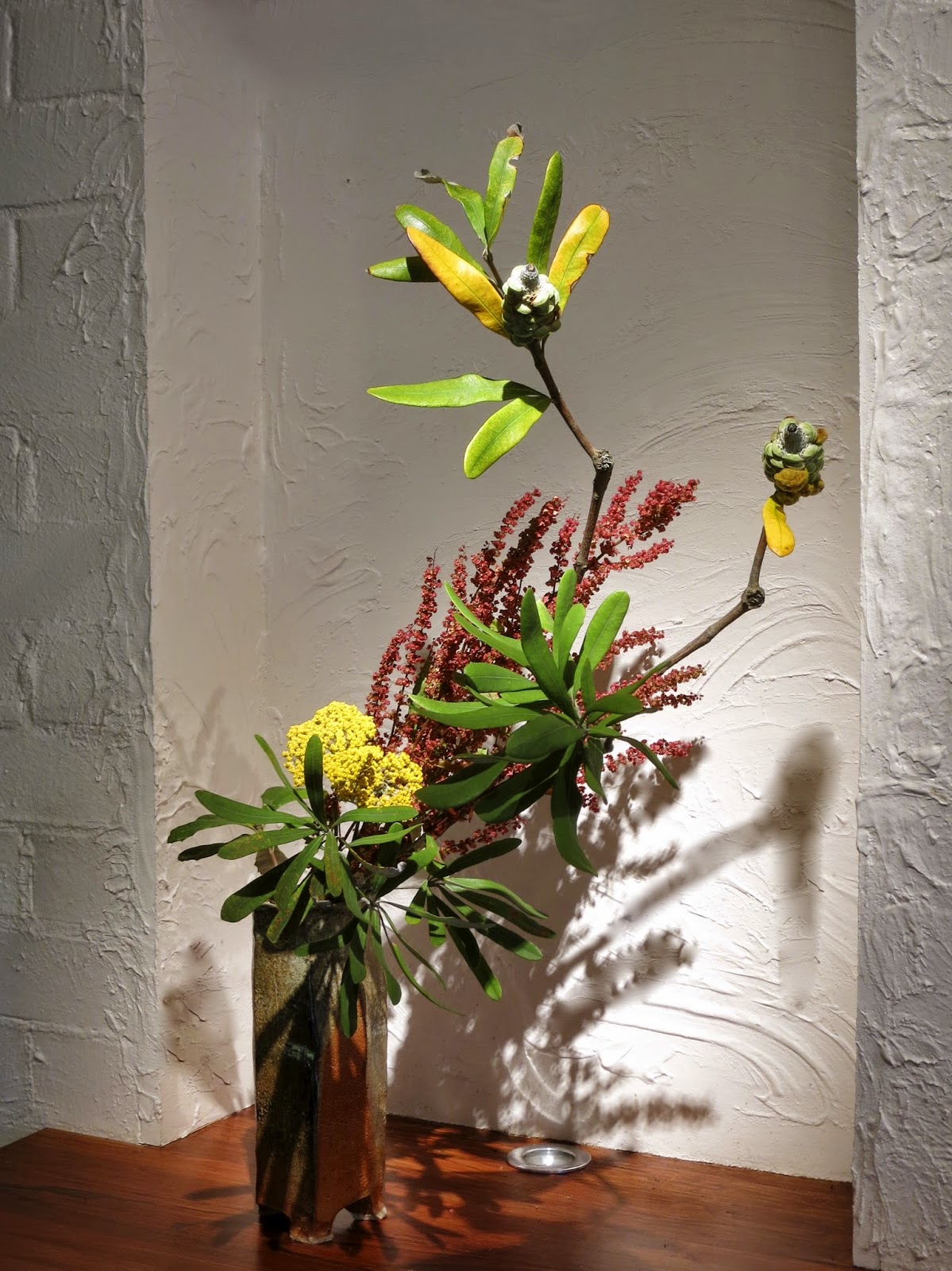
This week's ikebana has a Banksia (B. oblongifolia, [I think]) from the garden), some Dock weed, and a small yellow everlasting multi-headed flower from Western Australia. The beautiful wood-fired, Shino glazed vase is by the Canadian ceramic artist Don Goddard * from Lachine.  


Here it is again with some red and white mizukiki strings added, to wish you a happy New Year.


Greetings from Christopher
4th January 2015

* Click on blue text for further information.