WINTER SOLSTICE

This year the winter solstice occurs tomorrow, Sunday 21st June. Winter has been busy in our garden with a number of activities, including putting down a deep layer of mulch to suppress weed growth and to hold moisture in the soil when dry weather comes in Summer. 


While in the garden yesterday I noticed that the first of the Cootamundra wattle (Acacia baileyana) *  blossoms were opening.


The tree is beside the garden path, and the photo shows the blossom buds before opening, the blue-gray foliage and dark trunk and branches.

  
Here is the prostrate form beside some of the newly lain mulch.

  
Underneath the Cootamundra this small red flower has also just started to open. 


It belongs to a low spreading shrub called Swan River Pea, from Western Australia, that I have just discovered was re-classified as (Gastroloium celsianum) * in 2002. The next series of photos shows a local Banksia (B. integrifolia) * in three phases as the flower opens.


Above is a seed head.


I photographed the flowers close-up on this tree. 


On a side fence is a vine pandorea pandorana * (sometimes called 'Wonga wonga vine'). I recently had to prune it quite hard as it had grown up into a tree. The vine was fairly thick and had beautiful lines.


I thought it would make a good ikebana subject. Because this single entangled piece was so long I needed to use two cylindrical vases to support the vine and explore its lines. The arrangement is 1.2 metres wide. As a contrast I have added three oriental lilies and two buds.

I have recently learnt that 14 members of the Victorian Branch of the Sogetsu School have had their work selected for 'Poetical Ikebana' the latest publication by Stichting Kunstboek in Belgium. Special congratulations to Robyn Unglik who had one of her images chosen for the front cover of the book.


Greetings from Christopher
20th June 2015

JAPANESE DAY at IKEBANA INTERNATIONAL MELBOURNE

This week I attended the monthly meeting of Ikebana International in Melbourne. (The meeting included a tribute to a former life member of the Chapter, Mrs Masumi Jackson, who died in March.) The theme of the meeting was Japanese Day and our guest presenter was Mr Sam Ito, a chef, who gave a wonderful and informative demonstration of how to make sushi rolls, which later we all got to practise. 


I discovered the importance of moistening one's hands before handling the sticky rice (it stops the stickiness). 


The sushi in this photo was all made by I. I. members. Not too bad, I suppose, for a first effort by some of us.

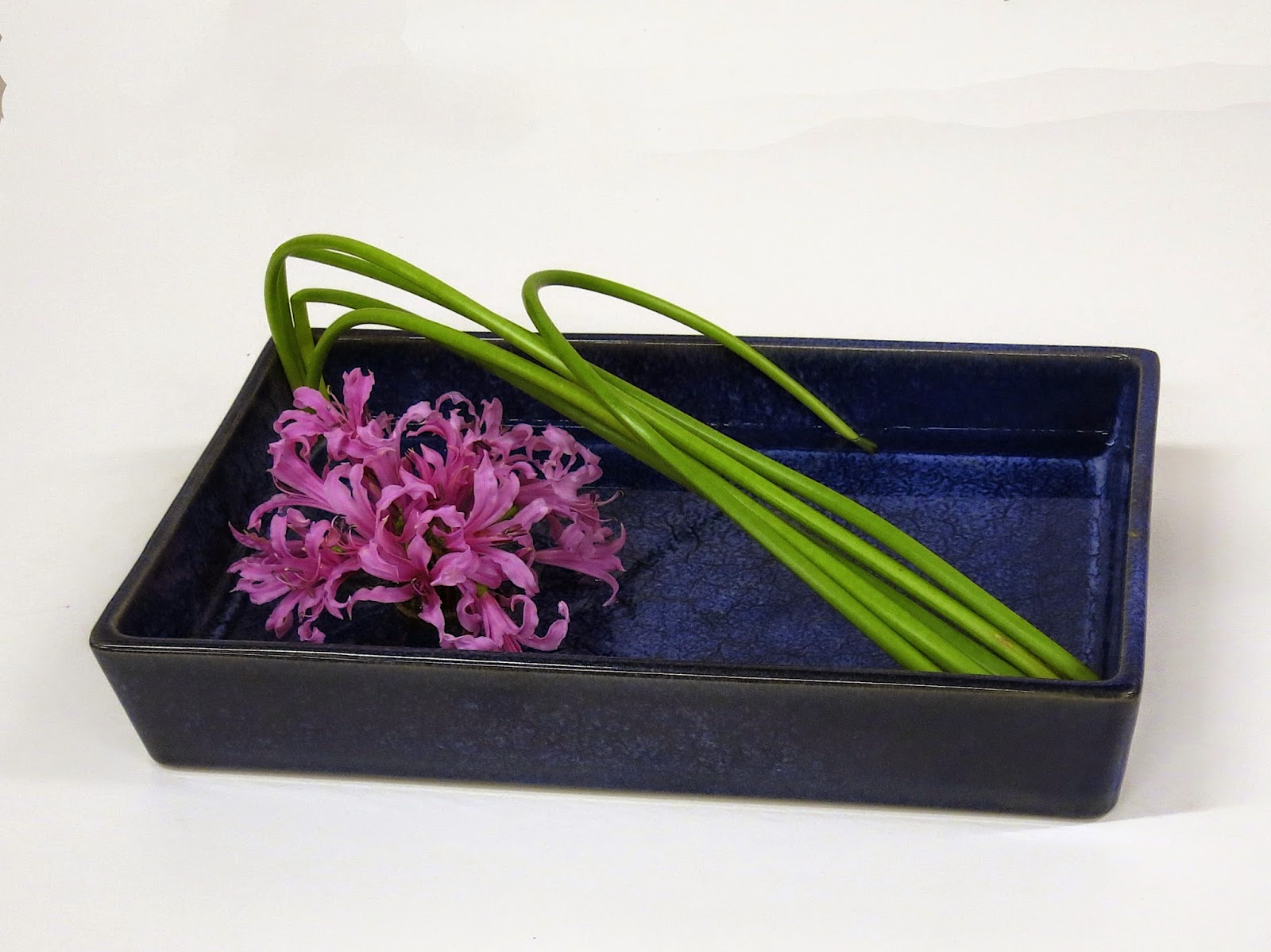
Before the meeting members were encouraged to make ikebana in tableware, in keeping with the sushi-making theme. 


I decided to use some interesting dishes made by Terunobu Hirata * , some of whose pots can be seen on this link. For more photos from the meeting, follow the links: Ikebana International * June meeting.

Greetings from Christopher
14th June 2015

* click on the blue text for further information

WINTER ON THE SOUTH COAST

A further 'holiday pics' indulgence. When I down-loaded photos from my camera this week I discovered a few from our last day in Queenstown, New Zealand, a couple of weeks ago. 


I was amused by the advertising gimmick of this landscape design firm. (They weren't just advertising plastic grass).


The depth of snow at the carpark on Coronet Peak, about 20 minutes from the centre of town, was sufficient for this child to have fun throwing handfuls of snow.


We were therefore rather surprised to see snow making machines operating.


For someone not much used to snow this view across Lake Wakatipu was really splendid. I was entranced by the bright patches of sunlit snow glowing through the layers of clouds. By comparison winter is much more mild on the south coast of Victoria. However, we regard it as cold when the temperature is less than 13 C at its maximum; as was the case earlier this week.


Today I spotted this Egret * in Spring Creek, Torquay...   


...and realised this was what made these lovely patterns in the mud a few weeks ago.


This week's ikebana has a wintery feel, and is a freestyle using lichen covered seed pods of Eucalyptus forrestiana * . I am not sure of the name of the greenish flower, which is also a Eucalyptus species. The silvery looking ceramic vase is by Arikawa Makoto, a young ceramic artist who had a temporary exhibition that I saw in Tokyo in 2011. 

Greetings from Christopher
6th June 2015

* Click on the blue text for further information.

TRAVELS IN NEW ZEALAND

Over the past three weeks I have published posts about workshops I have conducted in Wellington, Dunedin and Christchurch in New Zealand. Usually when I travel I include photos about the countryside through which I travel. For various reasons this has not been possible until now. So this week I am including a link to some of those non-ikebana-related photos. Travelling in New Zealand * . 


Laurie and I at the first bridge on the walk to the Hooker glacier on the southwest flank of Mt Cook.


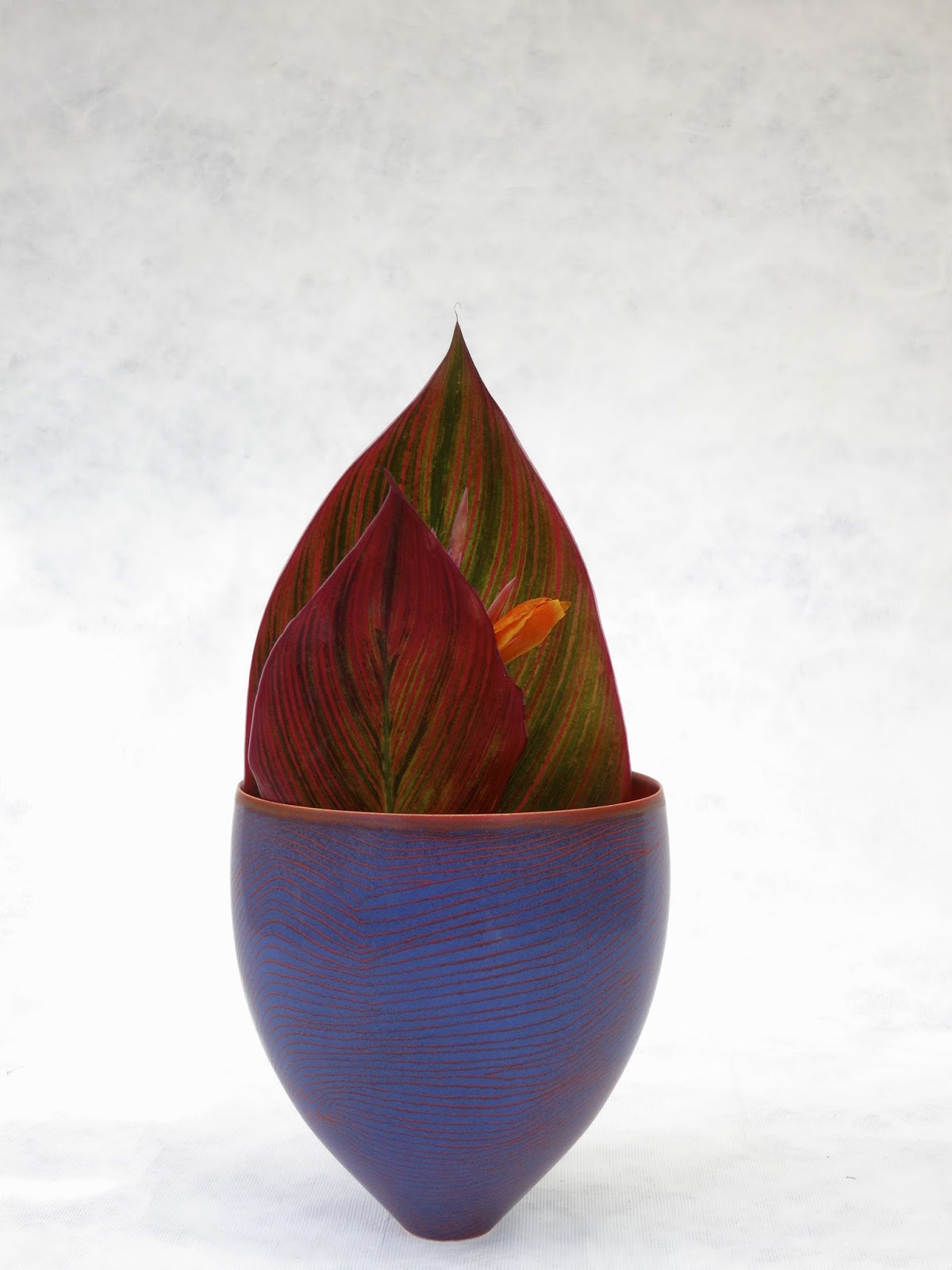
This week's ikebana is an arrangement of two Durban Orange canna lily * leaves and its orange flower bud. This ikebana meets at least three of the Sogetsu curriculum exercises: taking into account the 'shape of the vessel', taking into account the 'colour of the vessel' and a 'composition of surfaces using leaves'. Note that I have left some space between the front lip of the vase and the surface of the front leaf, as well as a space on the right hand side of the leaves.The vase is by Pippin Drysdale * .

On the right hand side of this blog I have added links to Sogetsu and Ikebana International branches in Wellington and Christchurch.

Greetings from Christopher.
31st May 2015

* Click on the blue text for further information. 

CHRISTCHURCH, New Zealand

On Thursday I gave the third New Zealand workshop, in the city of Christchurch; a city still much affected and being rebuilt in the aftermath of earthquakes in November 2010 and February 2011.

The workshops were held in the Visitor Centre on the edge of the Avon River in the Botanic Gardens. I demonstrated a ‘basic slanting’ arrangement and an ‘arrangement without the use of a kenzan. The materials were collected from the beautiful garden of Lyn Leslie-Cartwright, the Director of the Christchurch Branch of the Sogetsu School.


Red maple leaves and pink roses.


Cherry branches and home grown (!) alstroemeria.


Vicky arranged yellow chrysanthemum with autumnal branches in a low bowl.


Ellen created this arrangement in the workshop, using pine and a vine with a small white flower.

Some of the works were then installed in the cafe and shop in the Visitor Centre as an exhibition for the next few days.


At one entrance Gloria and Kay created this large sculptural work. Behind the glass screen, within the entrance vestibule, was a second structure.


The two works connected to each other through the decorated glass screen. Vicki’s arrangement can be seen to the left of the larger structure. It is inside the shop.


Ellen’s workshop piece became a joint arrangement when it was re-worked by Lyn for the exhibition, with the addition of some golden pine and dried branches. It is standing on the highly-polished stainless steel counter-top of the Visitor Centre shop.

Click the following link to photos from the  'Wellington workshop', you will need to scroll down to the last two photo links marked Christopher James workshops.

Greetings from Christopher

24th May 2015

DUNEDIN New Zealand

For those of you who, like me, have read Tolkien's 'Lord of the Rings' (more than once), or seen the Peter Jackson film (more than once), you may have been amused and delighted to read a sign at the Wellington airport. It read, the 'Middle of Middle Earth'. You would also be similarly delighted to see the gigantic sculptures in the main concourse of the airport. 


The wizard, Gandalf, riding on the giant eagle, Gwaihir...


...and Gollum.

And the reason for these images becomes evident in the photos below.


The hills in Martinborough appear to be covered in thick green velvet...


...and inhabited by curious and alert sheep. Where else would you find a rural paradise like that described by Tolkien?

I was in the Wellington airport to catch a flight to my next ikebana assignment, two workshops in Dunedin on the southwest coast of the south island (Te Waipounamu). Day one was spent collecting materials from the gardens of ikebanists, their family members and the roadside. The next day I gave a workshop on the theme of 'an arrangement in a suiban, without the use of a kenzan'.


My demonstration example, above, was created with apple tree branches arranged, because of the width of the branches, in two suibans. I have added iris stems with bright orange seeds and St John's Wort (hypericum * ) Of course, this provided an opportunity for the participants to practise their wiring technique.


In the afternoon the workshop theme was, 'an arrangement using fruiting branches'. I used some branches with apples, that fortunately did not fall off, and some yellow roses that enhanced the ripening colour of the highest apple on the branch. The block of wood under the vase was necessary to stabilise it, as the table was covered in a layer of soft spongy material. You will see it in a couple of the photos of the participants' work. Dunedin Workshop Photos *.


Greetings from Christopher, in Dunedin NZ.
17th May 2015

* Click on the blue text for additional information.

AOTEAROA: LAND OF THE LONG WHITE CLOUD


This week Roadside Ikebana comes to you from Wellington, the capital of New Zealand. 


Laurie and I arrived on a windy and rather cool, late afternoon for a three week visit during which I will give a series of ikebana workshops in the cities of Wellington, Dunedin and Christchurch. 


I was pleased on the morning of the first workshop, with members of the Wellington Branch of Sogetsu Teachers Association, to wake to the view above across the Wellington harbour.

    
The workshop was held in a lovely bright, modern hall that allowed plenty of room for the participants. The first of three workshops for the day was on construction techniques for using dowels and wiring to fix materials.


The blurry image above is a detail from a larger photo showing a small sculpture made from cypress that had been dowelled and placed on a ceramic box.


Here I am showing that the same small sculpture can be used in a variety of ways according to the imagination of the ikebanist.


Next, I asked each of the participants to practise wiring, using a technique that is very firm and prevents the branches from sliding on each other.


This method is perfect for securing the smaller branchlets of materials such as this birch, enabling the creation of freestanding, 'no kenzan' arrangements like the demonstration example above. This was the subject of the second workshop for the day.


The third workshop for the day was making an arrangement 'with leaves only' or 'repeating shapes' in an arrangement. The photo above is my demonstration work for the latter exercise, using three aspidistra leaves and a single nerine flower. Unfortunately, I was not able to also take photos of the participants work.

Greetings from Christopher
10th May 2015


HOMAGE TO HIROSHI

One of the lessons in the Sogetsu School curriculum is 'Disassembling and Re-arranging the Material'. An earlier version of this exercise in older text books was 'An arrangement in which the appearance of the material has been changed'. The new title of the exercise is a more accurate description. I set this exercise for my advanced students last week and for inspiration emailed them photos of examples by the previous Iemoto, Hiroshi Teshigahara.

I think the value of this exercise has two particular aspects. Firstly, by taking material apart the ikebanist's attention is focused on its separate elements: leaves, branches, flowers, petals, seed pods and so on. This causes us to see those elements with fresh eyes.  Secondly, because we have effectively destroyed the beauty of nature's creation, we now have to have to focus our attention on the aspect of design and re-imagine how we can make something beautiful from these discrete elements. The consequence of having to build up a work in this way is that quite often the result is sculptural in appearance.

Below are photos from the class.


Alana, stripped a cotoneaster branch and floated the berries in a glass vase. In the smaller vase, at the back, she floated a single leaf.


In this second work, Alana partially submerged a bunch of berries and placed a branch across the vessel. The reflection of the branch on the surface of the water enhanced the feeling of the water.


Christine has used a succulent with the common name Black Rose * . She inverted the stem on the left and has taken a rosette of leaves apart and attached them on the side of the stem on the right.


Helen used a eucalyptus (possibly E. pluerocarpa * ). She created a cascade of seed pods falling from a star-burst made from the tips of branches. 


 Maureen has used the same material inverted in a shallow bowl coming to a layered cluster of leaves at the apex of the design.


She also created this two vessel work with a straight stemmed plant that had red berries.


Above, Maureen created curves from nerine stems, braced them in a suiban and bunched the flowers separately.


Ellie used a banksia in a harmoniously coloured suiban. She inverted the flowers and wove some leaves through sections of the stems braced across the vessel. The leaves on the left created a sense of movement from left to right in the work.

Greetings from Christopher
May 2015

* click on the blue text for further information