VICTORIA'S WESTERN DISTRICT

After I published last week's posting I removed a photo. I had incorrectly identified an ikebana arrangement of one of Emily Karanikolopoulos' students.  Here it is again. 


Margaret Wilson created this arrangement using a partially furled Strelitzia Nicholai leaf and stem, and a maroon succulent.


*          *          *

During this past week Laurie and I have toured around western Victoria with our visitors from Ottawa. 


We stayed a night in the Grampians (Gariwerd) National Park, where we walked along this stream to the series of rock pools known as Venus Baths. 
      

In the resort at Halls Gap where we stayed, I noticed this huge Waratah * (Telopea)  bush.


I had never seen one so large and prolifically blooming. This is the state floral emblem for New South Wales.


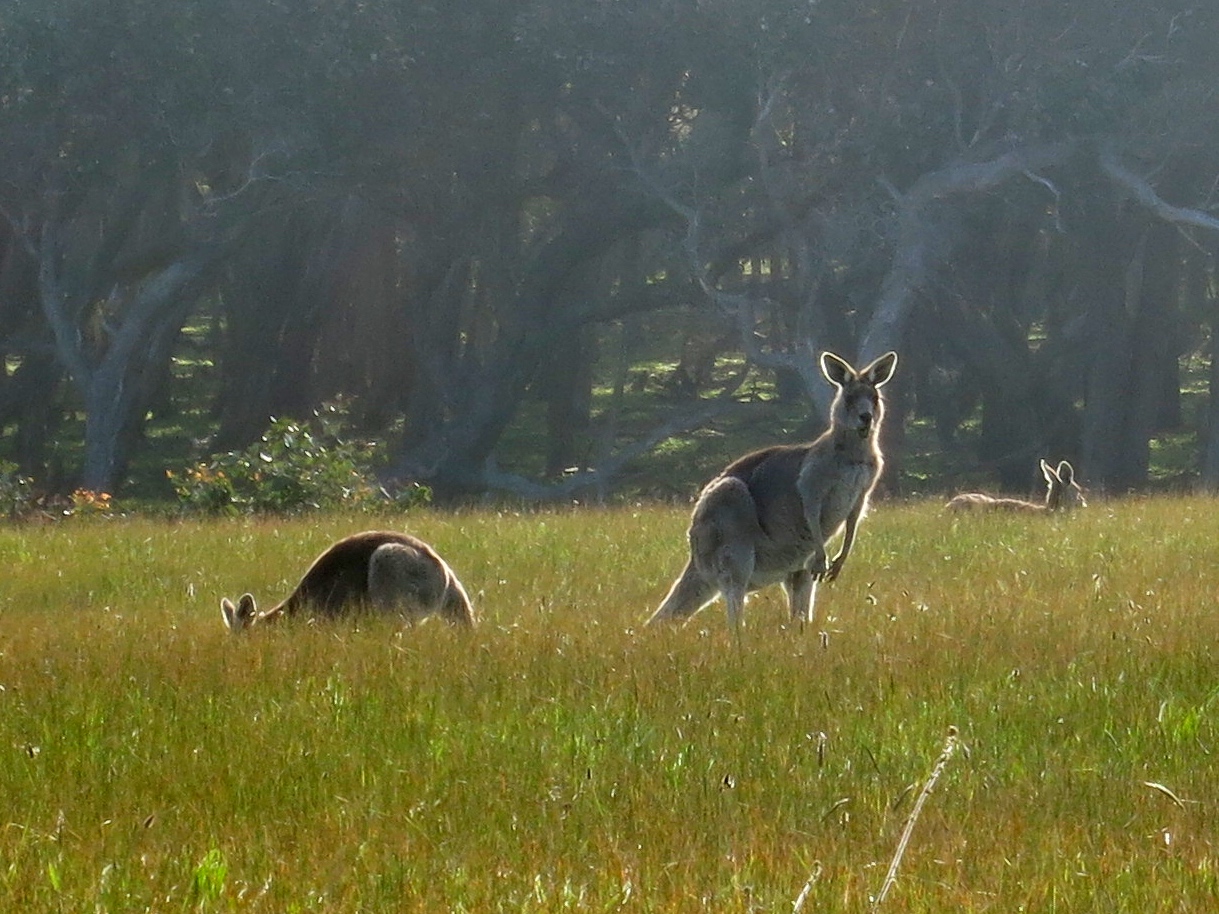
In the evening kangaroos came out of the bush to feed on the grass around the cabins, this one with a 'joey' in her pouch.


The next day we went down to the coast and at Tower Hill State Park near Port Fairy we came across this male Emu protecting his chick.
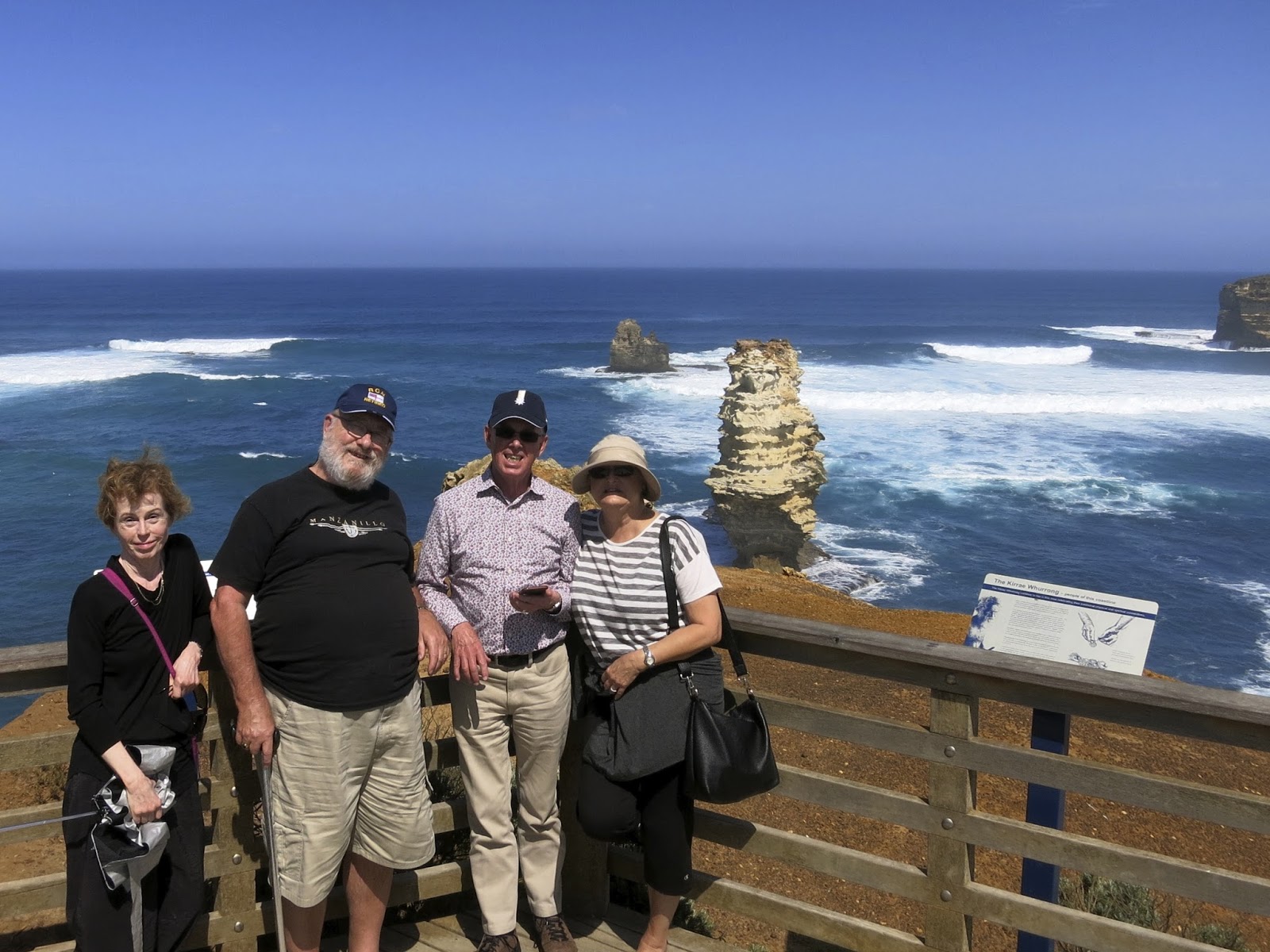


Eleanor, Richard, Laurie and Leonora at a lookout overlooking the Twelve Apostles.


 Some of the Apostles. These are large 'stacks' that have resisted the erosion of the waves and are left standing as the cliffs behind are slowly worn away.


Heading back toward Torquay we passed through the rainforest in the Otway ranges where tall tree ferns grow.


On the road to the Cape Otway light house many koalas are to be seen. Sadly they are causing a great deal of damage by stripping the trees of leaves and as a result are running out of food.

This week's ikebana was an impromptu exercise I set for Leonora and Eleanor. I asked them to improvise a vessel and make an ikebana arrangement in it.


Leonora chose three pieces of thick bark, using the inner curve as her vessel. She reversed a small piece of the bark to show the outer surface. The flowers are the pink buds of a delicate grevillea that contrasted with the strength of the improvised vessel.


Eleanor created a structure on a picnic table using some long pieces of eucalyptus bark that had curled on itself. She used the same grevillea, slotting it into the curling bark. In this case the pink in the grevillea enhanced the soft pink tones in the bark.

Greetings from Christopher
11th October 2015

SIGHTSEEING WITH VISITORS

As I mentioned last week, we are hosting visitors from Ottawa at the moment. So of course we had to go in search of some Australian flora and fauna at the Iron Bark Basin nature reserve, part of the Great Otway National Park.

                                
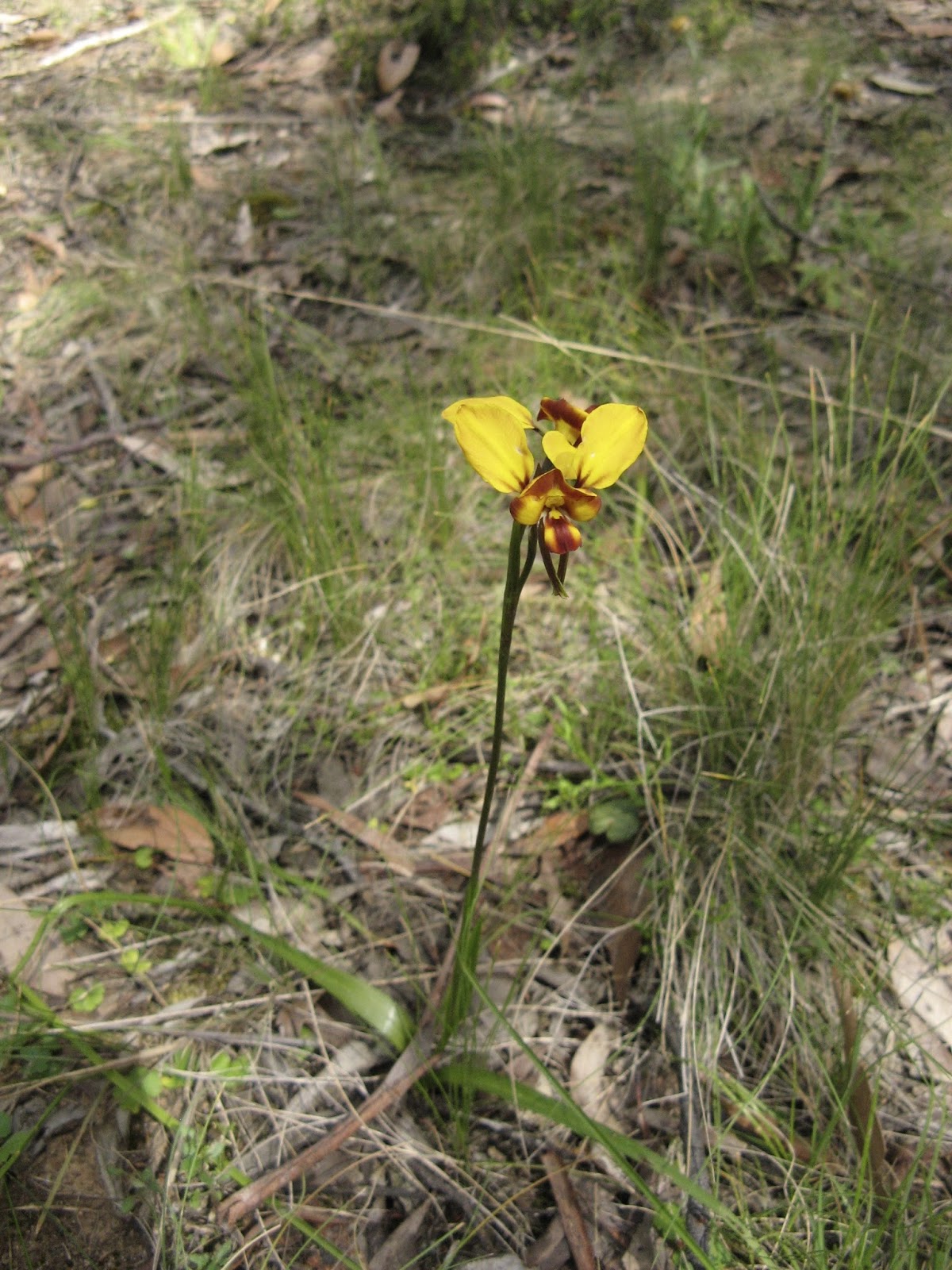
This view is of the walking path into the reserve and is typical of the forest type, with low-growing eucalypts, an understory of Grass trees (Xanthorrhea * ), and a variety of heath plants including - at this time of year - small terrestrial orchids. 


This orchid is known as the Donkey Orchid * (diuris carinata).

              
We also spotted this crimson rosella * coming out of a hollow in a tree branch.


The nature reserve is in the forest above these cliffs at the sea shore.


We saw this sign at the road side...


...and the proof can be seen in the distance between Leonora and Laurie.


The wonders of a zoom lens! 

On Wednesday Leonora and Eleanor attended a class with Emily Karanikolopoulos in which the subject was to work with the pruned leaves of her overgrown Strelitzia Nicolai * .


Leonora made an arrangement in two vessels, using dried and fresh material and added an arum lily. 

     
Eleanor used a large dried strelitzia leaf, some fresh strelitzia leaf and a small palm spathe.

As I mentioned last week, Emily gave a workshop for the Victorian Branch of the Sogetsu school at which participants were invited to create ikebana inspired by a favourite artist or work of art.
Follow the link: Art re-interpreted * . 

Greetings from Christopher
3rd October 2015

TRANSLATING FROM ONE ART FORM TO ANOTHER

This week we were delighted to welcome my ikebana friends, Leonora, Richard and Eleanor, from Ottawa to Melbourne on their ikebana holiday to the southern hemisphere. Leonora had invited me to Ottawa, last year, where I gave two workshops at the beginning of October 2014. 


Laurie took this photo of Leonora and me in front of a spear lily (doryanthus palmeri) *, in the Royal Botanic Gardens in Melbourne.  


*        *        *       *
On Saturday Leonora, Eleanor and I attended a Sogetsu workshop led by Emily Karanikolopoulos on the theme of interpreting a favourite work of art into an ikebana arrangement. The challenge was to create an ikebana work inspired by an image, sculpture or other work of art, but not to simply try to recreate it with botanical materials.


I chose this wood block print of Laurie's by the Japanese artist Onda Akyio. It depicts a traditional Japanese New Year celebration in which a young monk is 'ringing out the old year' at the Eihei-ji Temple * in Fukui Prefecture in western Honshu. I have always like the dynamism in this image that depicts the wind and snow swirling around the monk in the belfry.


I have curved the stems of arum lilies to create a sense of movement and added gypsophylla to represent the flying snow.

Greetings from Christopher
27th September 2015

* Click on the blue text for further information.

SPRINGTIME: IKEBANA INTERNATIONAL MELBOURNE EXHIBITION

In this part of the world the weather in Spring-time is especially variable. On Monday last week the temperature got to 28 Celsius. At the end of the day a cool change brought the temperatures down and very welcome heavy rain overnight. The maximum on Tuesday was 13C. 


At 8.00 am the beach look like this...


...and the creek was flowing swiftly out to sea as a result of the overnight rain.


Then the sun came out, illuminating the cliffs. The combination of warm weather and rain has brought out the first of the roses. 


On the pergola a climbing Lorraine Lee releases its perfume.


And hangs over a Cecile Brunner.


The annual Ikebana International exhibition that I mentioned a couple of weeks ago finished last weekend and photos can be seen at I.I. Melbourne Annual Exhibition * . For the first time the exhibition was held over two weeks. This meant greater exposure for the Melbourne Chapter and the opportunity for 39 members to exhibit. For me, as the curator, and other I.I. members, it also meant a lot of work. 

We were fortunate in being able to hold the exhibition in the ground floor gallery of the Town Hall in the main thoroughfare of the city.


This was the view from the footpath through one of the windows on the street. I was responsible for the layout design, the placement of the exhibitors' arrangements and installations and the design of the window poster seen in the photo above. The ikebana featured in the poster is by Chieko Yazaki the President of Ikebana International Melbourne Chapter.


Taking the advice of my mentors, my own ikebana contribution, in the second week of the exhibition, was uncomplicated. One head of a gymea lily * flower and three leaves arranged in a vessel by Graeme Wilkie of Qdos Gallery.

Greetings from Christopher 
19th September 2015

* Click on the blue text for further information.

SOGETSU MELBOURNE WORKSHOPS: part two.

To continue last week's theme, the second day of workshops on Sunday 23rd August with Mr Umemura from Sydney were again focusing on two Sogetsu curriculum exercises combined. The morning workshop was combining the following two exercises: 'Kabuwake' (two or more groups of material), and 'using branch material only'. Branch material can include flowers that occur on the branches.


I decided to use again some of the prunings from the apricot tree, that had started to flower after being placed in a vase, with Japanese flowering quince and some camellia leaves. The apricot provided wide sweeping lines that the quince leaned into. While the camellia concealed the kenzans and provided a small mass high in the arrangement.

The afternoon workshop combined the themes, 'using two or more vessels' and 'using only one kind of material'. This second part, 'one kind of material', is made a little easier when the material chosen has very distinctive elements, such as contrasting flowers, leaves, stems or seed pods, for example.


I had only a little of my camellia left. However, I was able to make a freestyle nageire arrangement, in the tall vase, and float a single flower in the bowl. This enabled me to make a feature of the surface of the water, thus creating an additional element to the composition.

Examples of Mr Umemura's and my colleagues' work can be seen by clicking on Sunday workshops * .

Greetings from Christopher
12th September 2015

THE TEMPTATION OF BANKSIAS

The first workshop on Saturday 22nd August, given by Yoshiro Umemura from Sydney, was on the two themes of: 'a vertical arrangement' and 'an arrangement using flowers only'. Now, to do this double exercise properly, one needs to be attentive to the traditional Japanese nomenclature of plants, with regard to ikebana. There are two principal classes: tree plants and grass plants. The category, 'grass plants' includes those plants that westerners think of mostly, as annuals and perennials, in which flowers are on stems that grow up directly from the ground. For example: iris, arum lilies, tulips, poppies and the like.  On the other hand, camellias are in the category of 'trees'. So are banksias. My good friend Heather has in her garden a most spectacular Banksia, a cultivar called Giant Candles * , with huge, long flower heads. Very suitable for a vertical arrangement, one would think. But not for the exercise that was set at the workshop!


While this is a vertical arrangement, I'm afraid it didn't meet the 'flowers only' criteria. (The bowl is by Phil Elson * .)

Meet my friend, the talented gardener, Heather (and her banksia).


It is pretty obvious why I was tempted to use these amazing flowers for the workshop. 


This flower-head was so heavy the branch couldn't hold it upright.

You can see photographic examples by people who got the exercise right at Workshop Number One * . The second workshop was on the two themes  of: 'a horizontal arrangement' and 'using leaves only'. Photos of the second exercise are below the first set of photos.

Photos of the Ikebana International exhibition that I mentioned last week will be posted in the next week or so.

Greetings from Christopher
5th September 2015

* Click on the blue text for further information.

AN EXERCISE IN TRIMMING

It has been a very busy time in the ikebana world lately. Last weekend we had two days of workshops with Mr Yoshiro Umemura * from Sydney. On the Victorian Sogetsu website you can see photos from the first workshop *, other photos will be posted over the next week or so. On Monday afternoon the Ikebana International Melbourne Chapter 29 annual exhibition, which I am curating, will be opened. It is open for two weeks. If you are in Melbourne do come along.


At a recent class, with Elizabeth Angell, we were set the exercise of making a simplified arrangement. In the Sogetsu text book the student is advised to study the material carefully and remove all that is superfluous or extraneous to the design. The challenge is to not go too far, so that the material becomes unrecognisable. Before the class I found a dead ivy branch still clinging to the trunk of a tree by the river. The branch had interesting lines and character. 


The photograph above shows the branch before I began trimming. My goal, of course, was to preserve the character of the material and its interesting lines, both the fine and strong lines. 


To provide a foil for the branch I contrasted it with a flowering camellia stem, from which I removed most of the leaves. It is not easy to see, but I have created a support for the principal branch so that it does not rest on the left-hand side of the vase opening.

Greetings from Christopher
30th August 2015

* Click on the blue text for further information.

HIROSHIMA PEACE DAY and DAFFODILS

The 6th August this year was the 70th anniversary of the bombing of Hiroshima. On Sunday 9th August, the first Sunday after the 6th, an ecumenical commemorative service was held in St Paul's Cathedral in Melbourne. Ikebana International Chapter 29 provided two arrangements for the service and the Japanese Consul General, Ms Haneda, was in attendance. The most recent posting on the I.I. website shows some photos of the arrangements, by Chieko Yazaki (Shogetsudokoryu school) and Elizabeth Angell (Sogetsu school), for the Hiroshima Peace Day * service.

A couple of weeks ago my teacher had set the exercise of using either narcissus or daffodils in an arrangement. 


I used these flowers in a revision exercise of a 'basic upright arrangement', for some of my students. The branch material is New Zealand 'mirror bush' * (Coprosma repens). A very hardy, salt spray tolerant, bush that has become an environmental weed in some places in southern Australia.


Here are some more daffodils in a freestyle arrangement. Perhaps a bit too subtle, as there is a third daffodil behind the corky elm. The tips of some petals are peeping on the righthand side. I rather like the contrast of these bright yellow petals with the rough texture of the elm.

Greetings from Christopher
23rd August 2015