FOUR MASTERS - FOUR SIGNATURE STYLES

Last week I attended the final workshop of the Sogetsu School, Victorian Branch, for this year. It was lead by Lara Telford, one of the Melbourne based teachers. She challenged us to choose one of the four Iemotos (Heads of the School) and create an ikebana work based on his or her style. 

In her preamble Lara made some observations that I found particularly interesting. This included that: 

  • an artist's style is that 'thing' which makes you recognise a particular work as being by a particular artist even when viewed from a distance; 
  • that material is not the same as style; it is the way an artist uses material that reveals their style; and 
  • artists express something of themselves in their work.

I chose to take the present Iemoto, Akane Teshigahara, for my inspiration because I think two things that characterise her ikebana are, the use of abundant materials and her focus on fresh floral material. The question that arises is how do you do this and maintain a feeling for the intrinsic qualities of ikebana?


I have used some branches of Bursaria spinosa  * that has masses of very small white flowers. These branches were just coming into flower, so they were not quite ready. I have added some dark mauve and white chrysanthemums and dietes bicolour. The mass on the left is balanced by the line on the right and spaces within the arrangement. See more photos from the Sogetsu Melbourne * workshop.

The deep potbellied vessel is by Isabella Wang * a Melbourne based ceramic artist.

Greetings from Christopher

5th December 2015

* Click on the blue text for further information

AN EVERY-DAY OBJECT

Late Spring in Melbourne is when two of my favourite Australian flowering trees reveal their glory. The first being Brachychiton acerifolius * also known as the Illawarra Flame Tree.


I noticed this one in the Royal Melbourne Botanical Gardens last week. The second tree is Grevillia Robusta * , sometimes called the 'Silky Oak' because of its wood grain.


I took this photograph beside the Yarra River in Melbourne. We have both of these 'trees' in our garden, which have been struggling with poor soil and low rainfall for about 25 years, and we are waiting patiently (?) for the flowers still.

*               *               *               *               *               *               *

At Elizabeth's class this week our exercise was to make an ikebana arrangement in 'an everyday object'. This stretches the imagination and creativity a bit in terms of the object, which is to temporarily become a vase and then the choice of material that is going to be suitable.


My colleague Ruth used these very cute tea service objects with intense red roses and a fine green line.


Sandra used a stackable ceramic lunchbox, with red eucalyptus flowers and some long stemmed white flowers.


Maren used a lemon squeezer that she had bought on her honeymoon. Her materials are grape leaves and alstroemeria.


I used a stainless steel cutlery drainer that I have tilted to give a 'dynamic' feel and not have it simply look like a vase with holes in it. I struggled for some time before I found this way of using an 'egg ring' to tilt the drainer. The second ring provides a further sense of this being an object out of its usual context. The materials are agapanthus flowers and dietes leaves.

Greetings from Christopher
29th November 2015

* Click on the blue text for further information


STRONG MATERIALS STRONG VASE

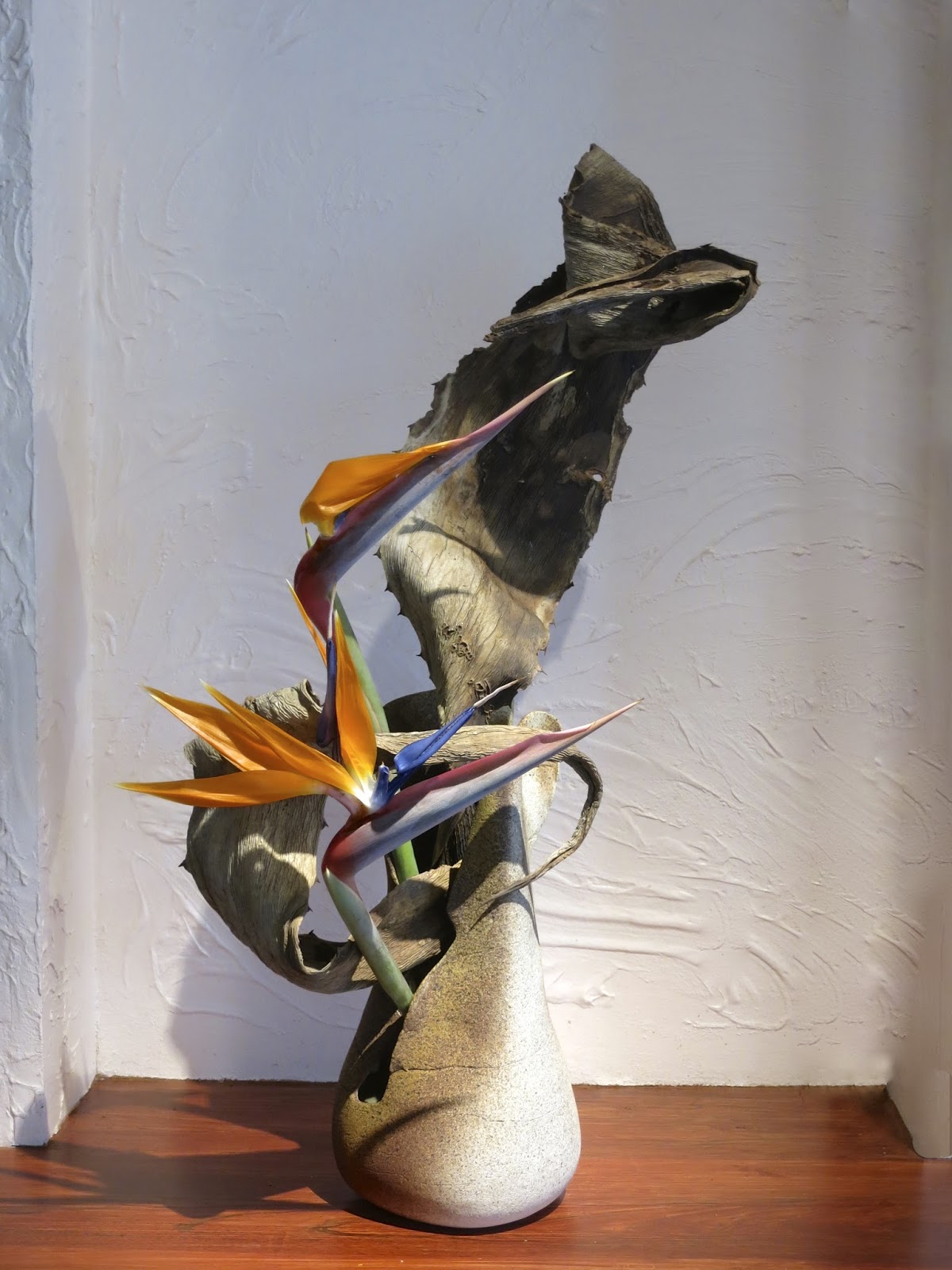
In the garden this week the strelitzia (s.juncea) * has finally flowered; it seems to be late and has fewer flowers than last year. I decided I should use it in ikebana before the flowers are damaged by wind or rain.


Here it is beside the path and you can see why it is called the 'rush leaved' strelitzia. It has miniscule leaves at the end of long pointy stalks.


I was intrigued by the satiny appearance of the soft petal as it emerges from the spathe.


In this photograph of the same flower, you can see the soft folds of the still fresh emerging petal.

When I make an ikebana arrangement my usual starting point is the material itself. Some particular qualities of the plant will draw my attention. In this case the vibrancy of the flowers and the unique beauty of the emerging flower. Because these flowers are visually strong I needed to find other visually strong materials to balance them. In my ikebana storage pile, under one of the garden trees, I found some dried agave leaves that I had collected last year. They have beautiful texture (and still sharp thorns).


In this first photo you can see that the upper flower is still emerging.

I decided to use this visually strong vase, given to me by my Canadian friends who visited recently. The cylindrical vase has been manipulated after being thrown and is split down the sides. This enabled me to fix the materials as though they were flowing around the vase.


By the time I managed the set-up to take a better photograph, in the warmth of the house the top flower had opened! The unique vase was made by Janet Keefe, a Sogetsu ikebanist and ceramic artist from Ottawa.

Greetings from Christopher
22nd November 2105

* Click on the blue text for further information


HAIKU

On Tuesday this week I attended the monthly meeting of Ikebana International Melbourne. 

We had an interesting guest speaker, Dr Hironobu Kitaoji, Director of Japan Seminar House, who spoke about haiku - Japanese short form poetry. He made some very interesting points about haiku, including some parallels with ikebana. 

The traditional pattern for haiku is that the poem has two connected ideas expressed in three lines of: 5 syllables, then 7 syllables, then 5 syllables. When haiku poems, written in Japanese, are translated into English the original word order is almost always lost even if a 5-7-5 syllable structure is retained.

At the meeting members were invited to create an ikebana arrangement to express their favourite haiku. After searching the web I came across the following haiku that put me in mind of a hot summer day on the beach:

'I walk across sand
And find myself blistering 
In the hot, dry heat.'


To try to capture this feeling I have used driftwood, spinifex longifolius * and orange-yellow alstroemeria. I used the same shino-glazed bowl I used last week by Elena Renka*  

There is more information and photos on the I.I. Melbourne blog. You will find these at: I.I.November meeting * (10th Nov 2015). 


I would also like to draw your attention to the launch of I.I. Melbourne Chapter's new website. The address is: www.ikebanainternationalmelbourne.com *

Greetings from Christopher
15th November 2015

* Click on the blue text for further information


ELEVATED MASS

In mid August I posted the image, below, of some small native Clematis (c. microphylla) growing on our back fence. This dainty flower makes a large creamy-green mass covering the surface on which it grows. 


One of the delights of the plant is that it makes a second fluffy mass when all the seeds heads form, now three months later.   


These two photos are of a plant growing on a fence on the cliff top overlooking the beach. You can see the barbwire fence in the top right hand corner of the photo.


               * * * * * * * * * * * * * * * * * *

I recently set my students the exercise of making a mass 'floating' above the vessel that they were using.


This example is one I made a long time ago using Abelia *  in a tall ceramic vase that has two side openings.


Above is my class demonstration, using New Zealand Flax and a single Calistemon from the garden. The vessel is by the New Zealand ceramicist, Elena Renker * . 

Greetings from Christopher
8th November 2015

* Click on the blue text for further information.

'ATTENTION TO THE PLACE'

A couple of weeks ago Laurie and I took our Canadian visitors to the 'Australian Garden' at the Royal Botanic Garden in Cranbourne. It was a great opportunity to see some of the huge variety of Australia's unique flora.

Here Leonora is examining a Gymea Lily, Doryanthus excelsa * .


Eleanore and Laurie checking-out a Queensland Bottle Tree, Brachychiton Rupestris * .

We also came across some Grass Trees, Xanthorrhoea * that were in flower.

The same flowering spikes from below.


This species above, grows in the clifftop-heath west of Torquay.

A close-up of the flowers.

*              *              *

Earlier in October the theme in Elizabeth's class was a Sogetsu, Book Four, curriculum exercise: 'Paying attention to the container and the place where it will be put'. Ikebanists are instructed to allow the work to 'stretch freely' so that the space becomes part of the work. We chose the locations for our work in advance and then brought along materials that we felt would work there.


Emily chose an elevated shelf and used this beautiful clematis from her garden, in a hanging arrangement 'to be viewed from below'.


Elizabeth created this dramatic arrangement on two shelves connected by strong angular lines of reed. It looked excellent and I'm afraid the photo does not do the work justice.

I liked the large surfaces of the fireplace chimney and thought it would be interesting to create an ikebana that would stretch across and around these surfaces. The day before the class, Laurie and I took our visitors to a cafe by the Yarra River and on the way back I picked some large dried stems of last summer's wild fennel. We must have made an odd sight, walking home in single file each with a bundle of fennel sticks.


I chose a large vase by Alistair Whyte * , that belongs to Laurie, and using fennel branches that still were green at their bases, arranged them at the corner of the fireplace. Some of the branchlets have been brought across the side surface of the chimney as this work could be seen through 270 degrees.


I used lighter branches, inverted, to make a strong line across the surface above the fireplace and added some pale yellow dried agapanthus stems for a lighter contrast.

Greetings from Christopher
30th October 2015

* click on the blue text for further information.

IN A COUNTRY GARDEN

Last weekend my guests and I visited the home of one of my students in the countryside northeast of Melbourne. It proved an opportunity for an outdoor Sogetsu sculptural installation workshop, for my Canadian visitors as well as my host. 

Out door work is always a challenge, most particularly because botanical materials are likely to get lost when competing with features in the landscape. Therefore, one strategy to overcome this is to try to integrate the 'sculpture' with some elements of the environment.


Leonora, who worked with Nici, chose to site their work against this large elm tree and to incorporate an old iron, garden-chair.

    
They added lines of fallen eucalyptus branches and yellow roses.


Notice how the branch lines continue up into the branches of the tree. Unfortunately the photo doesn't do the sculpture justice as the rusty metal of the chair blends into the texture of the elm's bark.


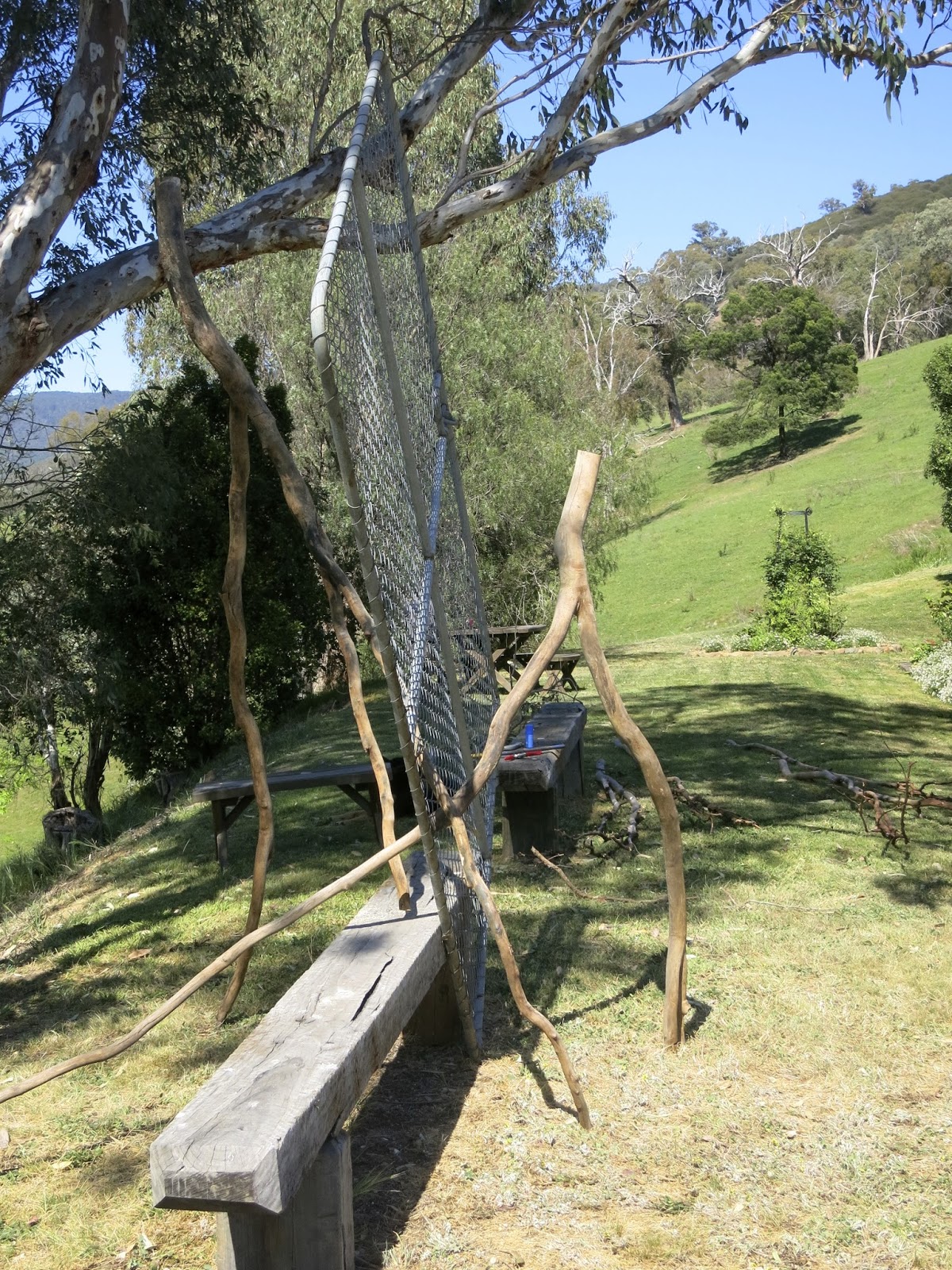
Eleanor and Marcia chose to site their work against these benches made from railway sleepers, looking across a wide valley. Marcia was keen to use a large old gate. It was fixed to the bench with some brackets and stood on one corner. Two large branches were threaded through the wire mesh to provide additional stability.


Eleanor and Marcia at work adding large pale grey-green artichoke leaves. 


The final result had a surprising sense of playful movement.

Greetings from Christopher
25th October 2015


AUSTRALIAN NATIVE PLANTS

The spring weather, as usual, is highly variable; although the heat extremes have been greater than ever before. One consequence of the unsettled weather is beautiful cloud formations. 


I took this photo of the surf beach at Torquay late in an afternoon last week. 

Ikebana activities continue apace with a meeting of Ikebana International last Tuesday on the theme of Australian native flora. Members were encouraged to create ikebana using indigenous plants. An excellent talk was given about the Royal Botanic Garden's Australian Garden at Cranbourne. Details through the following link: Ikebana International Melbourne * .


When we were in Apollo Bay last week we bought some beautiful Waratahs (Telopea Speciosissima) that Leonora used with Bushy Yate (Eucalyptus Lehmannii) to make this arrangement 'to be viewed from all angles'. Vase by Graeme Wilkie * .


This means the arrangement has quite a different appearance depending on the angle from which it is seen.


I slightly reworked my arrangement from the I.I. meeting which appears on the I.I. blog. I have used 'Cushion bush' (Leucophyta brownii) and a sedge (Lepidosperma gladiatum), both of which grow on the cliffs at Torquay. I found a newspaper article about the Bendigo potter, Ray Pearce *  who made the vase, which reminds me of a sea urchin.

Greetings from Christopher
17th October 2015 

* Click on the blue text for further information