CHRISTCHURCH WORKSHOPS


The major last destination of our trip to New Zealand was Milford Sound.

I was particularly pleased, and surprised, with this photograph. I took it from the moving bus as we were driven back to our accommodation in Te Anau. The reason it appeals to me is that it captures the feel of some of the early 19th Century paintings of this area. The Geelong Gallery has one of these by James Peele called "A Storm Gathering, Wet Jacket Arm". This and similar paintings powerfully capture the atmosphere of this extraordinary landscape.

We had a cruise out to the entrance of Milford Sound on a catamaran... 


...and were joined by some frolicking dolphins.


We were also taken to see some dozing New Zealand fur seals Arctocephalus fosteri. The rocks were still holding some of the warmth of the sun making them a suitable place to doze


At Te Anau we came across a native Bird Sanctuary where the endangered, flightless bird species Takahe Porphyrio hochstetteri is able to be seen. The species had been thought extinct after 1898. However, a small population was discovered 75 years ago. According to Wikipedia, in 2021 the total population had risen to 440.
 
As I reported last week, while in Christchurch I conducted some workshops for the Sogetsu Branch.
 

On the day before I was taken to the Red Zone where we were able to gather materials.


It was a great opportunity to give a lesson about what to look for when gathering materials for a particular exercise. That is, as distinct from wandering around gathering just what captures one's attention without any particular idea about how it will be used.

The morning exercise was revision of basic exercises in moribana (shallow vessel) and nageire (tall vessel) techniques. 
I did not have the opportunity to take photographs and can only share these two examples of Basic Upright nageire.


This ikebana by Mary Fulton included yellow Holly berries as the focal point.  
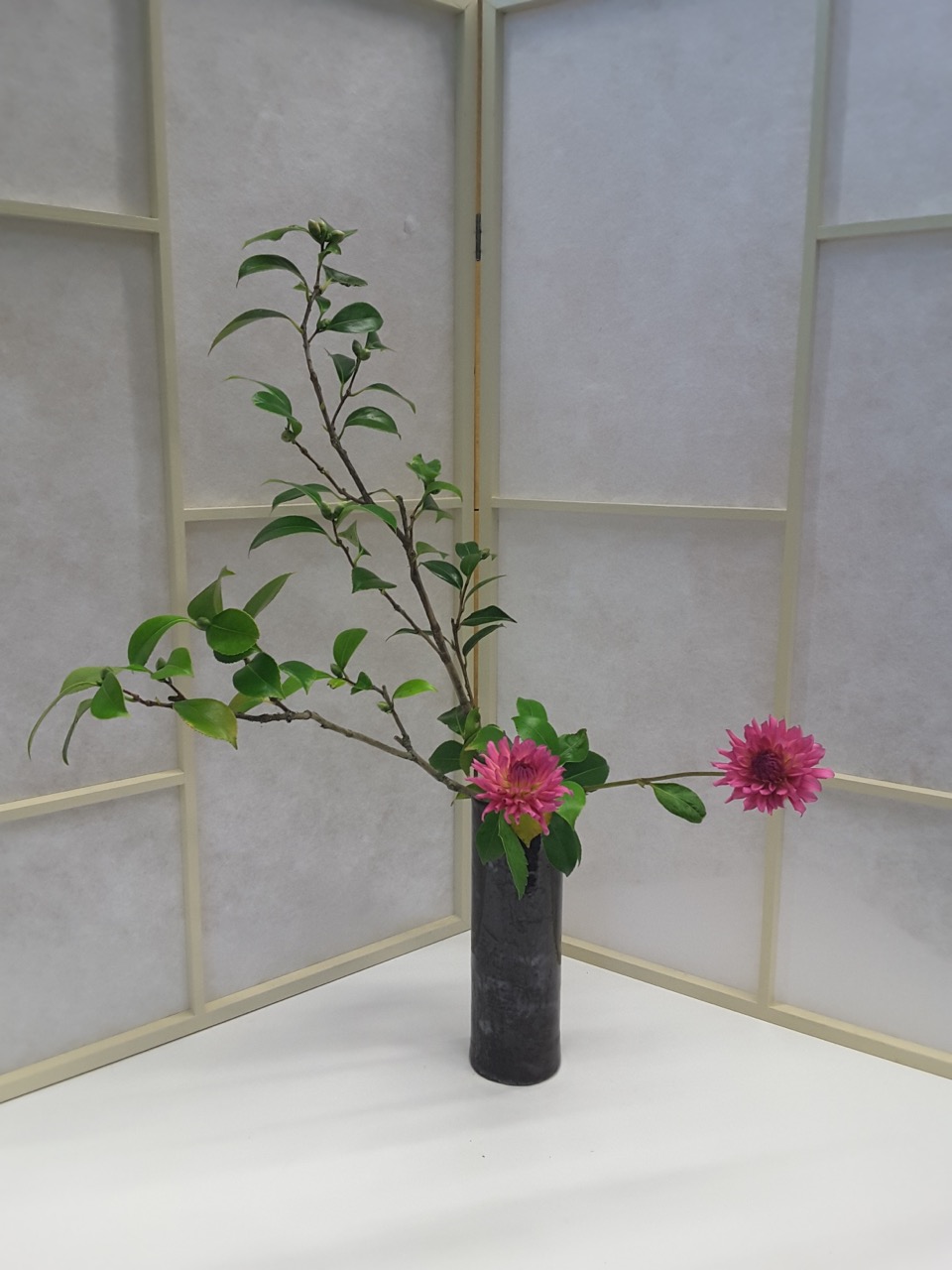

Ruth Huwes used Camellia branches for her Basic Upright ikebana with Dahlia flowers as the focal contrast.

In the afternoon the challenge of the workshop was to use both, previously unseen materials and unseen vessels. Lyn Leslie-Cartwright provided everyone, including me, with branches of Broom Spartium junceum some Gerbera flowers and vessels from her own collection. Some participants were also blessed with a kenzan.

Because of these constraints I became a participant in the exercise. I did not provide a demonstration as it was unlikely that any or many of the participants could need to use the techniques I ended up employing.


This ikebana was made by Claire Maetzig.


I was given a ceramic boat-shaped vessel but not provided with a kenzan, so I had to devise my own fixing techniques. I wanted to give the ikebana height. Otherwise, I thought it would have to be a low-set minimal material ikebana. My solution was to brace three stems, with their side branches 
intact across the vessel. This then enabled me to set two branches inverted into the cross-braced material. I kept the stronger of the two branches long and stabilised them with a small double ended pin where they touched. I then added a single Gerbera as a focal point set high in the ikebana. Initially this was too dominating, until I removed about three of the outer rows of petals.

Greetings from Christopher
16th April 2023


DEMONSTRATION IN CHRISTCHURCH


Last week I posted some photos of driftwood on the beach at Greymouth and lamented that fact that I could not bring some back home. However, I was delighted to find the driftwood inspired creativity in others, not just ikebanists.

In particular, in Hokitika there were many examples of driftwood sculptures along the waterfront.

This was one of the first that I saw and was impressed by its mysterious, powerful and quite elemental feeling.

Further down the beach was this very large figurative sculpture that to me had a haunting feeling.

From Hokitika we travelled further down the west coast and then across the mountains in the direction of Queenstown.

The journey took us past the Thunder Creek waterfall, which had its own rainbow in the morning sun.

A kind visitor from the Czech Republic took this photo of Laurie and me while we were there.

Over last weekend I conducted workshops for the Sogetsu Branch in Christchurch and presented a public demonstration at the Fo Guang Shan Buddhist Temple. On the Friday before, we collected materials from the Red Zone, and selected some vases from the Consular Office of Japan in Christchurch. 

Mr Hada, the Director of the Consular Office also honoured the occasion with his presence.

The first arrangement I made was a Basic Slanting moribana using Japanese Maple and pale pink roses from the garden of the Director of the Christchurch Branch of the Sogetsu School, Vickie Hernshaw. Unfortunately, I was unable to photograph the work because of the busy background.


Next I arranged two flower heads of Fatsia Japonica, removing all the large leaves except one extending to the left and two smaller ones on the right. To cover the base of the flower stems I inserted an inverted leaf into the vase below the water level showing its back. The lower part of the vase was 50%  bigger than is shown in the photo. It was empty of flower material to create a feeling of lightness and space within the work.


For my third arrangement I used two large dried sunflower heads. I was interested to show the back of the flowers because of their velvety green texture and their strongly ridged lines.


Two long straight lines of variegated New Zealand Flax completed the ikebana which was placed against a 30cm wide pillar.


For the sake of this photo I have created extra width in the background using photo editing.


In my last ikebana I used a dried lichen covered branch provided by Vickie Hernshaw, to which I added two branches of Holly Ilex aquifolium, one with yellow and the other with red berries. The flowers are a new hybrid of Gerbera with narrow longitudinally curled petals.


Greetings from Christopher
9th April 2023


WORKSHOP IN WELLINGTON


On Monday last we took a ferry across the strait from the north to the south island of New Zealand.


These rocks were on the (port) left-side of the entrance to Wellington harbour. It was a relatively smooth crossing in spite of the very cold wind that kept me inside for most of the journey.


The last part of the journey through Queen Charlotte Sound / Totaranui, was like the proverbial 'mill pond'.


This is the harbour of Picton, in the evening, where we stayed  the night before driving to Greymouth on the west coast.


I had previously heard about the driftwood to be seen on the beaches of this coast and was not disappointed. 

Except that there was no way of getting any of it back home to Torquay. This timber has fallen into the streams and rivers in the Southern Alps from where it is washed down to the sea and then back onto the beaches by the fierce westerly winds and tides.

While in Wellington last weekend I conducted two workshops for the Sogetsu Branch there. The first workshop was to make the curriculum exercise, Variation Number eight; that is, creating a single ikebana using two vessels. In this case a suiban (shallow) and a nageire (tall) vessel. It is a good way to review techniques for the two basic forms taught in the Sogetsu school.

This photo was taken as I was conducting the critique in the afternoon session. In this session the first part of the exercise was to make an ikebana on the Sogetsu curriculum theme of 'Disassembling and re-arranging'. That means finding a material and cutting it into its component elements. For example: stems, leaves, flowers, fruit, etc. Then the ikebanist has to make a completely new art work with these discrete elements. 

I added an extra element to the exercise of adding some text to the work.

Thinking about the exercise the day before it occurred to me that I should treat the text in the same manner. Disassembling and re-arranging. So I cut out single letters in a variety of fonts and colours from newspapers, which I made into the mass on the top left. I then created a sentence which issued from the mass. You may recognise a quote from a John Denver song if you can read the words.

The plant material is the flower stem, the fruit and a rosette of leaves from a Pineapple lily Eucomis.

At the end of the day a visitor kindly took this photo of the fourteen participants (and me).


Greetings from Christopher
1st April 2023


AOTEAROA - WEEK TWO


A couple of weeks ago my friends Heather and John had told me about the mountain in the photo below. They said some claimed it to be the most symmetrical mountain in the world. As we were driving away from New Plymouth a couple of days ago we were treated to this wonderful sight. 

It is Mount Taranaki on the west coast of the North Island of New Zealand viewed from its north side.

This photo was taken from its east side confirming the symmetricality of Mount Taranaki. If you follow this link you can scroll down to read about the Maori legend concerning the mountain.

We had travelled to this part of New Zealand specifically to visit the museum that holds the recovered Taranaki panels which I had heard about in a radio conversation only a month ago. They come from the gable of an elevated store house. The museum at New Plymouth has an impressive and moving display of a number of beautifully carved panels that are believed to have been hidden in swamps as long ago as the late 1700's. Five panels from one particular storehouse had been illegally smuggled out of the country and sold to a private collector in Europe. They were returned to New Zealand in late 2014.

*          *          *          *          *
To ikebana.  


At my Melbourne class two weeks ago, Marisha's exercise was to make an ikebana for a special occasion or location. Her vertical ikebana was planned to be placed on the altar of a Buddhist temple she attends. It has an appropriate feeling of formality.


Jacqueline's exercise was an ikebana 'Using a Variety of Materials'. It is a challenging exercise to achieve a satisfactory balance like this, when we so often use only one or two materials in ikebana.


Here is an example in point. For Eugenia I had set the exercise of making an ikebana incorporating driftwood. She has set a visually strong piece of wood on the edge of a shallow dish-shaped suiban, and added two stems of Banksia with two small flowers. The suiban contains only water revealing its reflective surface making a counterbalance to the mass of the driftwood.
 
This post is brief as I have spent the last two days preparing for and conducting workshops for my ikebana colleagues in the Wellington Branch of the Sogetsu school.

Greetings from Christopher
26th March 2023


KINTSUGI


A Change of location.

Today Roadside Ikebana comes to you from Aotearoa New Zealand. This weekend we visited the Auckland War Memorial Museum in the Auckland Domain parkland.

The first major exhibition space documents and celebrates the progressive migration of Polynesian peoples from south east Asia across the western Pacific Ocean starting 3,000 - 1,000 BCE and finally coming to New Zealand 800 years ago. This large interior which has been installed in the Museum, is a Wharenui the large meeting house of a Marea, a fenced-in complex of carved buildings and grounds.

The traditional patterning on these roof beams features predominantly flowing recursive lines. The richness of the symbolic carving and painted decoration creates a powerful atmosphere of the Maori community life.

Both Laurie and I, separately, had spent time in our early working lives in Papua New Guinea and, as a consequence, have strong feelings of respect for the cultures of the South Pacific. 

Elsewhere, in the Auckland Art Gallery...

...my attention was caught by this lovely, somewhat surrealistic sculpture. A tree is "growing" through a wall above which hangs a wire. Small birds sit on the wire and branches of the tree. All made from steel. The title of the sculpture, by New Zealand artist Shona Rapira-Davies is: There Are No Bees In My Garden.

Speaking of gardens and surrealism, thank you to the person who recommended the Hamilton gardens, where we went this afternoon.

The entrance to the Surrealist Garden looks like this, and it is quite disturbing to walk across these tiles.

Don't you feel overwhelmed after a day digging in the garden when things get all out of proportion?


Poor Laurie!
Shades of "Through the Looking Glass"...

...everywhere.

I was very taken with this pastiche of an Ancient Egyptian garden. References to Akhenaten and Tutankhamun are to be found in the relief sculptures and garden furniture.

In the Garden at Torquay...


... the Golden Rod Solidago altissima has opened further and I was able to use it in the ikebana I created for the Ikebana International Melbourne Chapter meeting last Tuesday. 

The theme of the meeting was "Celebrating Imperfection", inspired by the presentation of the guest speakers Mr and Mrs Murooka. They are practitioners of the Japanese art of Kintsugi; that is, the art of repairing damaged ceramic objects with lacquer coloured with gold powder. My ikebana included the 'imperfection' caused by the cold air that damages green leaves and changes their colour to autumn tonings as they slowly die (although others of us might call it beauty). In this case ornamental grapevine and Nandina domestica leaves. 

The tall Japanese ceramic vase has a Tenmoku glaze, and so far is not damaged.

Further images from the meeting can be seen here, Ikebana International Melbourne Chapter.


Greetings from Christopher
19th March 2023 


MORE THAN TWO VASES


In the garden this week...


...the Golden Rod Solidago altissima, has finally come into full flowering. It had become a bit dry with the recent warm weather and responded well to extra watering over the last week. I was relieved by this, as we are going away next week and I had wanted to use the material while I had the opportunity.


The Ikebana above, is in its second iteration. I had initially demonstrated a basic upright style using leaves instead of branches for the benefit of my new students. When I came home I thought it would be interesting to create a vertical composition with the materials using two kenzans. The vessel is by the New Zealand ceramic artist Elena Renka.


Also in the garden, the Hydrangea has now 
taken on autumnal toning and the colour has deepened into a fairly rich red. The pink sepals have also hardened and I am hoping that they will dry when I bring them inside.


           (Those that I used two weeks ago have deepened 
            to a bluish grey with pink edges).

I decided to pick the six best flower heads before they are damaged by rain. I had deliberately cut the stems slightly longer than usual. However, when I brought them inside, I struggled to find a suitable vase (which does sound bizarre!). The stems were not long enough for the larger vases and the mass of six was overwhelming because of the intensity of the colour.


The solution was to be more respectful of the individual flowers. Less is more. These blooms are so richly coloured that they are seen to better advantage with, in this case, just two flower heads and a few leaves. The modern black ceramic vase turned out to be the ideal foil and it also provides the line element in this simple ikebana.

Earlier in the week the Sogetsu Branch held its AGM followed by a workshop led by Thea Sartori, a senior teacher of the Branch. The theme she set was to make an ikebana using more that two unrelated vessels. This turned out to be quite an interesting challenge.


I first chose three vases: a celadon glazed vase in a traditional Chinese form, a modern matte black vase and a blue glass bottle-shaped vase. The materials are two Coastal Sword Sedge leaves Lepidospermum gladiatum, some partially-opened Golden Rod flowers and an inflorescence of pink Cane Begonia. First of all, I carefully curved the sedge leaves which I used to link the vessels.The vase on the left is not touching but stands forward of the black vase and its sedge leaf gestures towards the blue vase. The other sedge leaf curves over and sits across the opening of the back vase.

More photos from the workshop can be seen on the Victorian Sogetsu Branch website through the link.

Greetings from Christopher
12th March 2023