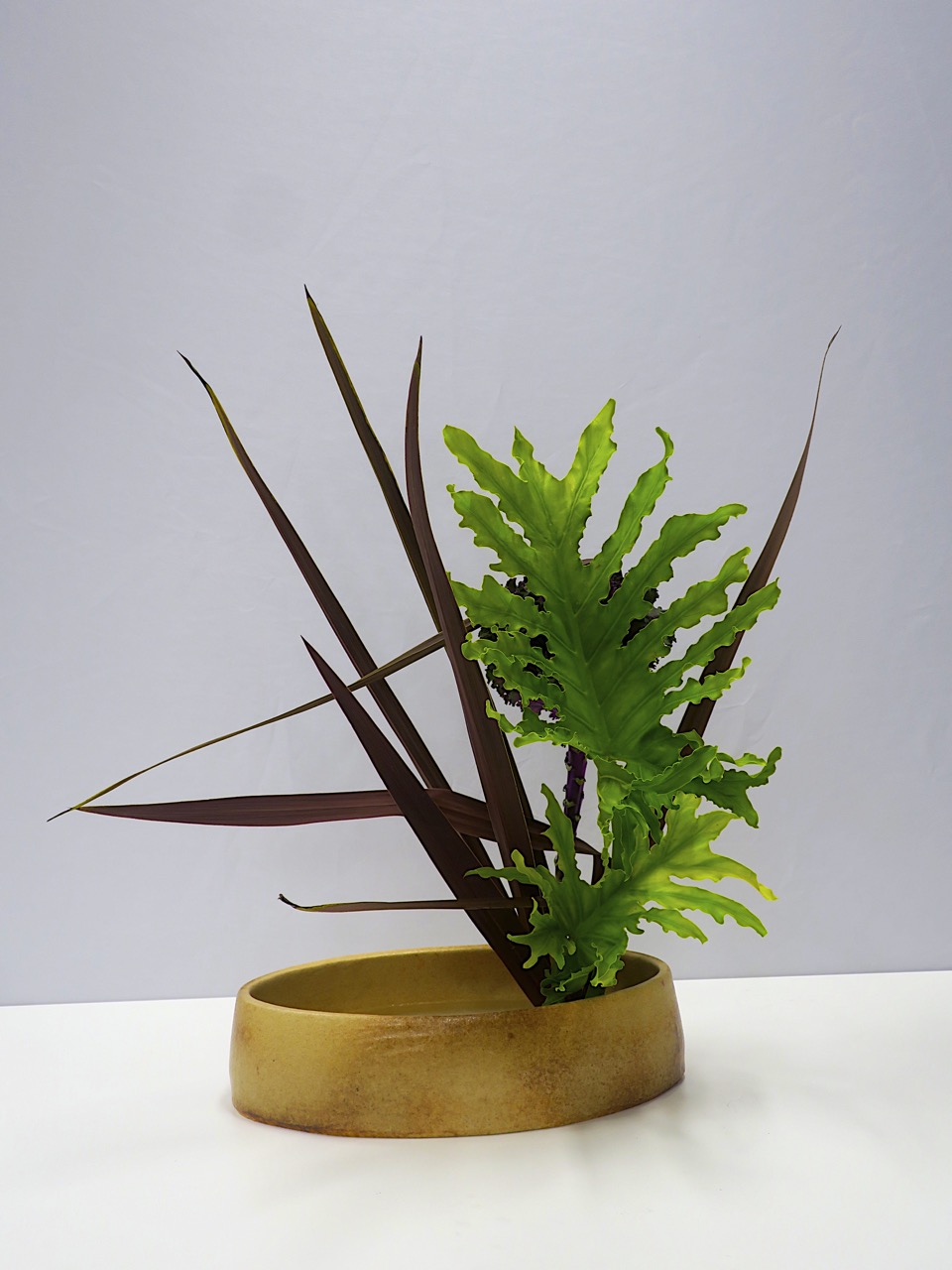
FLAX and KALE


This morning the yellowing leaves on the apricot looked bright against the dark bark of the eucalyptus in the background.


And when the sun came out they positively glowed. T
he colours were also intensified with the rain that fell overnight. I have noticed the changes of the season with the coming of winter. The first buds have appeared on the Japanese Flowering Quince and strong new growth is showing on the climbing Lorraine Lee rose.

In the warmth of the classroom my Geelong students had various ikebana exercises to complete recently.


Jo's exercise was to make an ikebana without the aid of a kenzan. We had not discussed the exercise in advance and she quickly produced this very contemporary looking ikebana with a bold design. It has a good feeling of space and shows the water surface well. However, this exercise is an especially good opportunity to practise techniques of fixing so that the materials do not need to be supported on the sides of the suiban.


This was Jo's second ikebana, using branching material that can be intersected so that the branches are braced against each other. The use of wiring is permissible in this case, as long as it is not noticeable. Although it is not apparent in this photograph, the middle branch in the ikebana is not touching the back wall of the suiban.


The senior students' exercise was to make a slanting, variation number two, ikebana in a nageire vessel. I had not expected Christine to use Anthurium flower as the main stems. However, the proportions and angles were correct and the result quite striking.


Here is Ellie's version of the exercise. She used Magnolia grandiflora branches and white Chrysanthemums in a pale blue nageire vessel. The multi-headed nature of the flowers made it hard to emphasise the line element in that part of the ikebana.


Maree's exercise was to make an arrangement using leaves only. The straight lines she has used are a maroon Dracaena and the light green leaves are from a Split-leaf philodendron; recently re-classified as Thaumatophyllum bipinnatifidum. Her third material is Ornamental Kale Brassica oleracea. I felt this material did not technically qualify for the exercise as the leaves were not used individually. Maree has placed the Kale behind the other material.

After the class Maree kindly gave me two of the Ornamental Kale which I used later when I came home.


Using two of the New Zealand flax leaves from last week's ikebana, I 
was particularly attracted to the silvery-fawn colours in the damaged part of this leaf.


The tall line on the left was intended to show the colour but it was not really successful. Quite a bit of mechanics went into positioning the angled leaf. Unfortunately it insisted in being seen side on and thus the colour was lost from this angle.


A few days later I re-set the materials in this black ceramic vase which showed off both materials much more satisfactorily. The position of the single flax leaf enables the surface to be seen clearly and has held its position without any help other than the "cross bar" fixture within the vase. I also feel that the mass of the Kale is more harmonious with the vase.

The vase is by the Victorian ceramicist Terunobu Hirata.

Greetings from Christopher
28th May 2023


USING WOOD


As we walked home yesterday my attention was caught by the dark clouds and rain on the horizon that threw into high relief the brief shaft of sunlight on the cliffs at Rocky Point. A dramatic moment of transient beauty. Today the sky is overcast with showers and strong winds from the southwest.

Last Monday the Victorian Branch of the Sogetsu School held a workshop meeting that was led by Lara Telford, one of the senior teachers of the Branch. For the workshop Lara set the topic of creating an ikebana featuring wood with a strong character. My mind went to a large, highly-textured piece of wood that I have had for over twenty years. I originally collected it to place in the garden. However, its ikebana possibilities became apparent very quickly. The piece of wood has graceful curving lines. However the principal challenge of this piece is that it is very heavy, weighing 6.3kg. 


The last time I used it was at an exhibition curated by Emily Karanikolopoulos in April last year. Because of the weight of the wood I had to use a large number of stones in the base of this Shigaraki storage vessel to prevent it from tipping over. I did not want to use this large vessel again on this occasion. So in advance of the workshop I tried out a number of larger vases that might work with the wood.


I finally settled on my largest ceramic cylinder. 
Above is a trial with the wood standing with its heaviest end at the base. However, this was not stable and the lines in the wood were lost.

I finally settled on this configuration with the vessel on its side. What appealed to me about this was the way that, from the left hand end, the wood seemed to leap over the vessel. I then collected three long leaves of flax from the garden so that the ikebana would have only a small amount of fresh material that would keep the wood as the principal subject of the ikebana.

Although it is not particularly apparent, I used a cross-bar inside the cylinder so that the leaves are not resting on the table. I chose the leaf on the right because it has started to wither and has some interesting colour and texture. Barely visible under the arch of the wood and between the other two leaves is a small dried Hydrangea head. In retrospect this element should have been a brighter colour. I was appreciative of the advice at "critique time" to slide the cylinder back so that its opening was closer in to the arch of the wood.

More photos from the workshop on the Sogetsu School Victorian Branch website under Recent Workshops tab. Lara can be found on Instagram and Facebook: lara_telford

Greetings from Christopher
21st May 2023


MOTHER'S VASE

 
The bright sunshine and almost windless, calm air on Saturday lured Laurie and I out to walk with friends, Heather and John. 


They chose a delightful beach walk along a short section
, between Anglesea and Aireys Inlet, of the Great Ocean Walk. We were in luck as the tide was very low and were able to explore beaches that we had not previously walked along.


It is always fun to discover 'new' 
places like this natural arch between two beaches, where Heather and Laurie posed for me;


and later, with John as well in the photo, they posed with the Split Point Lighthouse at Aireys Inlet in the background.


A closer view of the lighthouse and Eagle Rock from the beach.


Earlier on our walk I took the opportunity to photograph a small section of clay that was composed of 
pink and cream alternating layers.


The layers are very strangely folded together...


...which immediately brings to my mind larger scale patterning of alternating colours sometimes seen in aerial photos. Also it reminds me of the surface patterning of Pippin Drysdale's ceramics.

*          *          *          *          *

In my Geelong class this week I set the senior students the exercise of making an ikebana with berry bearing branches.


Helen stripped all the leaves from the branches to make this large double vessel ikebana using Cotoneaster. The removal of all the leaves creates a bold statement because of the reduced colour palette and the intense red of the berries.


Ellie created her ikebana in a glass vase with the main element being a red painted Corokia that she submerged inside the vase. She then added a Cotoneaster branch with red 
berries as well as some white berries.
 

Maureen used branches of Sweet Pittosporum, Pittosporum undulatum, for her ikebana which she arranged in a copper vessel. She carefully defoliated the branches to show the lines while preserving some of the glossy leaves and showing the matte orange berries.


Tess chose Mirror Bush Coprosma repens, as her subject material. She also removed quite a lot of the leaves to show the lines and the fairly sparse orange berries.


Maree's curriculum exercise was to make an ikebana "Using Flowers Only". It is quite a difficult task given that the element of line is so important. She she created a gentle S-curve, with vividly coloured Snapdragon Antirrhinum, which is contrasted with a mass made with orange Chrysanthemums.

Earlier in the week I attended a workshop meeting of Ikebana International Melbourne Chapter. The focus of the meeting was to make an ikebana referencing our Mothers or mother figures in our lives. Today, the second Sunday in May, is Mother's Day.


This very simple ikebana was my offering. As I said to the members, it was not really about the camellia stems and flowers. It was about this vase that was made by my mother in 1955 when she attended evening pottery classes in Melbourne.


When I look at this vase I am impressed by the skill she developed very quickly in just a couple of years. We then moved to Torquay and that was the end of her pottery classes. I had never previously used the vase, which was given to me only a few years ago by one of my brothers. Oddly, it is only in this last week that I have realised that my awareness of the beauty and unique qualities of hand-made ceramics dates back to my early childhood.

Greetings from Christopher
14th May 2023


COLOUR HARMONY


In the garden autumn colouring is evident in some of the northern hemisphere plants...


...such as this Japanese Ivy Parthenocissus tricuspidata (also known as Boston Ivy). Our soil, climate and proximity to the sea (300 metres away) are not very suitable to many of the deciduous plants that colour well in autumn.


However, this 
Australian native, Banksia ericifolia is doing well and flowers beautifully in this season through to winter.  


The hook-shaped styles of the inflorescence are orange and give a rich colouring to the yellow tepals.

*          *          *          *          *
This week, in my Geelong class, I had set the senior students the exercise of making an "Autumn ikebana, focusing on leaf colour". 


Ellie created a nageire ikebana, which requires a tall vase. She used a strong, slanting branch of yellow-orange leaves for the principal line and orange-centred yellow chrysanthemums as a textural contrast.


Maureen used two branches of Manchurian pear Pyrus ussuriensis in an unusual flat-topped ikebana vase with a well for the kenzan. She deliberately removed some leaves from the bottom of the branches to show the newly formed flower buds. A small stem of Ginko leaves provides some lighter colour at the centre of the arrangement.


Tess set two curving stem lines of "Beurre Bosc", an old Belgian variety of Pyrus communis, with red leaves. The green leaves at the mouth of the vase are lilac Syringa. Unfortunately, the flattening effect of the photograph conceals the fact that the righthand line curves forward. The vase is from one of the Bizen kilns.


Jo's exercise was to make an ikebana that can hang on a wall. As a frame-work she used a structure she had made last year from thin stems. The green leaves are Agapanthus and the orange flowers, Clivias.
 
My Melbourne students also had individual exercises.


Marisha's exercise was to make an ikebana "Using leaves only". 
In this case, dried Aspidistra, cut-leaf Maple, variegated Bromeliad and fallen Crepe Myrtle leaves.  She also used her long lasting "Ozaka" leaves (botanical name unknown). Marisha decided to set the leaves in a glass vase to create this flowing line design.


Jacqueline's exercise was to use unconventional (man-made) material in her ikebana; in this case, wire netting. She first moulded the netting into a cone shape and then fixed it into the spherical vessel so that it issued from one of the two openings. A single stem of Jasmine vine, Jasminum officinale, is supported by the netting and three small Camellia flowers provide colour highlights. 

The maroon ceramic vase was used to give height, so that the vine did not touch the table surface.

My ikebana this week is made using Hydrangea flowers that I picked two weeks ago.


I was interested to notice how well they had dried with no wilting and very little shrivelling. Their colour change was also fascinating. The red had become maroon and the pale green parts had developed into a matt blue-green.


When I placed the vase on the sideboard I noticed the close harmony between the petal's grey-green and the celadon platter behind them. I photographed them against a white backdrop for clarity of this image. I added a small bare branch from the apricot tree as a contrasting element.

The celadon platter is by the Adelaide ceramicist Dawn Slade-Faull (1927-1987). The white, domed vase is by the Tasmanian ceramicist Sallee Warner.

Greetings from Christopher
7th May 2023

COLOURS OF AUTUMN


Last week saw the return to classes for my Torquay and Geelong students at the beginning of Term Two. We are well into autumn and there has been some good rain recently, which means that the gardens are looking fresh and there is not too much heat stress showing in the leaves and flowers. 


Anne is a new student and working on the early exercises where the focus is on the principles of the proportions of lines to the vessel and the angles at which they are placed. This ikebana above is a variation in which the principal line, the shin, is placed toward the back and leaning slightly toward the right side of the suiban.


Maree's exercise was to make an ikebana in a tsubo, a round-shaped vase. She created a massed arrangement using Pin-cushion Hakea H. laurina flowers which are contrasted with smaller masses of Acacia and Plumbago P. auriculata flowers. 

The exercise for the senior students was, first, to make a basic upright ikebana using New Zealand Flax leaves; then, second, to re-use that material to make a freestyle ikebana in a different vase provided by one of the other students. The photos below are of the second phase of the exercise.


Tess set her flax low in Ellie's unusual lobe-shaped vessel. The blue flower peeping above the flax is a Butterfly Lobelia.


Maureen created a tall ikebana with flowing lines in a glass vase provided by Tess. The small yellow focal point is made with Chrysanthemum flowers.


Christine used two maroon-coloured flax leaves to create a space for a large autumnal Hydrangea. and repeat the horizontal lines on the vase provided by Maureen.


Helen set her flax in a slanting design in a vessel provided by Christine. Unfortunately the small mass of deep blue Salvia flowers are hard to see against the dark background.


Ellie created a strong horizontal emphasis in her ikebana. This was because of the difficulty in fixing her relatively short flax leaves in the very deep vessel provided by Helen. A tight mass of Chrysanthemum flowers makes a focal point at the mouth of the vessel.

*         *         *         *         *
In the garden...


...this Hydrangea looked positively luminous last week. When I saw it again this week it had started to fade a little so I decided to use it in my ikebana before I lost the chance this season. A little later in the garden I had to do some pruning. A long branch of Mirror bush Coprosma repens, was coming through the neighbour's side fence and shading some plants that needed sun. When I looked at the cut branch in my hand I realised that it had a beautiful line.
 

The pruned branch became a graceful shin line in my horizontal ikebana. I picked the three remaining Hydrangeas on the bush, leaving their stems long. The photograph has a flattening effect, hiding the fact that the branch to the left and the flowers in the middle are coming well forward of the vase. The photograph is uplit by the sun reflecting from the living room floor. This has thrown shadows upward from the flowers and reduced the intensity of colour in the Hydrangea flowers.

The vase is by the Victorian ceramic artist Graeme Wilkie and has a pale pink textured surface.

Greetings from Christopher
30th April 2023


AUTUMNAL HYDRANGEAS


This week I had a class with my Melbourne students for the first time in five weeks. The most noticeable change since we were last in the city was the seasonal shift into autumn. The gutters in the streets around the Botanic Gardens were full of fallen leaves from the many Plane Platanus x acerfolia and English Elm Ulmus minor 'Atinia', trees in the area. Autumn colour was also apparent in the first two ikebana arrangements below. I had set these students the exercise of making a single ikebana work in two non-matching vases.


Marcia used a white-glazed ceramic bottle and black ikebana vase. Her materials were Crepe Myrtle Lagerstroemia, and Haemanthus coccineus in the black vase. There is also a small group of Pomegranate Punica granatum leaves which connect to the two fruit-bearing stems of Pomegranate which are in the white vase.


Eugenia also used black and white vases. The one at the back is 
made like a bottle-shaped ceramic net and is lying on its side. The materials are Grape vine Vitus, and white flowering Cane begonia.


Marisha's exercise was to make an ikebana that expresses herself. She has re-used two long-lasting leaves (Bird's nest fern?) and imagined this ikebana as an offering on the alter of the Temple that she attends. 


Jacqueline's exercise was " Focusing on the uses of water" Here she set a single stem of Asparagus fern A. setaceus, and a small cluster of pink Chrysanthemums. The ikebana is in a clear glass dish which is placed on a larger white plate so that when it is placed on a wooden surface the woodgrain does not overwhelm the ikebana.

*          *          *          *          *
Because of the nature of our climate, and the characteristics of the soil, our garden is mostly populated by trees and shrubs that are Australian native species. However, to provide variety for my ikebana, I do grow a number of exotic plants - some of which are in pots. A month ago the Golden Rod was fully out and the ornamental grape vine was at its best. Now they are looking feeble. They are among the few plants in our garden that show the seasonal shift that is characteristic of northern hemisphere autumn colours. However when we returned to Torquay last weekend the autumn colour in the Hydrangeas had really intensified. 


I showed this photo of one of the potted Hydrangeas early in March. It is now a deep red with a somewhat velvety surface. I decided to use it in my ikebana before it is damaged by rain. The colour and the mass of the flower heads left me struggling for a while over what other material to use as well.

A stroll around the garden brought me to the slowly growing Strelitzia nicolai, given to me by another ikebana friend Emily Karanikolopoulos. Aha! a suitable contrast for the Hydrangea that can match its volume.

I chose an irregularly dome-shaped vase with a greyish glaze for the ikebana. After setting the flowers in a mass and line design, I added a single new leaf from the base of the Strelitzia in order to provide a balancing line as well as a smooth green surface behind the Hydrangeas.


After I had photographed the ikebana I placed it in the niche in the living room. In doing so I noticed again some of the smaller, beautifully-coloured leaves in the middle of the ikebana that are visible when it is seen from a little to the right side. This reminded me of my teacher, Carlyne Patterson's, observation that an an ikebana arrangement should not show itself all at once. There should be a little mystery to be discovered. Which, of course, is why we should not confuse a beautiful photograph of an ikebana with the experience of the living thing itself experienced in a physical space and in real time.

The vase is by the Victorian ceramic artist Owen Rye.


Greetings from Christopher
23rd April 2023