IKEBANA AT HOME


I was very surprised to see a large number of under-7 and under-8 year old school children on the beach this morning. The cool wind from the south was moderate and it had made the surf quite choppy. I had just put on a rain-proof jacket as light rain had started.

The children were attending a summer program that teaches water safety, and was being run by the Surf Life Saving Club.  

It was reassuring to see that the children were being closely supervised by a proportionately large number of fully qualified surf rescue teachers as well as parents. I noticed that the program had obviously been modified for the day's poor weather conditions.

Now to the world of Ikebana. This week my Geelong students held an end-of-year social gathering, which at the last minute I found I was able to attend. The gathering was held for the first time at Jo's house and the students brought along food to share. Some of the students brought materials to set up "Ikebana at home". It is always a pleasant challenge to make ikebana in an unfamiliar environment. On this occasion I took the photographs against a plain wall so that the ikebana was easier to see.


Christine set a single Strelitzia Nicolai inflorescence in a cast iron, boat-shaped bowl. The bowl showed off the Strelitzia's subtle colours as well as its dramatic form.


Jo arranged two red-painted bare branches to which she added ropes of red beads for a "Christmas touch". The focal point included a branch of pine, a single arum lily Zantedeschia aethiopica  and a white Agapanthus.


Maree set a branch of Mediterranean Cypress Cupressus sempervirens vertically in a suiban and added three white painted dried Lotus pods and a stem of red Asiatic lily. 
  
   
Ellie used a clear glass cube into which she arranged an Aspidistra leaf below the water and a single white Chrysanthemum flower floating on the surface. A deep red glass bauble was attached to the Aspidistra stem.


I participated in the exercise also. However, I have re-set and photographed my Ikebana at home. Because of the relative abundance of Strelitzia flowers in the garden this year I was interested in the idea of making a mass with flower heads only. Using five flowers each pointing in a different direction, I set the flowers on the left side of the vessel's opening. In recognition of the end-of-year celebration and approaching holiday season, I added a sheet of gold-coloured foil. I liked the colour harmony of the foil. However, I lost the rather attractive space on that side.

The vessel was made by a friend and Ikebana colleague from Sydney, Margaret Hall who, as you can see, is also a talented ceramicist.

Greetings from Christopher
10th December 2023
 

HOME AGAIN and STRELITZIA JUNCEA

 
On Friday 24th November I was able to visit the Head Quarters of the Sogetsu School in Akasaka, Tokyo, the day that we left Japan.


From the fourth floor lobby I was surprised to see the towers of Shinjuku rising above the trees in the grounds of the former Akasaka Palace, now the State Guest House in Tokyo. A rather rare view in Tokyo.


On the fifth floor I was delighted to see this large ceramic sculpture "Do-VIII", by Hiroshi Teshigahara, the third Iemoto. I had not expected to see the warm colours of the clay body showing through on the lower part of the sculpture. 


The sculpture was set to the left of this large ikebana arrangement by Master Instructor Suikei Sakaguchi. The materials are: driftwood frame, Balloonplant Gomphocarpus physocarpus and Winterberry Ilex verticillata (a deciduous form of Holly).

Laurie and I were able to have a "farewell" lunch in the mezzanine cafe with seats overlooking the park at the side of the building. Then we caught a train to Narita airport for our return home.


Most of the days have looked like this for the past week. The photo was taken on Jan Juc beach looking west at 8.30 pm last Monday evening. It has been very strange to arrive home to the bright evenings of daylight saving. Not to mention the week of unseasonal rain. For which the garden is very grateful.


So much so that the potted Iris ensata opened late this afternoon.


And...


...the Strelitzia juncea is having its best flowering yet.


I decided to arrange two Strelitzia flowers in a shallow ceramic 1930's bowl by the Tasmanian ceramicist John Campbell. As there are no leaves to speak of on S. juncea, I added a leaf of New Zealand Flax that had started to go yellow. The leaf had a remaining stripe of green in the yellow part and its width gave a bit more substance to the otherwise bare flower stems. I bent the top of the leaf down to strengthen the mass at the top of the arrangement.

Greetings from Christopher
3rd December 2023
 

NAGOYA, and a class in TOKYO


Last weekend we returned to Nagoya for a few days, to catch-up with our friends there. On Tuesday one of them took us to the Hatcho Miso factory in Okazaki. I was really amazed when I learnt that the soy beans were fermented in wooden vats for two years.


This photo is of a fixed display, with models, showing the traditional preparation of the product. The large vat on the right contains six tons of fermenting miso with three tons of stones 
pressing down on the lid. The factory has been producing miso in this manner since 1645. 


We then walked to the nearby, reconstructed, Okazaki Castle, the birthplace of the first Tokugawa Shogun, Tokugawa Ieyasu.
 

We were surprised to come across an open air Noh theatre...


...in front of which was this bamboo structure that provides eye-catching illumination at night.


On closer inspection I thought it would provide inspiration for some very patient ikebana practitioners.


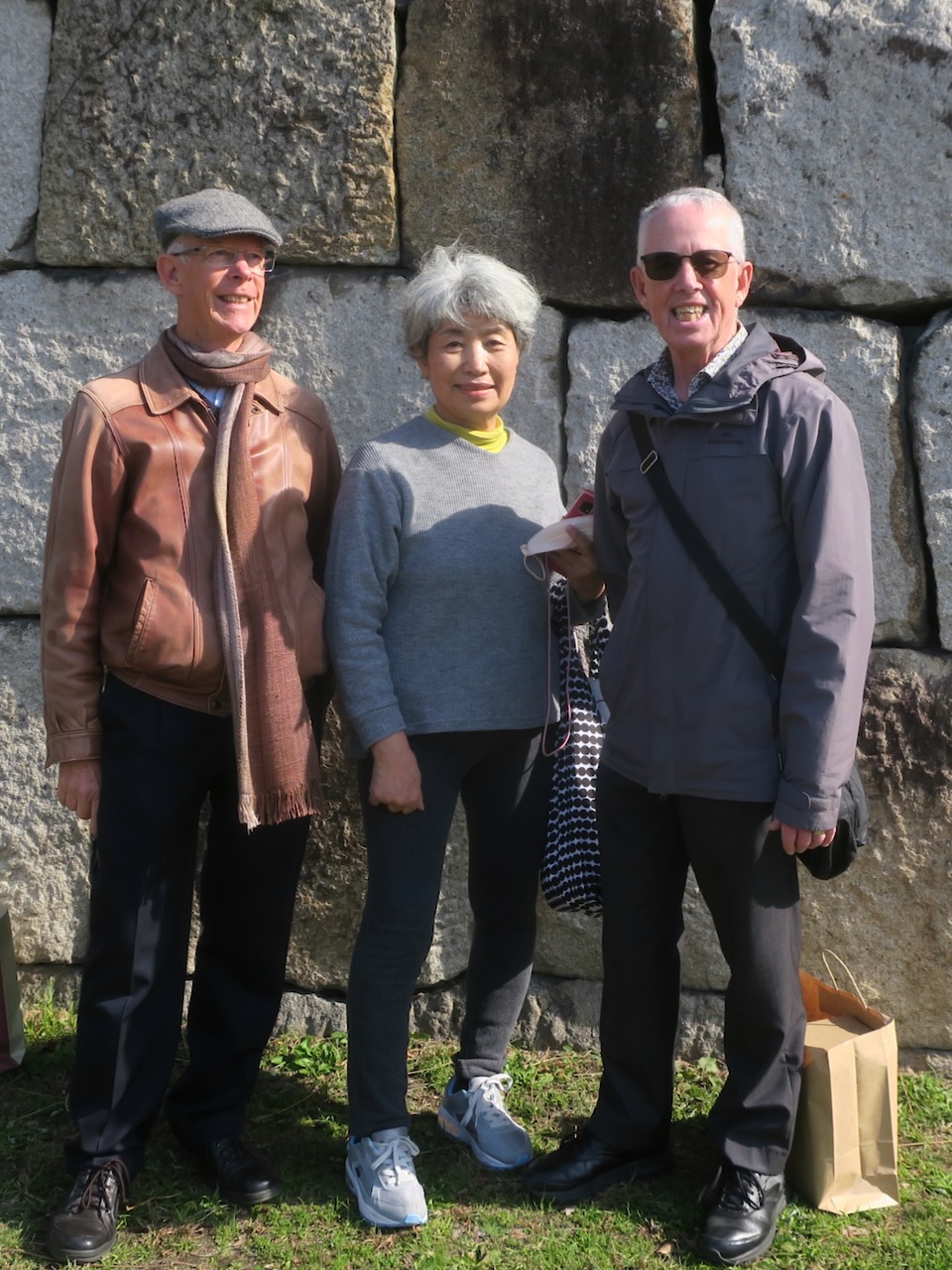
We also caught up with June, who was a fellow class-mate in my Ikebana classes back in 1992. Here we are standing by one of the outer walls of Nagoya castle. June and her husband, Takashi, took us to a sports centre within the old grounds of the castle where there was a ceramics exhibition.


It was being held on the floor of a Sumo wrestling stadium. As these photos show, it was a huge exhibition and market. 

Potters came from all around Japan to participate. The temptation to buy was very considerable. However, the weight and bulk of the ceramics constrained our impulses and we only bought two items.

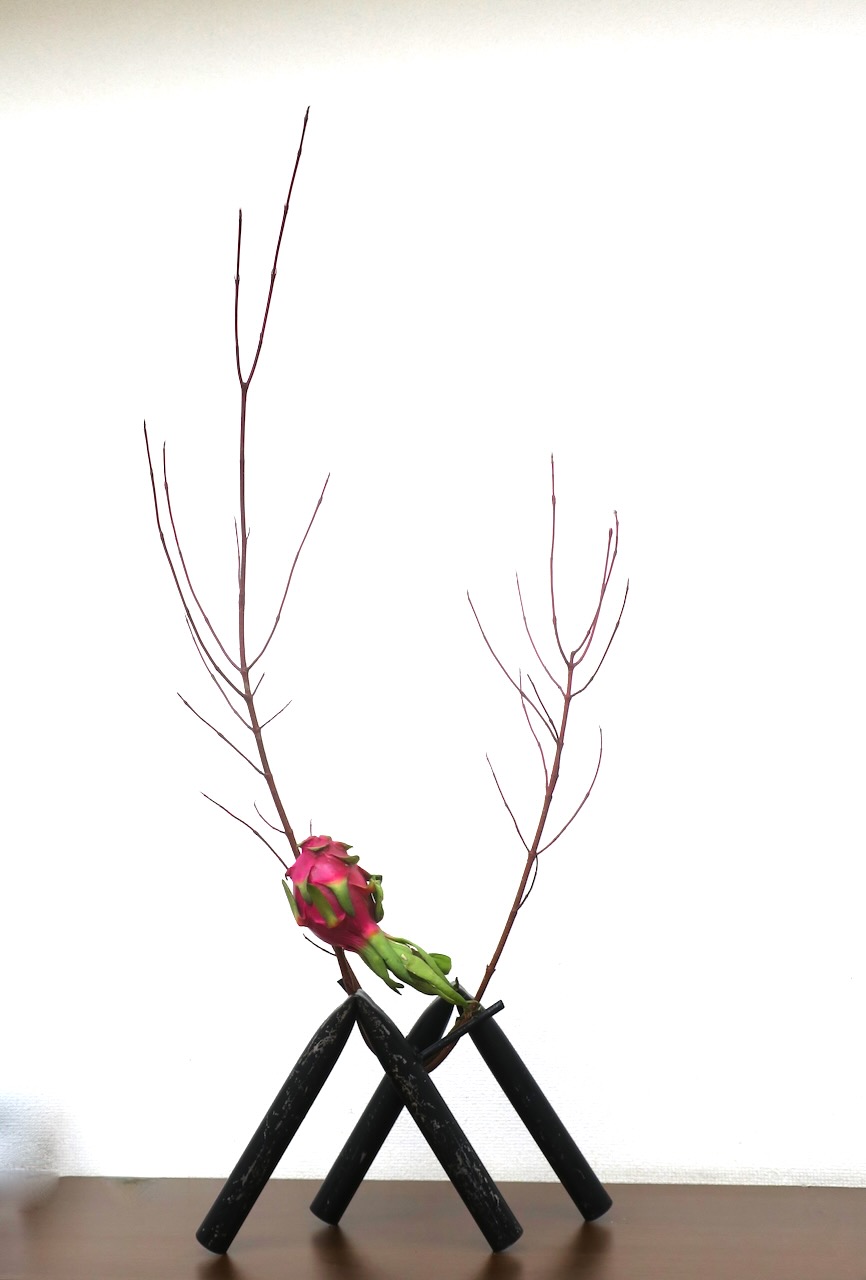
On Saturday last week I attended a class with Master Instructor, Kosa Nishiyama at her studio. In the flower shop nearby I brought two stems of red Siberian Dogwood and a single branch of Eucalyptus. The latter had a pink flush on the stem. Instead of buying flowers I decided to use vegetables and fruit. I had earlier noticed some Dragon Fruit in a supermarket and was drawn to its vibrant pink and contrasting green leaves. Some Broccoli was also added to my shopping list. These choices meant that the colour pallet of the materials was limited to red and green.


This is a  photo of my second self-selected exercise before correction. I had chosen a black metal vessel that was made with two tubes bent into a "V" shape, which were fixed parallel to each other off-centre and about 8cm apart. I placed the two Dogwood stems on the left side and the Eucalyptus on the right. To balance the arrangement I placed the Broccoli on the left leaning forward so that it presented its dome-shaped green surface to the front. I was not satisfied about the large space between the two parts. 

In her critique, Nishiyama sensei suggested that I bring the tip of the Eucalyptus curving down to connect with the Broccoli. As she held it in that position the ikebana immediately came together as a unified arrangement. Unfortunately I did not have time to photograph the corrected work as I had to rush off to another appointment.

This is the first ikebana I created with the the Dogwood and the Dragon fruit. I had placed the vessel upside down. Because of the extreme flexibility of the Dogwood I was able to secure it between the bars that joined the two "V" shaped tubes. I had impaled the fruit on a short stem of the Dogwood which lined up with the main stem. Sensei's correction was to create some space between the vessel and the Dragon Fruit by lifting it a little above the vessel. The photo shows the corrected version.

Greetings from Christopher
25th November 2023


ON THE ROAD WEEK THREE

 
On Sunday of last week we travelled to Mt Shosha near Himeji to visit Engyo-ji Temple, founded in 966 by Shoku Shonin. This temple complex is at the top of of a densely forested mountain. A really serene setting where the modern world seems to fade away.


At the top of these stairs is the temple hall, which appears to almost hang on the edge of the hill.
  

Beyond is a group of three buildings formed around a large square, open on one side. These large buildings were re-built in the Muromachi period (1336 - 1573) and, though grand in scale, are not intimidating structures. Because of their remote location these buildings have been used in many period Japanese films. As well, they have been used by Hollywood in such films as  'The Last Samurai'.

Beside the path I was really pleased to see a couple of Camellia bushes with early buds and one opened flower.


On Monday and Tuesday we visited two of the famous Art Islands in the Inland sea, Teshima and Naoshima.

We took a ferry each day from Uno Port enjoying the scene of the many small rocky-shored islands with rather dense tree cover.


On Naoshima the galleries are starkly modern. The approach into them is carefully controlled, so that a sense of anticipation is created in the visitor. This resulted in a sense of shock and surprise when the exhibition spaces were reached.


This is a very famous image: the Yellow Pumpkin installation by Yayoi Kusama at the end of a stone jetty.


Laurie and me enjoying the moment...


...and finding another at Uno Port.

When we got back to Tokyo we visited the daughter of one of Laurie's friends from the English conversation class he gave in Nagoya in 1978. She lives south of Tokyo in Chigasaki, where we went for a stroll to the (grey-sanded) beach. On the way we had to cross a highway on a pedestrian bridge.
 

The view was unexpected.

Greetings from Christopher.
19th November 2023


NARA to INUYAMA


Last Sunday we visited Joruri-ji, a small and very old temple east of Nara. It was built in 1107, during the Heian period (794 - 1189) and moved to its present location in 1157. It is the only surviving example of a Buddha Hall from this time and contains nine statues of the Amida Buddha.


The temple itself is set on the west side of a small artificial lake with a three-storied pagoda on the opposite side and an island in the middle. The whole setting is serene, being in a sheltered valley with tall trees all around.


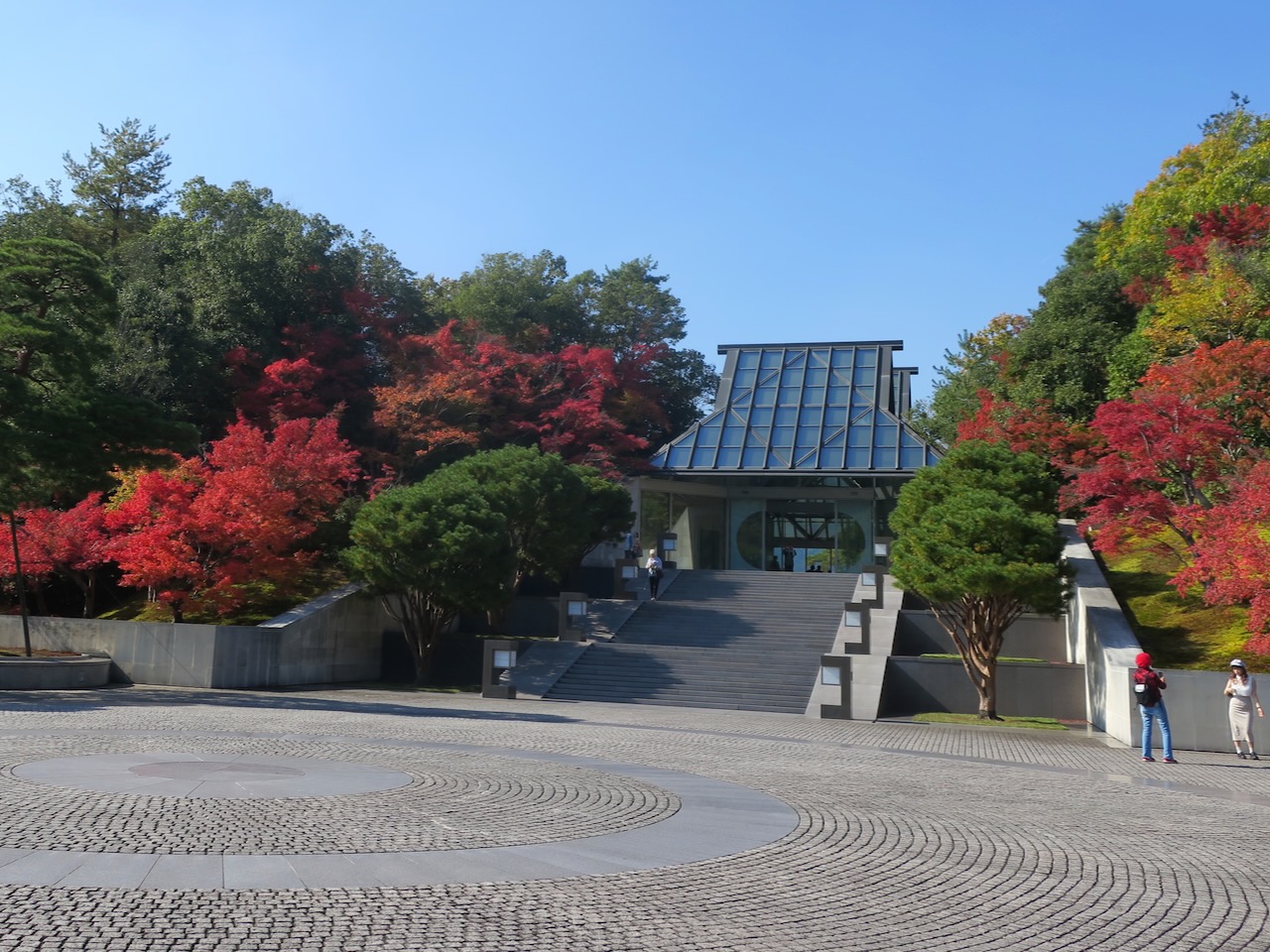
We then went to the dramatically situated Miho museum, which is also in set in a densely forested valley. 


The approach to the museum is via a long curving tunnel through a hill.


This photo shows the entrance building that references Shinto architecture. And you will notice a blaze of autumn red at last.


In Kyoto we visited Nishi Hongwan-ji temple...  


...which has a very large main hall because teaching practitioners is a major focus of Pure Land, one of many sects of Japanese Buddhism.

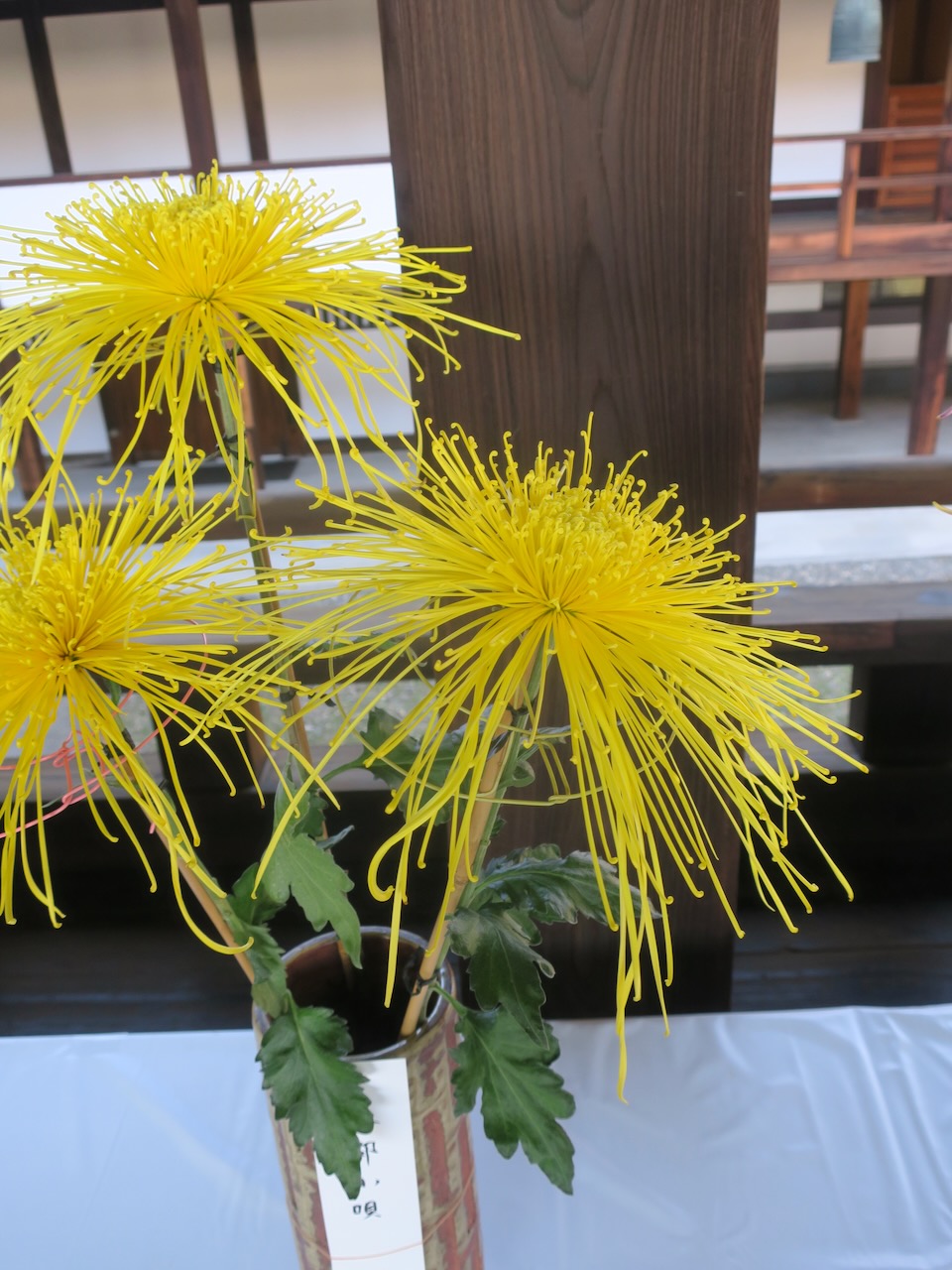
In the grounds there were a large number of Chrysanthemums on display, including these very beautiful ‘in-curve’ Chrysanthemums. 


I was particularly attracted to this one with petals that were pink on their upper surface and on the outer (under-side) surface a warm beige.


This spidery variety had the longest petals I have ever seen. Who needs mizuhiki (paper strings) if you have this flower?

.

Below are two photos I have seen of ikebana in public places.


This in a railway station...


...and this in a museum entrance.


On Thursday we travelled to Inuyama to see the smallest of the five surviving castles of the Tokugawa shogunate period that remain intact in their original form. I really like this castle because its scale is almost domestic. However, I should point out that this really was built as a military installation and not as a residence.


We were somewhat amazed to discover our overnight accommodation was in a new hotel, adjacent to the castle with this view from its central lobby.

Greetings from Christopher
12th November 2023


TOKYO - KANAZAWA - NARA

 
On the first day of our tour we visited a Japan National Trust Property in Tokyo. It was built in 1919 for its first owner Yoshisaburo Fujita, but after a few years was sold to Zenshiro Yasuda whose house had been destroyed in the Great Kanto earthquake of 1923. The house is one of the few remaining large houses built in the traditional style, using traditional techniques. 


The building zigzags down the long narrow block with a dry landscape garden that widens progressively. It is designed so that the garden's character is different when seen from each room.


The 
formal Japanese room on the ground floor has a large square tokonoma in which this ikebana was displayed.


I was particularly fascinated by the very distinct changes in the light levels of the rooms as well as the shadows that were cast on the shoji screens. These shifts in light level gave various parts, even of a single room, different characteristics. 

The next day we took a shinkansen to Kanazawa...


...where we caught our first glimpse of snow capped mountains.


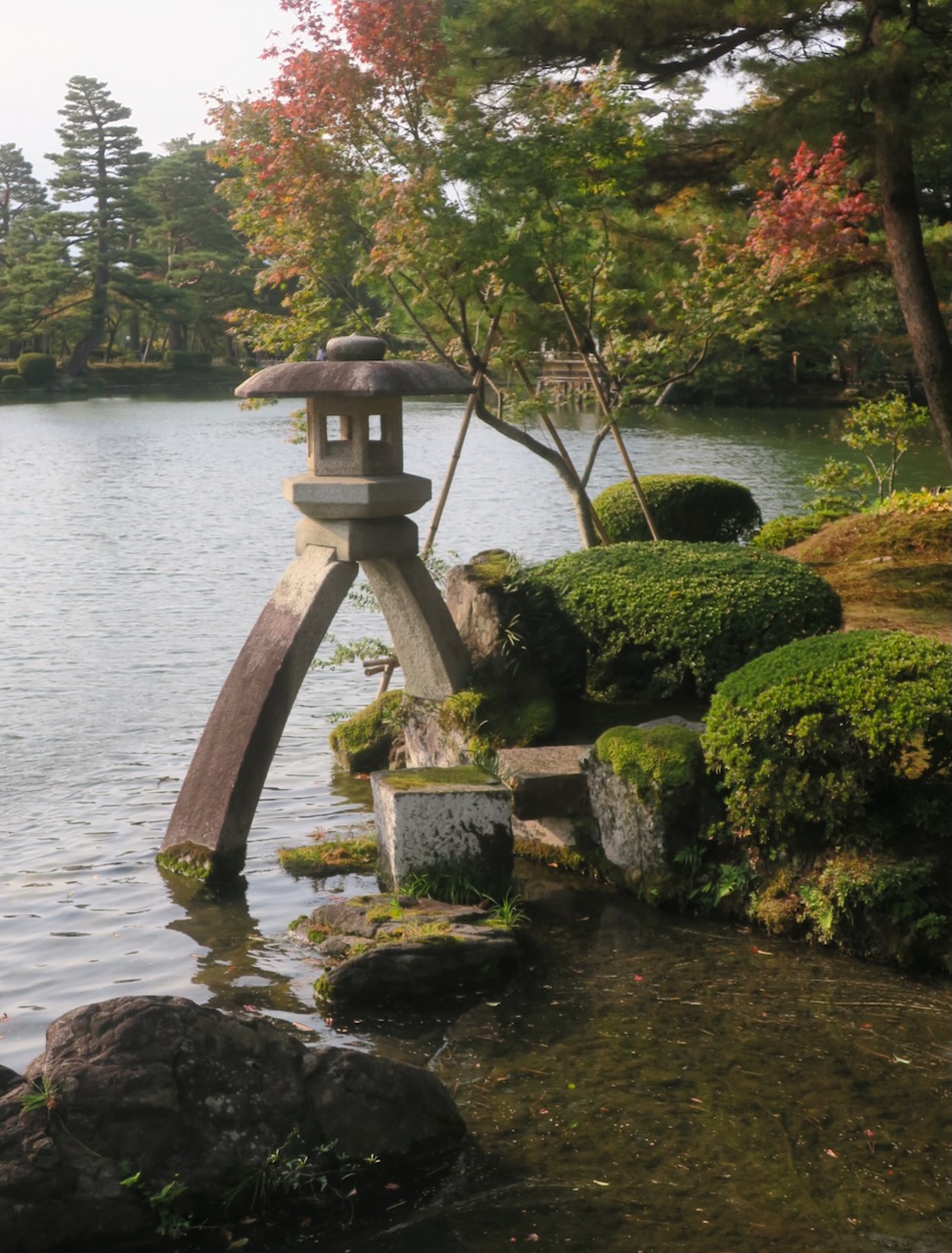
Our first outing in Kanazawa was to the famous garden of Kenroku-en. Because of the unseasonally warm weather there was not a lot of autumn colour. However, we had the good fortune to be present of the day when the long horizontal branches of some of the pines are secured to prevent their breaking under the weight of the winter snow to come. 


We saw large group of skilled arborists carefully tying ropes  around the branches from the top of a tall pole. All done with great precision and care.


The finished job looked quite beautiful. It also became apparent how necessary this task is when you realise that the large branch extending out over the water comes from the trunk of one of the two tall trees on the right.


A little further on in the garden I did come across some scattered patches of red Japanese maple leaves among the lovely soft green ones.


The end of this branch looked especially lovely with the sun coming through the leaves.

In our further travels as we headed toward Kyoto I was surprised to see a lot of Golden rod Solidago, which is native to North America and Mexico. Apparently it has become quite invasive in Japan.


I was surprised by my success of actually catching the moment  when this butterfly landed on a flower head.


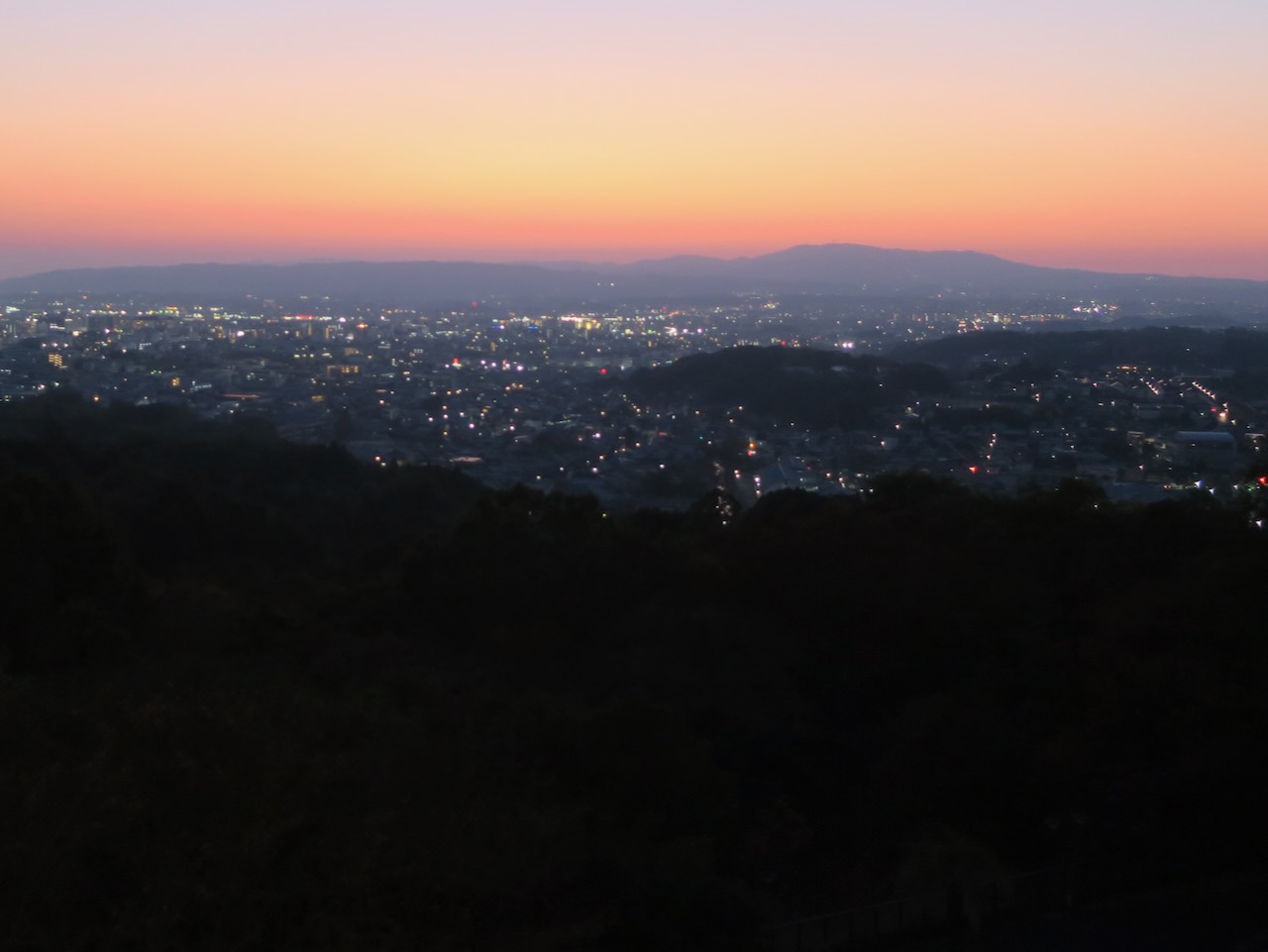
The next two nights we spent in the ancient capital of Nara. This was the view from our hotel room on the mountainside near the great temple of Todai-ji.

Greetings from Christopher
5th November 2023