SUMMER COLOUR


The weather on the Surf Coast has been quite fickle; typical of Victoria, is the common view. On Christmas day and the week following, it was cool and wet. However, in the last week it seemed like summer had arrived. A welcome change for the holiday visitors who have come to Torquay to enjoy the beach.


The gardener's pleasure is to see the summer flowers. I recently replaced my possum barrier beneath the frame that supports the climbing Lorraine Lee rose. The new barrier is corrugated colour-bond edging and seems to be working well.


This is the most prolific flowering of this plant to date. Of course the rain has helped.  The potted Hydrangeas are also doing well.


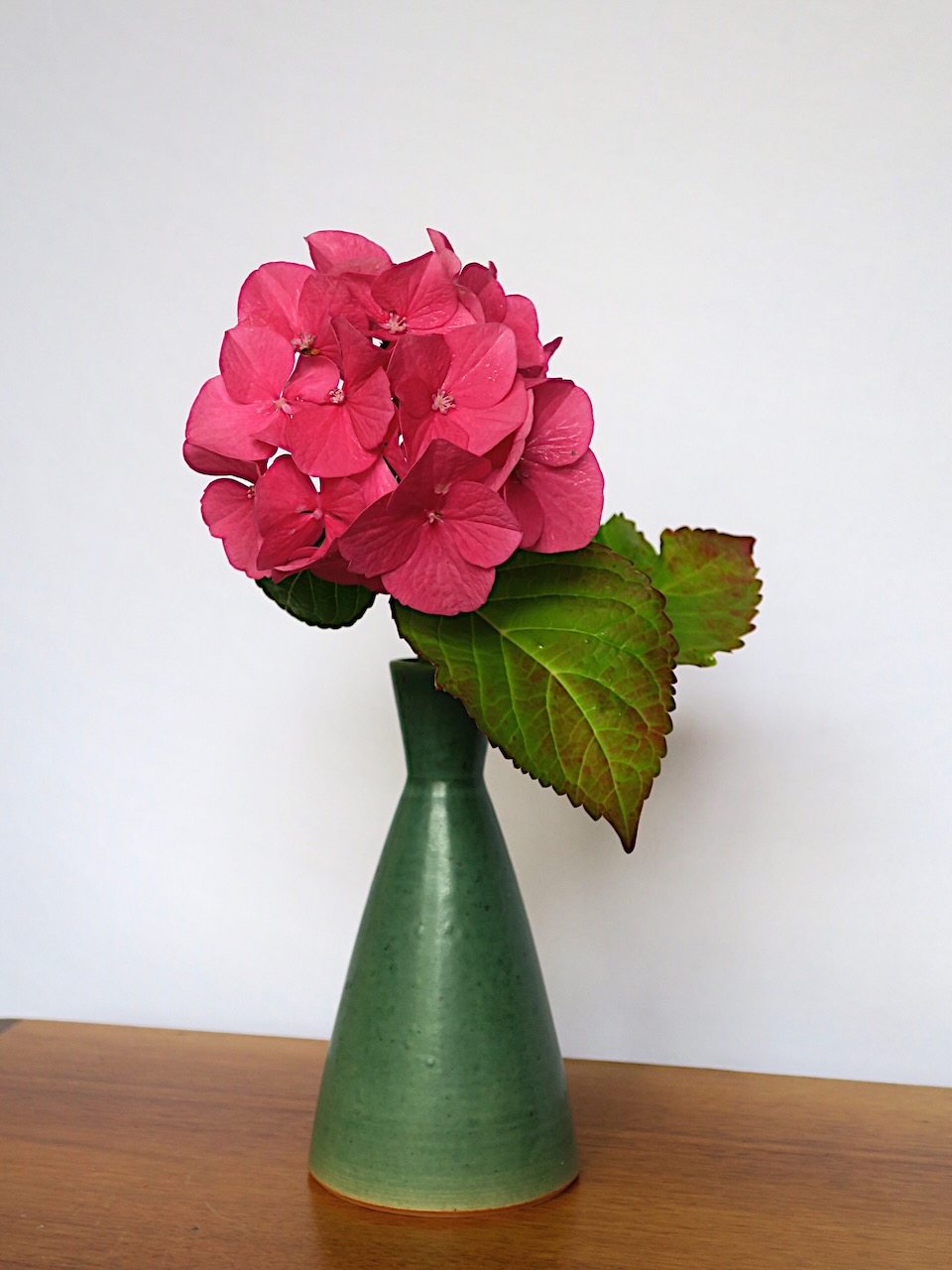
This vivid pink one has only produced small flowers this year. 


Small flower size was not a problem for this particular vase/vessel. Laurie bought it for me when we visited the Kutani Kosen Kiln in Kanazawa last November. His specific comment was, "...this will be both your Christmas present and your next birthday present...". We both really liked the elegance of the design of this vessel. The kiln is a family-owned business. Interestingly, the current head of the family commented that his father made a number of these vessels about thirty years ago. This being one of the last remaining from that time. He also said that he could not reproduce the exact colour of this glaze as the recipe and details of the firing process were lost.
Vase or sake carafe?
Both!


I was happy with the colour contrast between the glaze and the Hydrangea. The small size of the vessel required a simple arrangement.


Also in the garden a couple of patches of Crassula arborescens, ...

...are looking their best. This one is partially shaded by the Apricot tree. Consequently, some of the flower stems are growing at a low angle.


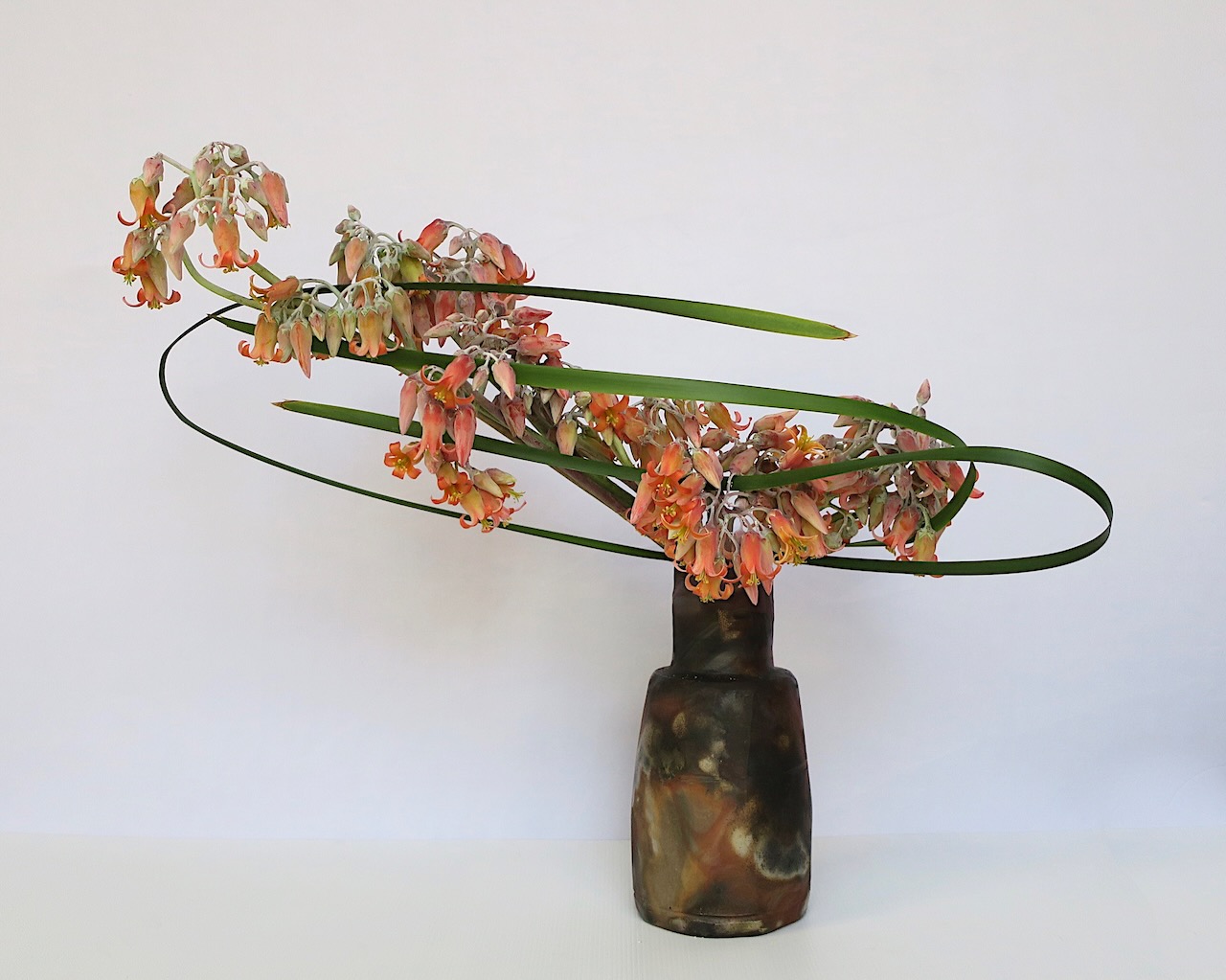
When I brought some of the flowers inside I noticed how their orange matched some of the rather orange-ish tones in this Bizen vase. This was the other ceramic purchase by Laurie last November. This time at the Yakimono-World Fair and Exhibition in the grounds of Nagoya castle. It was made at 
the Gorobee Kiln in Okayama.


This was the start of my arranging the materials in the Bizen vase. The overall darkness of the vase makes it dominant and the flower mass look small.


I have made a loose mass with the flowers, trying to maximise the visibility of their orange colour. I then added some lines with the green strap-like leaves of Lomandra lingifolia. The leaves gave the ikebana some movement and created spaces which allowed the flowers to "breathe".

Greetings from Christopher
14th January 2024


A SECOND LOOK


By the end of last Spring, the end of November, the Strelitzia juncea in the garden had more than 25 flower stems. As I noted back then, it was the best flowering this clump has produced. Now however, the flowers have faded and the petals shrivelled to a dry, dark-brown state. This is the way of things, of course; and one of the joys of the plant world is the seasonal change we observe.


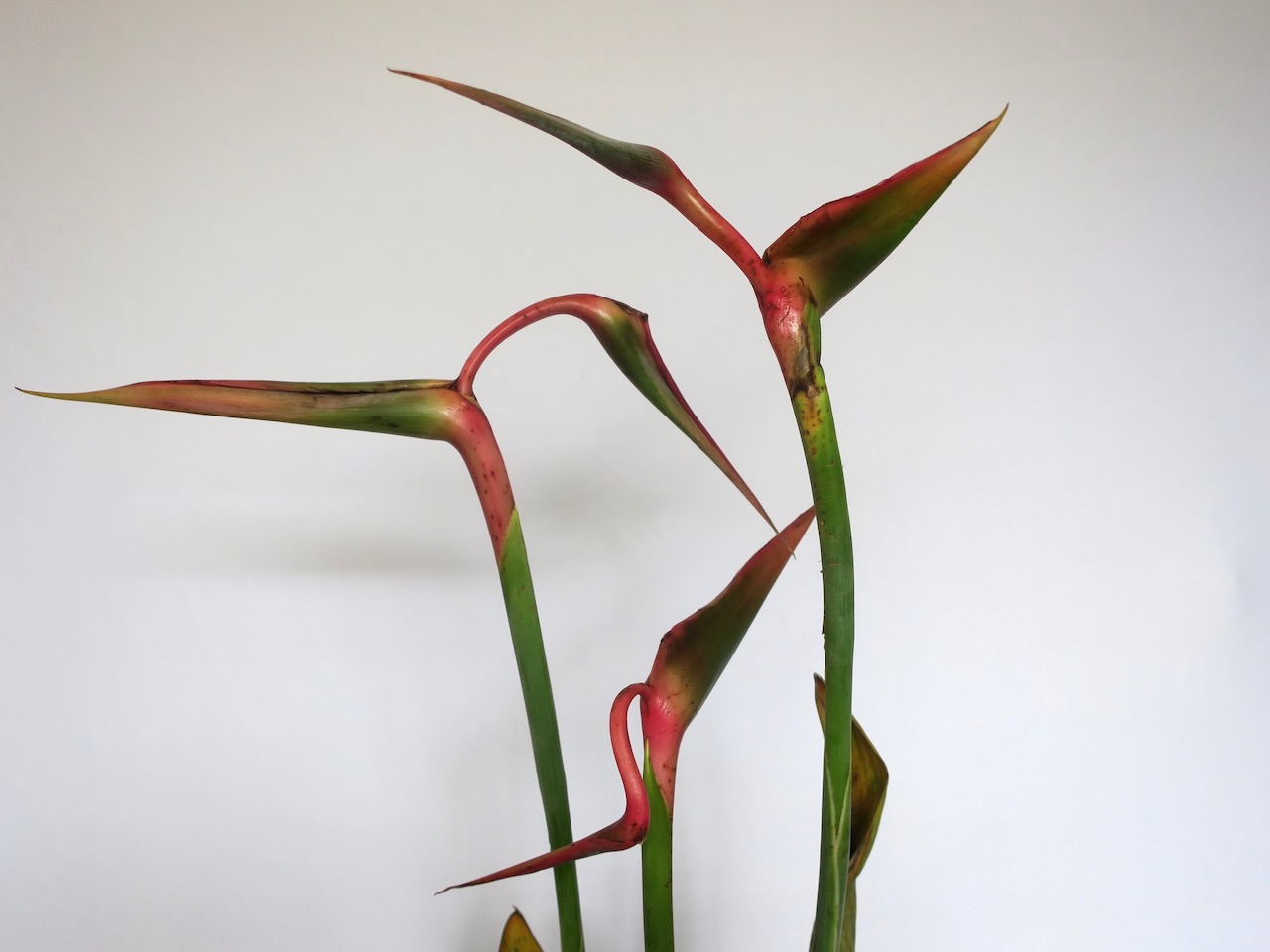
I took this photo of one of the last two flower stems, showing the drying petals as well as the final coloured petals for this season. I have previously been struck by the extraordinary colour that remains in the stem and spathe in this phase. I had pruned all of the other finished flower stems last week. After throwing several into the compost I felt I should not waste those that remained. Their colour and shape demanded the attention of my ikebana eye. I felt this material provided a challenge to my ikebana mind. 

Once before I had been struck by the colours that remained in the flower stems after flowering. In March 2020 I created the ikebana below.


In this instance the focus is on the pink at the back of the "neck", if the flowers were indeed "birds".


Last week I first focused on the shapes of three double-headed Strelitzia flower stems. For preparation I used olive oil to clean some of the sticky substance exuded from the flower spathe. Then I wiped the oil off with a paper towel, leaving a soft sheen to the surface.
 

This is the final ikebana. I re-used the fading leaves from a bunch, with flowers included, that were given to us four weeks ago. Unfortunately the flattening effect of the photograph removes the feeling of depth and the way the secondary flowers interact with each other.

The suiban is by the New Zealand ceramic artist Elena Renka.

Yesterday I decided I had to use the rest of the flowers I had set aside. To start with I used the same cleaning process described above. Then I observed that the spathes of the flower heads presented different angles to the main stem. Many were almost at right angles. But a couple "looked down" and a few more were "looking up".


I have used the spent flowers to make an ikebana in which the lines are closely placed to create a very structured arrangement of lines and angles. None of the flower heads actually touch each other and all of them face inwards toward the midline. The one downward facing flower I used is at the back. The right angle flowers were placed next then the upward looking flowers were placed highest. This placement gave a certain logic to the ikebana and an over-all coherence of design.

The following three quarter and side views shows the depth of the arrangement.


The vessel is by the Victorian ceramic artist Isabella Wang.
 

Greetings from Christopher
7th January 2024


TREE PHILODENDRON


In the week before Christmas I had a brief walk along the Barwon River at Newtown as I was early for an appointment. 


There was a light drizzling rain when I came across this patch of waterlilies, that I thought looked quite beautiful. A calming moment before seeing the dentist.

Last weekend we went to Melbourne for Christmas and had the luxury of a slow walk around the Royal Botanic Gardens.

 
There I saw more water lilies. Almost the whole surface of one of the upper lakes was covered in pink waterlilies.


This individual flower near the water's edge looked particularly beautiful.


As did this mass of pink, mauve and purple Hydrangeas.


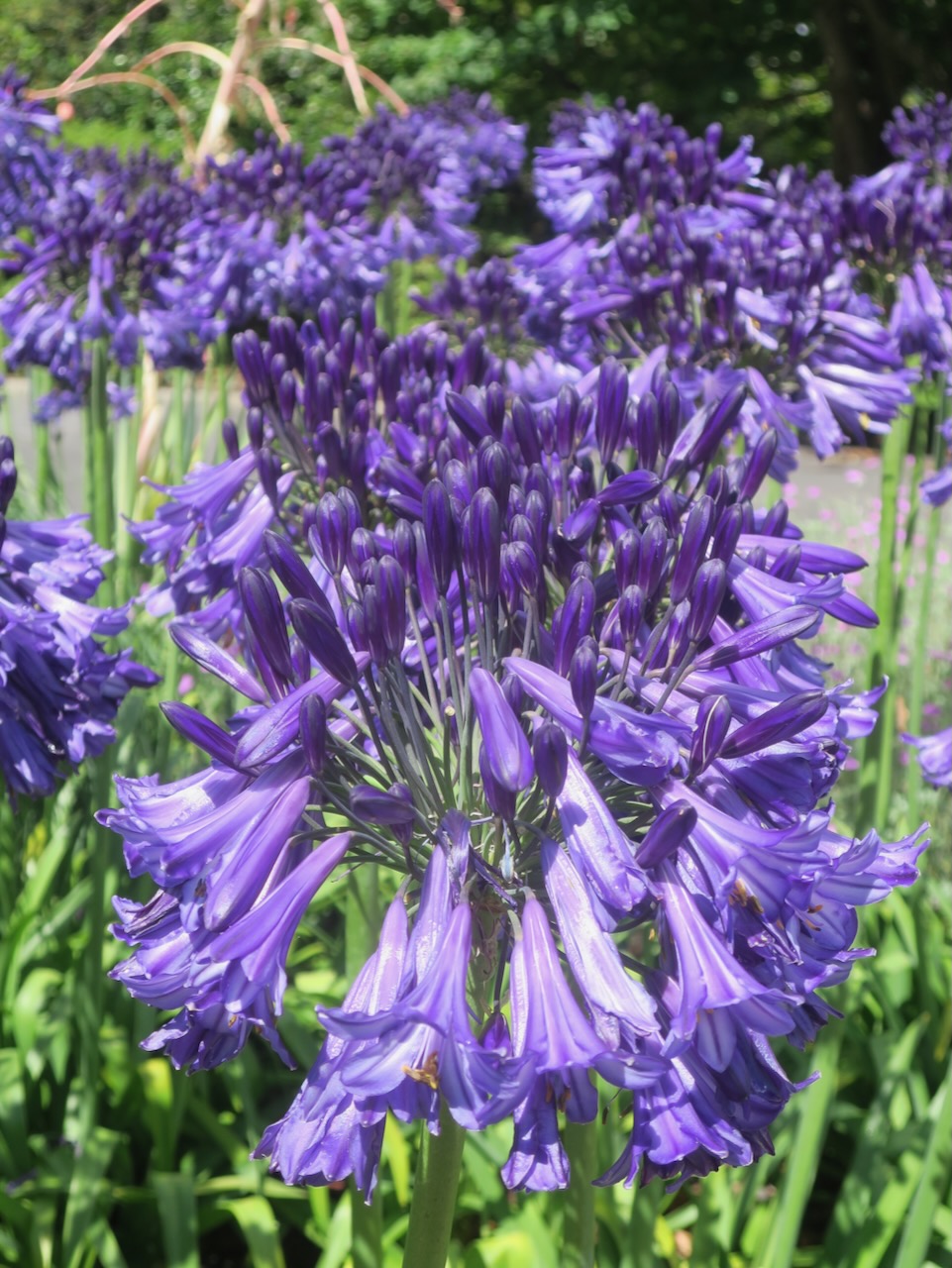
There was a whole bed of this dark blue Agapanthus. One of the cultivars that has appeared in recent years.


Summer is the flowering time for one of my favourite native trees, the Illawara Flame Tree Brachychiton acerifolius. In Victoria, if the conditions are right, it will loose all of its leaves before the spectacular flowering.


This close up of a panicle reveals part of the reason the flowering is so dramatic. The stems of the flowers are also the same intensely bright red. This panicle was on a tree in the Ian Potter Foundation Children's Garden at the Botanical Garden.


Which is where we also came across this tree where something small may live.

Over the past couple of months in the Botanic gardens I have noticed an unusual event. In a number of places around the garden some clumps of bamboo have started flowering. Bamboos flower infrequently, usually after 40 - 80 years. However, some species only flower after very long intervals, as much as 120 -130 years. 


In this photo it is easy to see that the flowers look like those of other grasses. 
 

In this photo most of the bamboo has already turned brown and is dying. It is a mass flowering event in which all the plants in the cohort will flower and then decline and die. Seeds that fall from these plants will start the regrowth of the patch.
*          *          *          *          *
Recently I re-introduced our Tree Philodendron Thaumatophyllum bipinnatifidum to the conservatory. The unfortunate, but very resilient, plant had spent the better part of two years out in the garden suffering considerable neglect. Finally, three or four months ago, I re-potted the plant and started to treat it more respectfully in the conservatory. It has responded well to the warmth, watering and feeding, by producing some larger leaves and two smaller shoots at the bottom. 


One of the leaves recently yellowed and began to die (of old age) first turning a beautiful bright yellow. This made it an interesting, somewhat largish, ikebana subject.


Because of a noticeable curve in its stem I decided to use this large curving vessel by Graeme Wilkie. The yellow leaf is the main subject but needed a foil. Green seemed best to highlight the yellow. I chose a fading leaf from the Strelitzia nicolai that had some autumnal tonings and a similar curve. With such strong materials, nothing else was needed.

I would like to wish you all a healthy and Happy New Year.

Greetings from Christopher
31st December 2023


SEASON'S GREETINGS


Last week I showed a close-up of a flower cluster on the Red Flowering Gum Corymbia ficifolia in the garden. The still smallish tree was a wedding present from a neighbour.


This photo shows the whole tree from an elevated position, so it just looks like a large shrub. Many more flowers have opened in the last few days and there are even more flowers that have not yet opened. I wanted to bring this intense colour indoors, so I picked a single inflorescence which had over forty individual flowers .


I set the flowers and a single branchlet in an irregularly shaped, mostly black, vase which has a closely matching red glaze across the mouth. It was made by the Adelaide ceramicist Rebecca Dawson.


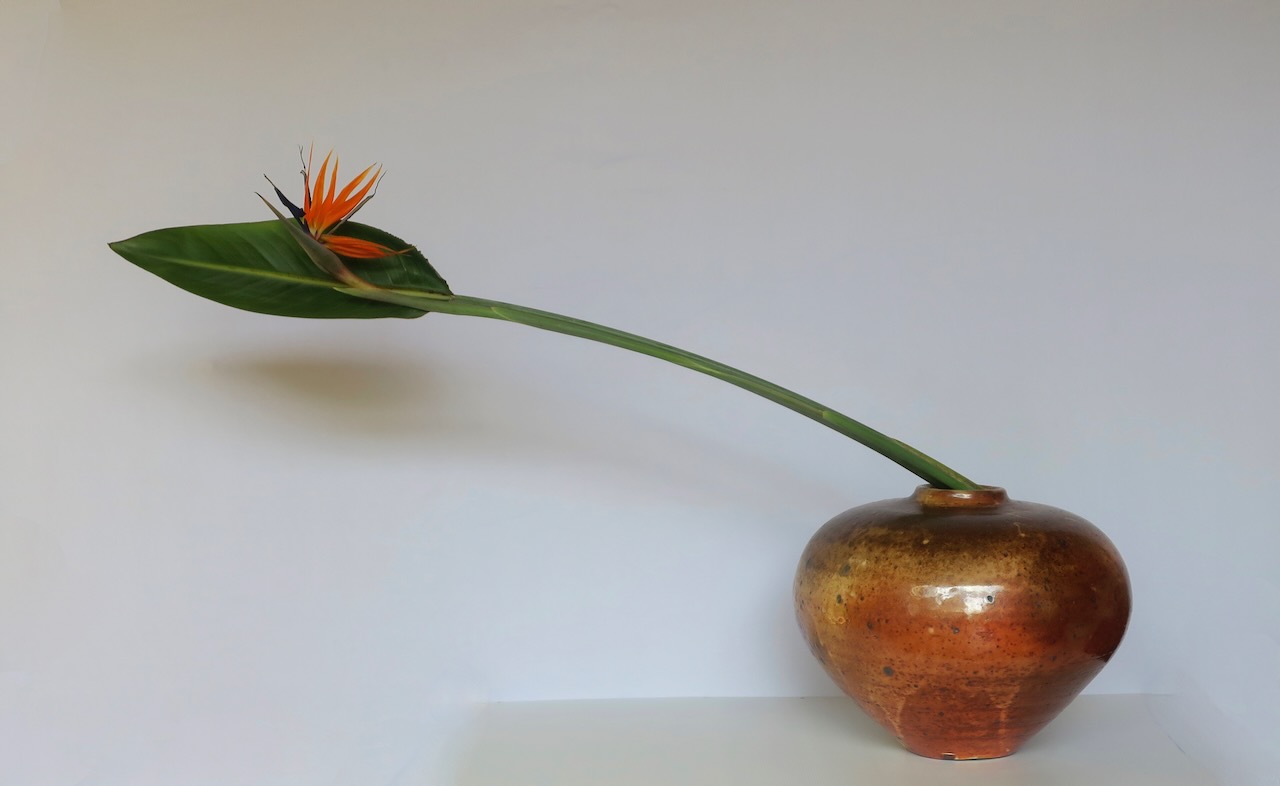
The leaves of the beautiful Strelitzias, that we were given two weeks ago, were still going strong earlier this week. One of the leaves was particularly long with a curve such that the upper surface of the leaf could be seen from the front view, if it was placed extending to the left.


Coincidentally one of the flowers from our S. juncea clump had fallen to a near-horizontal position and its flower head turned in the right direction to suit the leaf so that they both faced forward. I worked on the curve of the flower stem to make it match that of the leaf and then set them both in this large tsubo vessel.


This photo shows the fixing technique that I used to hold the stems off the rim of the vessel. I used a very flexible forked branch from the Bay Tree Lauris nobilis, and bent the ends down to follow the curve of the 
vessel's shoulders. Rather like a natural cross-bar. This elevation of the stems off the rim creates a space underneath and gives a feeling of lightness to the line. However, a stem that extends like this but which rests on the rim of the vessel will look heavy.


The final photo shows the ikebana on the sideboard at night. Hence the photo is a little dark. The shino-glazed woodfired vessel is by the artist Sergio Sill.

As it is Christmas Eve I would like to wish you a peaceful Christmas and good health in the New Year.

Greetings from
Christopher
24th December 2023


STRELITZIAS

  
Summer is definitely in the garden. Such a change from a week ago.


The Red Flowering Gum Corymbia ficifolia, that we planted five years ago is now about two and a half metres tall. I noticed the buds forming some weeks ago, which now have begun to open. It looks splendid on a sunny day and is obviously very attractive to the bees.


I took this photo of the largest clump of African Iris Dietes Grandiflora, in the garden a couple of weeks ago. On the previous evening I had noticed that the clump was covered in unopened buds. The next day was predicted to be warm, after a cool spell. True to form, all the flowers opened at once making a very conspicuous splash of bright white in the garden. It ocurred to me later that the simultaneous flowering may well be a strategy to provide a highly visible target to attract pollinating insects.

Also the Strelitzia juncea is flowering well, as I mentioned a couple of weeks ago. In spite of that, I was delighted when we were visited by friends who brought a gift of some Strelitzia reginae including several large leaves with very long stems.


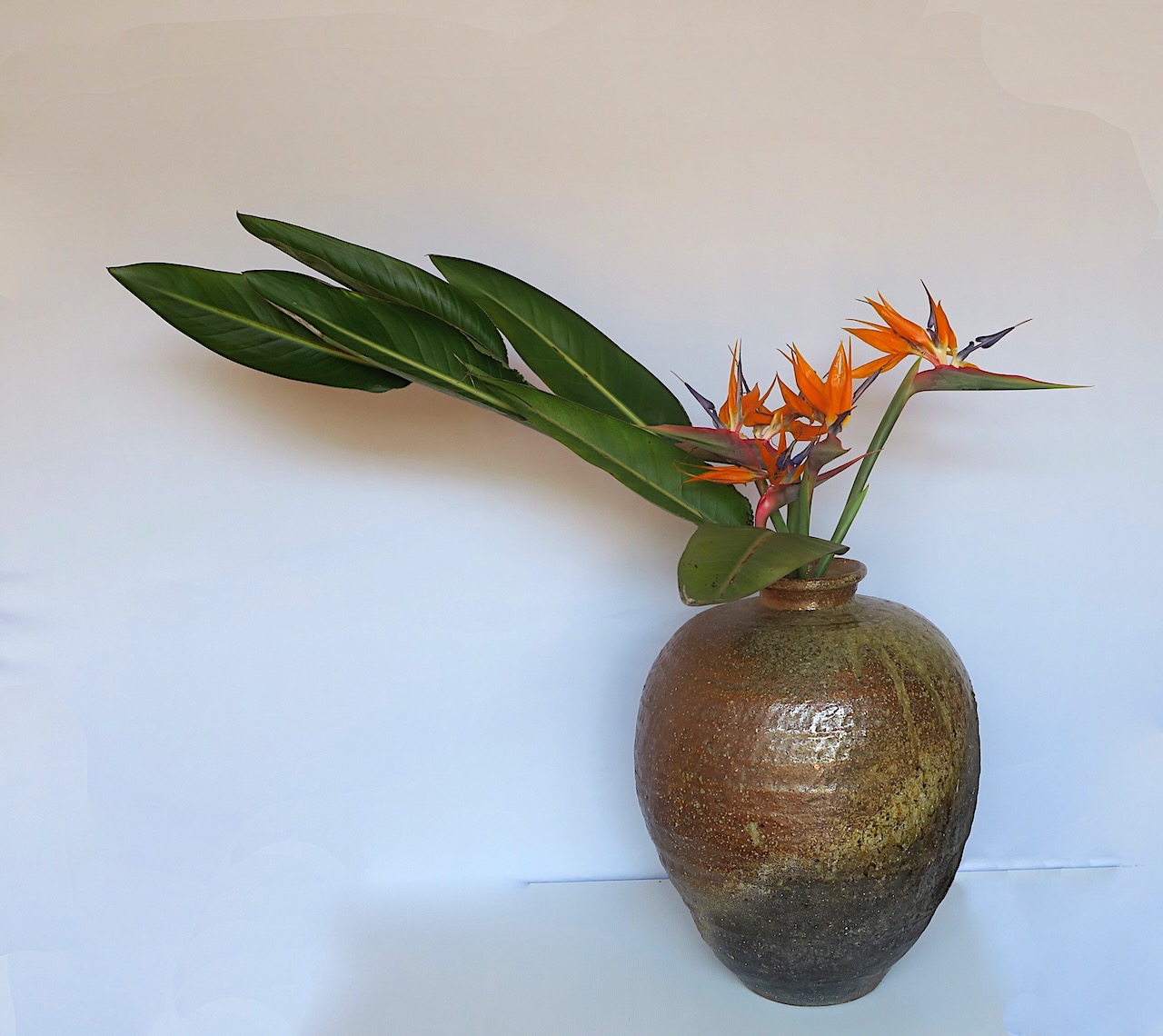
This gift was presented to Laurie but provided an enjoyable challenge for me. I took advantage of the long stems to create this ikebana in a large Shigaraki storage vessel. I massed five leaves in a line to the left. Four flower heads form a mass in the centre and a fifth flower provides a counter movement to the right. A
 sixth leaf is placed forward to neaten the mouth of the vessel, by concealing the stems of the massed flowers.


Later I re-used two of the leaves and three flowers in a suiban. I particularly like the form of Strelitzia leaves and find them very elegant. The tallest leaf is mostly seen from the back. However, at the top the leaf twists a little showing more of the upper surface. A shorter flower at the back gives depth to the ikebana while the flower on the right creates an interesting space. 
The suiban has an ovoid shape formed by a sinuous line. It was made by Graeme Wilkie at his studio, Qdos, in Lorne.

Greetings from Christopher
17th December 2023
 

IKEBANA AT HOME


I was very surprised to see a large number of under-7 and under-8 year old school children on the beach this morning. The cool wind from the south was moderate and it had made the surf quite choppy. I had just put on a rain-proof jacket as light rain had started.

The children were attending a summer program that teaches water safety, and was being run by the Surf Life Saving Club.  

It was reassuring to see that the children were being closely supervised by a proportionately large number of fully qualified surf rescue teachers as well as parents. I noticed that the program had obviously been modified for the day's poor weather conditions.

Now to the world of Ikebana. This week my Geelong students held an end-of-year social gathering, which at the last minute I found I was able to attend. The gathering was held for the first time at Jo's house and the students brought along food to share. Some of the students brought materials to set up "Ikebana at home". It is always a pleasant challenge to make ikebana in an unfamiliar environment. On this occasion I took the photographs against a plain wall so that the ikebana was easier to see.


Christine set a single Strelitzia Nicolai inflorescence in a cast iron, boat-shaped bowl. The bowl showed off the Strelitzia's subtle colours as well as its dramatic form.


Jo arranged two red-painted bare branches to which she added ropes of red beads for a "Christmas touch". The focal point included a branch of pine, a single arum lily Zantedeschia aethiopica  and a white Agapanthus.


Maree set a branch of Mediterranean Cypress Cupressus sempervirens vertically in a suiban and added three white painted dried Lotus pods and a stem of red Asiatic lily. 
  
   
Ellie used a clear glass cube into which she arranged an Aspidistra leaf below the water and a single white Chrysanthemum flower floating on the surface. A deep red glass bauble was attached to the Aspidistra stem.


I participated in the exercise also. However, I have re-set and photographed my Ikebana at home. Because of the relative abundance of Strelitzia flowers in the garden this year I was interested in the idea of making a mass with flower heads only. Using five flowers each pointing in a different direction, I set the flowers on the left side of the vessel's opening. In recognition of the end-of-year celebration and approaching holiday season, I added a sheet of gold-coloured foil. I liked the colour harmony of the foil. However, I lost the rather attractive space on that side.

The vessel was made by a friend and Ikebana colleague from Sydney, Margaret Hall who, as you can see, is also a talented ceramicist.

Greetings from Christopher
10th December 2023
 

HOME AGAIN and STRELITZIA JUNCEA

 
On Friday 24th November I was able to visit the Head Quarters of the Sogetsu School in Akasaka, Tokyo, the day that we left Japan.


From the fourth floor lobby I was surprised to see the towers of Shinjuku rising above the trees in the grounds of the former Akasaka Palace, now the State Guest House in Tokyo. A rather rare view in Tokyo.


On the fifth floor I was delighted to see this large ceramic sculpture "Do-VIII", by Hiroshi Teshigahara, the third Iemoto. I had not expected to see the warm colours of the clay body showing through on the lower part of the sculpture. 


The sculpture was set to the left of this large ikebana arrangement by Master Instructor Suikei Sakaguchi. The materials are: driftwood frame, Balloonplant Gomphocarpus physocarpus and Winterberry Ilex verticillata (a deciduous form of Holly).

Laurie and I were able to have a "farewell" lunch in the mezzanine cafe with seats overlooking the park at the side of the building. Then we caught a train to Narita airport for our return home.


Most of the days have looked like this for the past week. The photo was taken on Jan Juc beach looking west at 8.30 pm last Monday evening. It has been very strange to arrive home to the bright evenings of daylight saving. Not to mention the week of unseasonal rain. For which the garden is very grateful.


So much so that the potted Iris ensata opened late this afternoon.


And...


...the Strelitzia juncea is having its best flowering yet.


I decided to arrange two Strelitzia flowers in a shallow ceramic 1930's bowl by the Tasmanian ceramicist John Campbell. As there are no leaves to speak of on S. juncea, I added a leaf of New Zealand Flax that had started to go yellow. The leaf had a remaining stripe of green in the yellow part and its width gave a bit more substance to the otherwise bare flower stems. I bent the top of the leaf down to strengthen the mass at the top of the arrangement.

Greetings from Christopher
3rd December 2023