HOSTA and ALSTROMERIA


This week Roadside Ikebana comes to you from Ottawa. 

One of the famous features of Ottawa is the Rideau Canal which has its northern end in the city. The first of 46 locks is situated between the Parliament buildings and the Chateau Laurier (on the left in the photo). The canal links the Ottawa river, with Lake Ontario, via the Rideau River and the Cataraqui River. The photo shows the lowest lock in this section of the canal.

A short distance away is a bluff overlooking the river, where I came across a planting of materials that are indigenous to the area. The photo above shows a beautiful plant, Prairie Smoke Geum triflorum, which is just turning to seed.

Near by I was delighted to see this extraordinary sculpture which I first saw on our visit in 2014. It is called 'One Hundred Foot Line' and is by the American sculptor Roxy Paine. The artist used the natural growth patterns of trees as his inspiration and model for sculptures in this series.

Below some further ikebana from Hokkaido.

In a tsubo vessel, Eleanor made this ikebana using vine as the principal subject, with some  small Cypress branches and a single yellow Chrysanthemum.


Also, using a tsubo vessel, Aileen made this arrangement with some tall strap-like leaves, a large spider Chrysanthemum with a pinkish centre and some variegated Hosta leaves.

In Ottawa, we visited our friends Leonora and Richard. Leonora organised a gathering of ikebana practitioners for afternoon tea, and conversation about our shared passion. I gave a small demonstration of one ikebana arrangement. Being very limited in the use of my right hand, I was assisted by George.


Among the company were Gail and Wendy.


The material in the ikebana included two Hosta leaves and two stems of Alstroemeria flowers. The higher leaf shows the underside only, and the lower leaf is showing its upper surface. The main mass of the Alstroemeria is situated between the leaves with a couple of flowers below.

Greetings from Christopher
8th June 2025
 

FAREWELL TO HOKKAIDO


In Hokkaido we caught this view of Mt Yōtei, in the distance across Lake Tōya, a crater lake to the south of Niseko Hirafu, We had travelled there the day before our departure to Canada. 

In Canada the first city we visited was Toronto where we previously had a brief stay in 2018. That earlier visit left us keen to return to see more of the cultural life of the city. 

I was pleased that we were able to visit the Gardiner (ceramics) Museum. We also visited the Royal Ontario Museum and the Art Gallery of Ontario. We were also able to attend a short evening recital at ROM as well as attending a Beethoven concert with the Toronto Symphony Orchestra. 


This photo shows Laurie in front of a large concave-fronted building, which made the reflection of the flat-fronted building on the opposite side of the road appear convex.


On our second last day in Toronto, we took a ferry out to a small group of very low offshore islands in Lake Ontario, which were formed from sandbars. Since I was 8 years old I have lived on the southern sea coast of Victoria. I find it very strange to think that this huge body of water that disappears over the horizon is all fresh water.


It was delightful to walk in a less crowded place and in nature's greenery. The photo above shows a large flock of Canada geese with quite a number of goslings. The small fry seem to be being protected by all of the adults, not just the individual parents.


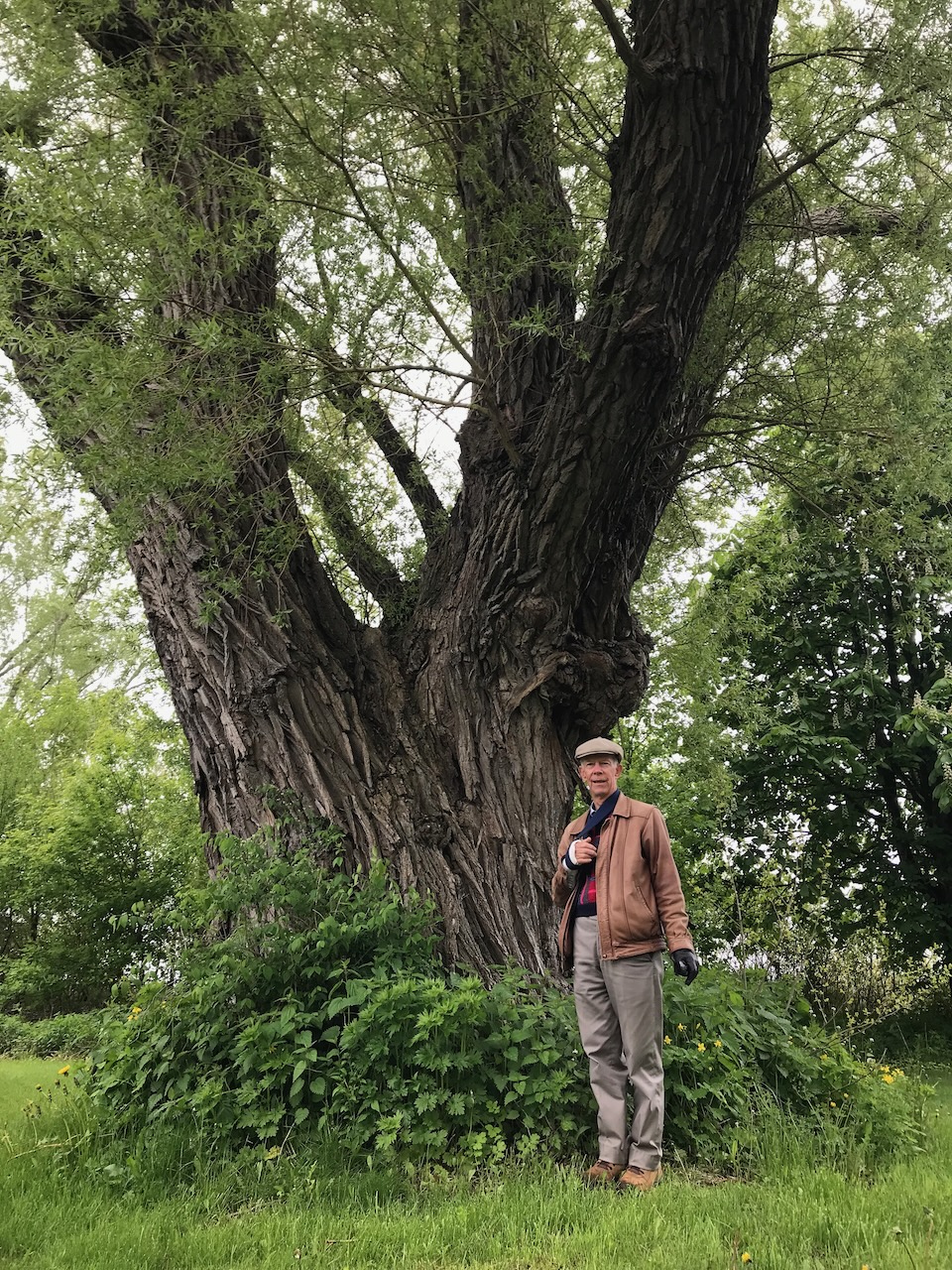
The islands are very low to the water level, but are able to support some large and obviously very old trees like the huge willow behind me in the photo.


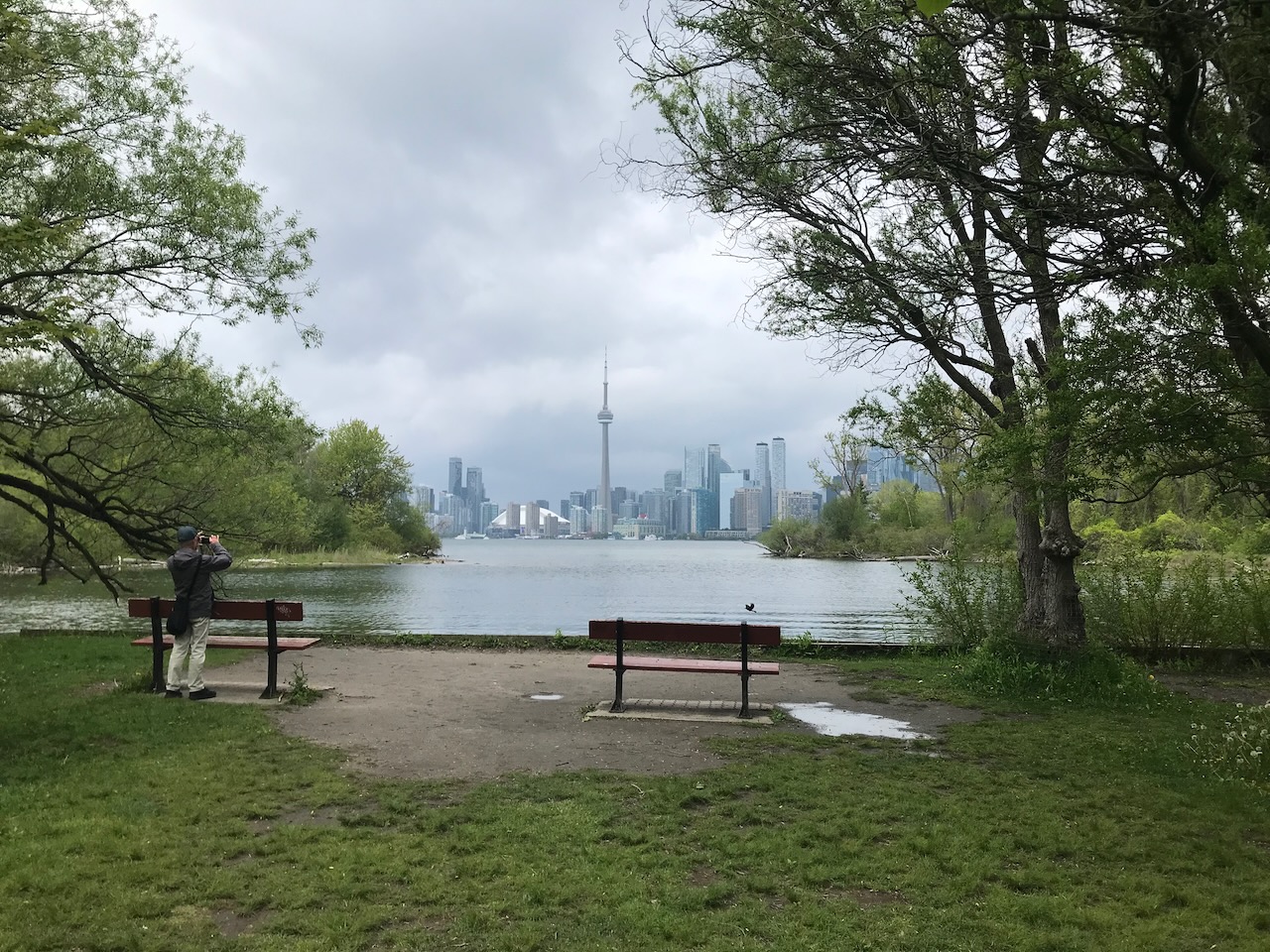
The view of the city made a striking contrast from the island.  The Toronto skyline is dominated by the enormous CN Tower. 

The following ikebana photos were made with purchased materials, supplemented with others foraged from around Niseko Hirafu a couple of weeks ago. 


Eleanor used two New Zealand Flax leaves Phormium and Wintercress Barbarea vulgaris in a shallow trough.


Andy arranged Narcissus and a large unidentified leaf in a tall footed vessel.
  

In a shallow trough, Aileen arranged Indian hellebore Veratrum viride as a receding mass, with a single yellow tulip.
 
While foraging for wild materials I came across an unidentified vine.


The vine is the principle subject of my ikebana which I arranged in a tsubo, spherical vessel. I added an unknown green branch material, pink flowers and two white tulips.


The arrangement met the criteria for the Sogetsu curriculum exercise, as one to be 'seen from all angles'. Such an ikebana needs to present a different appearance from each angle.


Greetings from Christopher
1st June 2025

FROM HOKKAIDO

This week Roadside Ikebana comes to you from Hokkaido, the most northern of the four largest islands of the Japanese archipelago.

Towering to the east of our accommodation is Mt Yōtei, 1,898m high. It is very spectacular and known as the Fuji of the north. 

Being in the countryside gave us some great opportunities for walking.

Laurie and friends on their way to an almost abandoned village and railway station.


On another occasion we walked to a crescent lake on the lower slopes of Mt Yōtei.

I was delighted to learn that there was an Ikebana International exhibition by members of the Sapporo Chapter which we attended last Sunday.

(L - R) Aileen Clarke, Yoko Uneta, Sapporo I.I. Chapter President and member of the Sogetsu School, and  me.

Below is a selection of photos from the exhibition.

This ikebana was made by Ms Uneta in an unusual Bizen vessel.

My attention was really caught by these two boldly coloured glass vases and the harmonising with the plant material colours.

This double Seika in the traditional bamboo vessel was particularly beautiful because of the expertly shaped and arranged lines of the green branch material.

I also liked this Reed and Gloriosa lily ikebana arranged in a narrow vessel. 

As you can see it was set edge on to allow increased depth.

This large group ikebana was made by members of the Sogetsu school and used three tall mirrors that made the botanical materials seem to be appearing from nowhere.

Finally, a collaborative ikebana Aileen and I made with a dried branch of low growing pine. We added some dense Cyprus for its freshness and a small bunch of white button Chrysanthemums to lift the darkness of the other materials. In the absence of a tall vessel, a glass vase was used to give height and lightness to the ikebana. The window beyond is a 'snow viewing window' that rises from floor level to about one metre so that the gaze is forced down to the ground. A stone garden lies beyond.

Greetings from Christopher
25th May 2025

ONE-HANDED IKEBANA


When I came to Nagoya for the first time in January 1992 I attended ikebana classes. My teacher was Noriko Ishigaki, who was recommended by one of Laurie's friends. As Noriko did not speak English and I did not speak Japanese, Laurie accompanied me to the class as a translation assistant. We were joined by Junko "June" Kimura who spoke some English. In addition to the classes, the four of us met socially on a number of occasions to go to exhibitions or have a meal together. Thus June became my first ikebana friend.

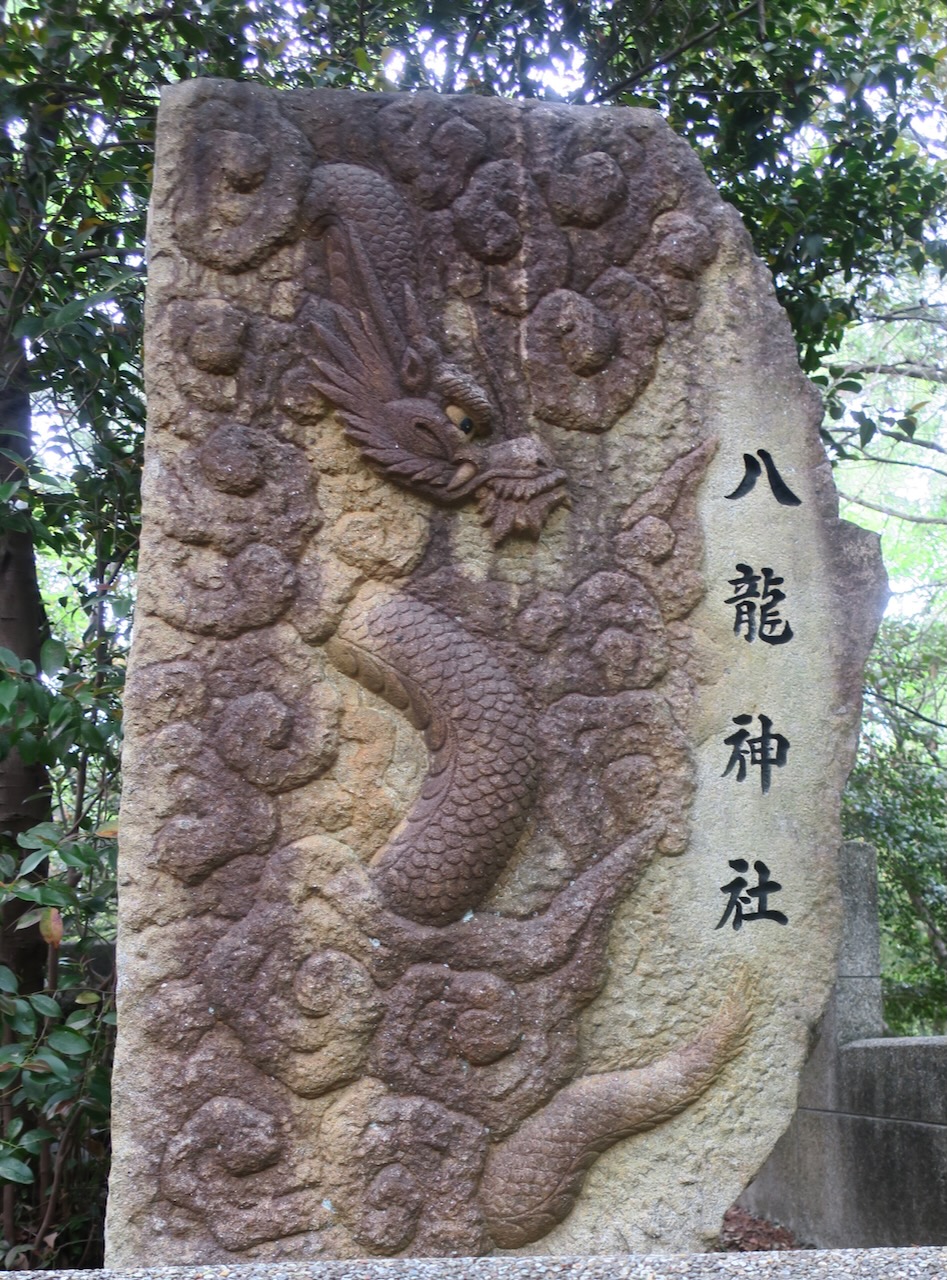
Laurie and I visited June and her husband last week and were taken to visit the small Hachiryu (Eight Dragons) Shrine near their house. The photo above was taken at the entrance to the shrine, which is set in a small quiet grove that conceals it from the nearby houses. 

This is the path in the grove that leads to the hidden shrine.

The shrine is entered through a Torii gate...

... and has this dragon image carved on a large standing stone.

Behind the shrine is a large sacred tree.

I noticed some beautiful lichen on a piece of wood in the ground nearby.

When we arrived at the house June immediately gathered a handful of small flowers from the garden and offered them for me to arrange.


This was no small challenge because I had to do so with my left hand only, having broken my right wrist two weeks earlier. With difficulty I could hold the stems with my right fingers while I removed leaves from the bottom of the stems. I was quite delighted with the graceful lines that I could show in the Jasmine vine.

Greetings from Christopher
18th May 2025
-

WOLLEMI PINE SPOTTED IN YOKOHAMA


This week Roadside Ikebana comes to you from Japan, where - to our surprise - Laurie noticed a rare Australian Wollemi Pine Wollemia nobilis. Prior to 1994 this plant was only known in the fossil record and thought to be an extinct species.

It was outside the apartment building of Yukiko, the daughter of one of Laurie's former English conversation students.

In the last class for Term One...

...Kerryn's exercise was to make a Variation No 1 of the Basic Upright style. She was not not able to procure suitable branch material so she managed with Lisianthus Eustoma flowers only.

I asked my Geelong students to make an ikebana using "Leaves only in a nageire (tall)vessel.


The main subject of Ellie's ikebana is the pair of Monstera leaves in the centre front that are interlocked. On the left are leaves with yellow colouring, including some New Zealand Flax Phormium, that has been arranged into angular lines. 


Helen has used Gymea  Doryanthes palmeri, leaves only in a large angular arrangement.
 

Maureen used variegated Aspidistra leaves which she manipulated into zig-zagging shapes as well as variegated Canna Lily Canna, leaves.

Christine used leaves from a large orchid plant that had suffered heat damage in one of the very hot days of summer. She commented that this was the first time for her to see the beauty in these damaged leaves. It is so disappointing when one of our precious plants are damaged that it is easy to only see the "damage".

Once more I am re-using some materials and a vase. 

The Gymea leaf at the front of the ikebana above, which I first  posted on 27th April, continued to change colour; so I needed to re-position it in the new arrangement below.

The new placement of the leaf is in the middle and toward the back of the work. I also added some small flowers and leaves of Coastal Banksia B.integrifolia. The pale yellow of the flowers picks up the yellowing of the Gymea leaf.

The vessel is by the Australian ceramicist Therese Rasanen


Greetings from Christopher
11th May 2025


HIROE SWEN


In preparing photos for my weekly posting I usually crop and colour-correct as best I can. I also remove distracting elements from the background of ikebana photos where possible. Unfortunately I cannot do so at the moment...


...owing to the plaster cast on my right fractured arm. I am restricted to the use of my left hand for tasks requiring fine movements. The muddy path was very slippery a week ago! I apologise for the reduction in the quality of the photos.

Last week I set my Melbourne students the task of making an ikebana in three non-matching vessels. I did not impose any additional criteria. 


Two of Marcia’s vessels had an arched top. She echoed this feature by arranging three diabetes leaves in a similar curve. Doing so also gave additional height to the Ikebana. In the right-hand vessel she added a single Hellebore flower, and in the left-hand, shallow vessel she added a white Camellia

Marisha arranged three vessels in unusual positions. A tall white vase at the front was placed almost completely horizontally. At the back, a traditional-looking vase, rested on the lip of a Bizen vase made from two slabs. She used Alstroemeria flowers in two of the vases only. 

Jacqueline arranged a single stem of Asiatic lilies Lilium in an unusual curved white vessel. Asparagus fern Asparagus setaceus, fixed in a small black bowl cascades forward over a narrow-mouthed white vase with white Alstroemeria flowers. (The background is a section of an ochre painting Moon and Star Dreaming by the indigenous artist Mabel Juli).


Eugenia arranged small bare branches in a tall vessel on the right and in a small bottle-shaped vessel on the left. To the rear and between the two is a narrow-mouthed bowl with a branch of Banksia which has three flowers clustered closely together.

The photo below is of a newly-acquired vessel from the last exhibition by the Japanese-Australian ceramic artist, Hiroe Swen.


The exhibition catalogue quotes her as saying; "In March 2024 I turned 90 and by May my life as a ceramicist had come to an end. My ageing hands and fingers would no longer function properly."

Her ceramic life began when she was 23 and started studying at the Kyoto City Crafts Institute. "The challenge of ceramics, “Born out of fire", is an endless attraction to artists, but for me after years of working on flat surfaces (oil painting and Batik textile dying) the combination of three-dimensional form and surface design was thrilling."

The vessel is from her 1984-1985  The Beach, series. The catalogue notes say: "This is one of my most representative pieces of freehand brushwork design, over multiple layers of applied glazes.'.

My ikebana this week again features re-used material.


I have re-set the "Last Hydrangea of Autumn" with a branch of Moonah Melaleuca lanceolata. I find the contrast of the soft appearance of the flowerhead with the solidity of the curving driftwood-branch particularly satisfying.

Greetings from Christopher
4th May 2025