USING WOOD in an IKEBANA ARRANGEMENT


Recently there have been some large flocks of Galahs feasting on the grass roots on the local football field. 


The largest flocks I have  seen would have been three times greater than in this photograph. I find the colour combination of their pale grey wings and pink face, neck and breast charming. Sometimes they are also quite playful in their behaviour.

The following ikebana photos are of my Geelong students' classwork.


Jo's exercise was to make an ikebana in a tsubo vase. She used Mirror bush Coprosma for the branch material and a single Hydrangea for the central mass. The fixing method she used involved the interlocking of the stems.

The senior students' exercise was to make an ikebana using bark and floral materials only.


Maureen's bark, which was very thick and inflexible, was positioned on the top of her vase. Orange Marigold Calendula were added, including one extending from an aperture in the vase. 
13/7/24: Editor's note. The orange flower was incorrectly identified, it is a Tagetes not Calendula. Thanks to Fermi for the correction.


Christine secured some curling bark on the top of a round vase, and used Pin-cushion Hakea H. laurina to create a mass within the curve of the bark.


Ellie used a tall traditional ikebana vase, setting some bark so that it cascaded down its side. Her floral mass was made with orange Gerberas.

My ikebana this week was made at the June meeting of Ikebana International, Melbourne Chapter. The guest presenter at the meeting was Mr Eijiro Fukuda, a Melbourne-based maker of traditional Kumiko (woodworking). This is a Japanese technique of  creating decorative panels by assembling wooden pieces without using nails. Members at the meeting were asked to create an ikebana incorporating wood to have relevance to the presenter's topic.


I had previously created a small sculptural structure from short lengths of Silver Birch wood. Given the nature of the material, I had joined the pieces together using dowels. This meant that the 
method of securing the pieces of timber was not visible. I positioned the structure across the top of a ceramic bottle. I then added a stem of Lemon Citrus x limon, with a green fruit still attached, and a single bloom of Brushfields Yellow Camellia.


I re-set the ikebana when I arrived home, bringing both the fruit and the flower further forward. The bottle was made by Akutsu Tadao, a ceramic artist in Mashiko. Click here I.I. Melbourne for more photos from the meeting.
 

Greetings from Christopher
30th June 2024

STRELITZIA JUNCEA


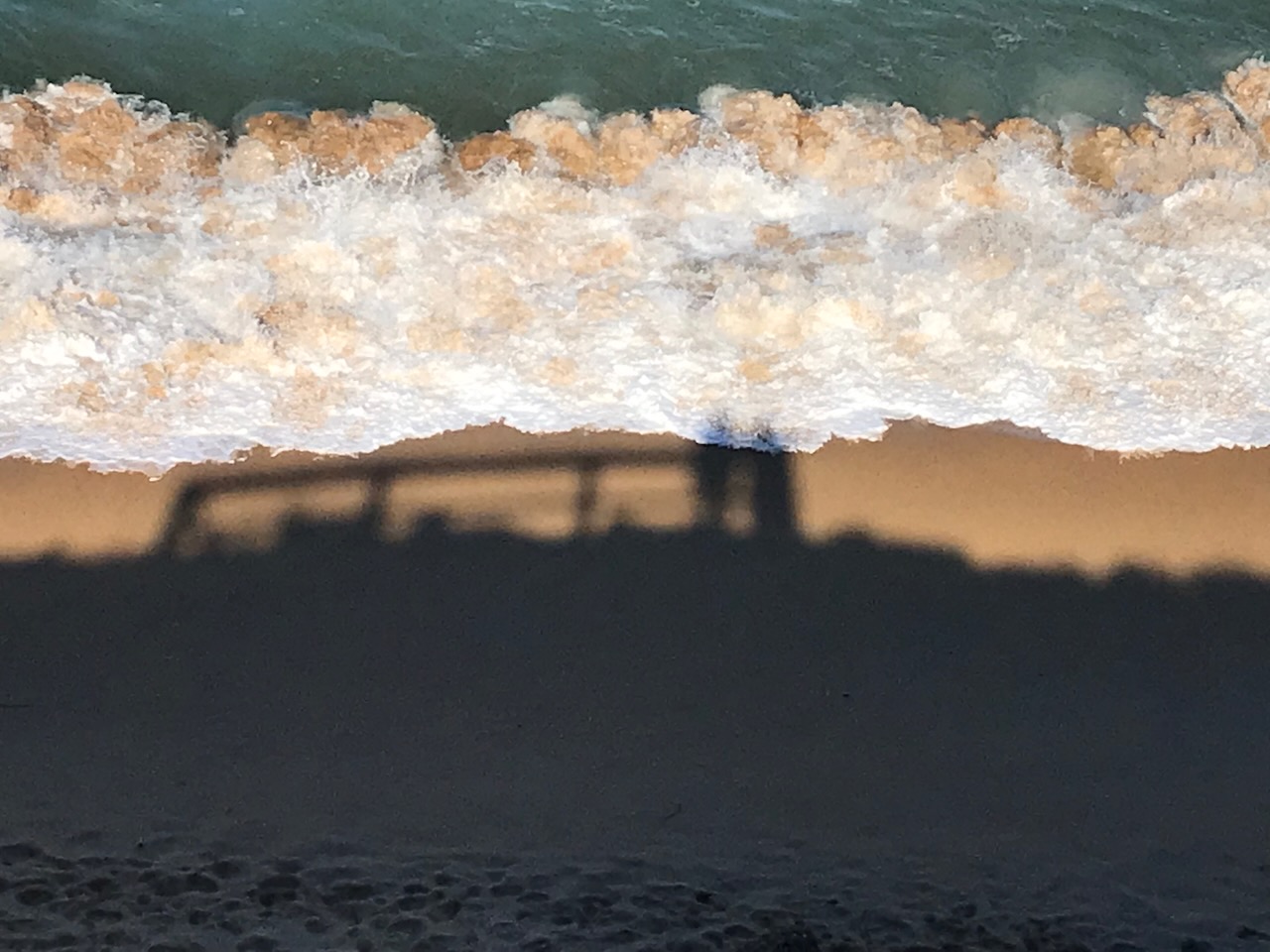
I took the photo below two months ago, on a day with cold winds and bright sunshine.
 

Laurie and I were both rugged up in warm, windproof jackets.  We had walked to Bell's Beach and, from the clifftop, looked down on the waves breaking just before they washed up on the sand. The sun behind us projected our shadows onto the beach  

Today was a similarly cool day (13 Celsius) with bright sunshine. 

In my Torquay class at the end of May I set my students the exercise of incorporating bark in their ikebana.


Róża found a long piece of bark which was able to sit securely on a flat section. Its position was stabilised by being inserted in the upright vase at the back. Two large Banksia flowers created a mass to contrast with the lines. 

Pamela brought a large piece of 'paper bark' from a Melaleuca linarifolia. The two developing infloresences are from an unidentified Banksia. Unfortunately, the photo does not show that on the righthand side the bark is 'floating' slightly above the table surface.

Norma arranged her bark across the middle of the vase and focused on the autumnal colours of the Manchurian pear leaves Pyrus ussuriensis, and Strelitzia reginae flowers.

Louise used two large sheets of quite thick bark and a similarly coloured thinner bark that was able to be coiled into a loop. She added purple Statice Limonium, as her fresh material contrast.

My ikebana this week was made at a workshop of the Victorian Branch of the Sogetsu School. The double theme was 'one kind of material' and 'to be viewed from all around'.

The material I chose from the garden was Strelitzia juncea. In the photo above it is easy to see the spear-like stems which have only vestigial leaves at the tip.

These stems are relatively soft and can be easily bent. This property allowed me to make two masses from four stems. I bound the stems together and then bent them across each other in an irregular fashion, progressively building them up into a ball. Four other stems were arranged separately, projecting long lines of different lengths in different directions. As a result the finished work looked quite different from each perspective. This is a requirement in the Sogetsu curriculum. If a work is to be "viewed from all around', it must present a different aspect from each viewing angle. 

The unique vessel is by the Victorian ceramic artist Mel Ogden.

Greetings from Christopher
23rd June 2024


WEEPING ELM


Recently, I set my Melbourne students the task of making a freestyle ikebana using large leaves with a floral focus.


Aileen used some Yuca leaves, which are tough and fibrous, to create a strong angular design. The flowers are an open Camellia and two buds.


Marcia set two Monstera leaves horizontally, one above the other, and placed a single partially-opened Peony between them.


Eugenia used variegated Cordyline leaves to create sweepIng lines above a double-opening vessel. She then added a mass of yellow-centred white Chrysanthemums to the right side.


In a white suiban, Marisha placed two Monstera leaves, the taller of which she curved back to show the veins on the underside. A cave-like space was thus created, into which she placed a pink Camellia as though it was sheltering. The only kenzan she had was black, so it was covered with white tissue. At the time of taking the photo, water had not yet been added to the vessel.


Jacqueline chose New Zealand Flax Phorium, which she set in a glass cylinder wrapped in white card. She emphasised the height of the flax by arranging it vertically and contrasted the line with a second flax leaf folded into a zigzaging line. In lieu of flowers she used three red Maple, Acer, leaves as the colour focus.

Last winter my student Jo and her husband gave me the pruned branches of a weeping elm from their garden, and delivered them to my house. The arching lines of these branches are particularly interesting because the subsequent curves of their side branches create a repeating effect. At the time of asking I did not have a specific plan for their use. However, I was confident I would eventually find one. My recent demonstration for the Geelong Gallery was the perfect opportunity.


I began with two branches, exploring ways to position them relative to each other. Their drooping ends were exceptionally long, straight and brittle, which made a purely naturalistic placement impossible. The resulting ikebana would have been too tall, and I could not transport the elements in my small car. The above photo shows a moment when the branches appeared to be twisting around each other.


However, this positioning suddenly created some new forms,. It felt like a "Eureka" moment. The spaces between the opposing curves seemed to come alive. They were filled with a dynamic potential.  


This is the final Ikebana. The two branches arise from a large ceramic 'half pillow' form. The ends of those on the left have been allowed to form sweeping lines. Those on the right have been cut straight across to the same length. Securing of the branches together has been achieved using three wooden dowels, two of which are made from bamboo skewers. In the central space between the branches I placed two short Gymea leaves Doryanthes palmeri and a mass 
of red Nandina "Nana". Both of these fresh materials will last without water for some time.

The full width of the ikebana is 2.1m and the height 1.4m.

The ceramic 'half pillow' was created by Graham Wilkie.

Greetings from Christopher
16th June 2024


BARK and BANKSIA


In Melbourne, away from Torquay's salt air and strong prevailing westerly winds, northern hemisphere plants have a better chance of flourishing.

I took this photo a few weeks ago of Japanese Ivy Parthenocissus tricuspidata, on a garden wall in South Yarra. The richness of the red and two contrasting leaves with some residual green colouring really caught my attention.


However, by the coast we are fortunate to have the much tougher Australian native flora with its often unusual forms in the flowers and seed-heads. This particular plant, Bushy Yate Eucalyptus lehmannii is endemic to the south-west of Western Australia. One of the beautiful phases of its flower development is the colour change from green to orange of the operculum before they fall of and reveal the green stamens of the flowers.

As I was taking the first photo Laurie pointed out to me the New Holland Honeyeater just below the opened flower. The black and grey feathers of the bird make it hard to see, apart from the yellow flash on its wing.

At a recent class in Geelong I set the senior students the exercise of making an ikebana using "One material only", in a nageire vessel.


Maureen used branches of Eucalyptus with leaves, flower buds, and gumnuts from the previous season, arranged in a tall metal vessel. The branches were carefully arranged and trimmed so that the lines of the leaves created a sense of movement.


Helen chose branches of 
Lemon Citrus x limon, which she arranged to emphasise the difference in the lines of the branches. This resulted in the creation of an interesting space between them. The branches included leaves, flowers and small early fruit.


Ellie used stems of Queen Anne's lace Daucus carota, (or one of its look-a-likes). The soft stems had gentle, snaking curves,  which she arranged on one side of the vase. These lines were balanced by a large flowerhead low in the right hand side of the Alabaster vase.


Maree's exercise was "An arrangement without a Kenzan". The  branch material most likely Viburnum odoratissimum, from a florist proved to be particularly difficult because of the lack of strong side stems to secure the branches. As a result she decided to revise the exercise in the next class. This is an important lesson for all of us practising the art of ikebana. Materials must be carefully chosen so that they are suitable for the particular exercise.


Above is Maree's successful revision of the exercise. This time she used bare Magnolia branches with strong side stems. The floral focus was made with two incurve Chrysanthemums.

Jo's exercise was to make a "Minature ikebana". This is not quite as it sounds. The exercise is to encourge the ikebanist to look very closely at the elements of which plants are made. Having done so, they are then required to harmoniously arrange the elements by placing them in a variety of very small vessels. This work really is difficult to photograph and is best appreciated by close inspection.

My own ikebana is the fourth photo from my demonstration for the Geelong Gallery in conjunction with the current "Cutting Through Time" Exhibition.


I came across a large piece of Eucalyptus bark, with a beautiful rich red-ochre coloured underside, while walking along the creek path. Because of its size, I chose a largish bowl-shaped vessel by Isabella Wang. The full width of the bark is just over one metre. As the bark is dry and does not need water I have arranged it so that is "floating" above the vessel. Three Coastal Banksia, B. integrifolia, leaves and flowers from the garden have been added, giving fresh life to the ikebana. The harmony with the wall behind is purely coincidental.


Greetings from Christopher
9th June 2024


THE FIRST DAY OF WINTER


The area around where we live has changed from open farm land with bare paddocks to an urban forest in the last 60+ years. The suburban development occurred in a period when garden fashion favoured Australian native plants. The consequence has been good for the enrichment of the environment and good for the wildlife that live in this area. I am particularly conscious of the much greater diversity of bird life compared to the time of my childhood.


A couple of days ago, while walking along the track by the creek, I noticed a family of 
Gang Gang cockatoos  feeding in a tree. I find it rather intriguing that these cockatoos are less disturbed by the close presence of humans compared to many other birds that we see. This juvenile male was calmly shredding the fruit of a Bushy Yate Eucalyptus lehmannii, while I stood on the path and took photographs.

In our garden... 


...I was surprised a week ago to notice that the Japanese flowering quince, Chaenomeles, had started flowering. It is rather early, which I attribute to the dry autumn with some heavy rain a couple of weeks ago. I am looking forward to there being more of these lovely flowers to make some ikebana with them.

In my Geelong class recently...
 

Jo's exercise was to make an ikebana using a glass vessel. She had brought a long Pomegranate branch with a number of fruit at the end of fine very flexible stems. The solution to the question of balancing the branch was to have the weight of the fruit within and very close to the vessel, with the branch stem cantilevered outside it.

The senior students' exercise was to arrange Autumn materials.


Maureen had also brought some Pomegranate branches. She arranged them 
naturalistically in this white vase that allowed them to hang in graceful curves.
 

Ellie made an interesting interpretation of the Autumn materials theme. Using glass box-shaped vessels she placed: Chestnuts, Japanese maple leaves (acer palmatum), and Persimmon fruit; all floating or submerged beneath the water. The vessel at the back is half-filled with water only, for the refracted images it created. 
 

Helen used a bare stem of Grape vine Vitis, three 
Canna leaves and a single Pomegranate fruit which is partially visible at the mouth of the vessel.


Christine used a couple of branches of Claret Ash, Fraxinus angustifolia, and some 
Hakea seed capsules in a large red-coloured resin vase.


My ikebana this week is one of the arrangements I made in the demonstration for the Geelong Gallery. It is a single material ikebana using the stem, flowers and leaves of Pincushion Hakea H. Laurina. In preparation I have stripped about 40 percent of the leaves from the two branches so that the flowers can be seen clearly. I have also positioned the branches so that the lance-shaped leaves are, in the main, curving upward. The lines of the stems and leaves, and the curve of the vessel, create a strong feeling of movement.

The vessel is by Graham Wilkie of Qdos Gallery in Lorne.

Greetings from Christopher
1st June 2024
 

AUTUMN TRANSITIONING INTO WINTER


The very large Liquidambar liquidambar styraciflua in the Royal Botanic Garden Melbourne was looking splendid a couple of weeks ago. There was still some green in the canopy which, by now, is likely to have changed to autumn colours.


The tree looked particularly striking against the green of the oaks in the background.


This mass of orange and yellow leaves certainly gives justification to the "ambar/amber" part of the tree's name.


I was intrigued to find this small group of leaves and a single fruit growing directly from the bark of a large lichen encrusted branch. These colours really are inspiring. However, the sight also leaves me grateful that the majority of Australia's trees are evergreen.  

*

I recently set my Melbourne students the exercise of making an  ikebana with "Intertwining materials". The exercise is open to a variety of interpretations.


Marcia used some branches of dried Tortuous Willow Salix matsudana, which were interlocked. With these providing a strong structure, she then intertwined some fine stems of Jasmine Jasminum. A single Parrot Tulip Tulipa, creates a contrasting focal point.


Eugenia used some dry branches of Corky elm around which she twined an unknown vine with long catkins. On the left side are some stems of the leafless Acacia aphylla which were twined around themselves.


Jacqueline used two New Zealand Flax leaves and some dried vine that was already twisted onto itself. She split one of the flax leaves into five and then threaded the sections into the other materials. A single Gerbera was added as a floral focus


Marisha had two lengths of Wisteria vine that were too long to be supported from a single cylindrical vase, so a second one was brought into play. This meant that the vine could be extended and intertwined without the risk of it breaking. Two Asiatic Lilies were placed toward the back to maintain the focus on the vine.

My own ikebana this week is the product of a demonstration I gave in conjunction with the exhibition "Cutting Through Time" currently showing at the Geelong Gallery (until 28th July). The exhibition focuses on the work of two Australian artists: Cressida Campbell and Margaret Preston, both of whom were influenced by traditional Japanese wood block printing. I highly recommend this exhibition if you have the opportunity to visit Geelong.


My first ikebana is a large horizontally-spreading ikebana that represents the transition from autumn through to winter (reading right to left). The materials are Japanese maple Acer palmatum, Chrysanthemum and a bare branch of Magnolia. The 
wood-fired vessel by Sergio Sill has a Shino glaze.


I made this second ikeba
na as a direct reference to a detail in one of the woodblocks by Cressida Campbell. The image is of the artist's living room which shows many paintings and prints on the walls. It also contains a small image of a very tall glass vase with a single pink Hydrangea and some material beneath the water in the vase. I was struck by the ikebana "correctness" of the image. The element below the water surface is clearly a part of the whole ikebana and there is and uncluttered "space" at the bottom of the vessel.

Greetings from Christopher
26th May 2024


ITS NOT EASY BEING GREEN *


At recent classes in Torquay and Geelong I set my students the exercise of making an ikebana using "Green Plant Materials" only. The logic of this is that Green is the predominant colour when we think about the botanical world. However, we often  focus on other colours, especially when it comes to flowers. The exercise is to encourage the ikebanist to pay attention to the many variations and textures of green.


Annie set her materials in a footed vessel. One of her materials was some current season Gumnuts with the beginnings of some maroon colouring.


Coralie used 
Bracken fern, Dietes leaves, which she interwove, and a small stem of vine (perhaps Kennedia). The Dietes leaves
were interwoven to repeat the triangular form of the Bracken.


Lyn set Pinus radiata, Olive, and Banksia. The latter was set so that the pale green backs of leaves were also visible.


Róża used two Strelitzi
a leaves as the principal subject, with Sage and a small unidentified herb. The right hand of the Strelitzia leaves had a striated appearance with yellowish bands parallel to the veins.

In the Geelong class:

Maureen used green gumnuts and Leucadendron branches. She also used some dyed Mitsumata Edgeworthia, one of the plants commonly used in making Japanese paper. This plant is unusual in that it naturally forms three branches at nodal points. The unusual branches are processed and bleached or coloured for use in ikebana.


Christine used the end of a Dracena branch, some pale blue-green salt bush and a large Philodendron leaf placed at the back of the arrangement.


Helen used only two materials. After arranging the Aeonium and then adding a mass of very fine-leafed Acacia, she realised that another material would weaken the design.


Ellie used some branches of 
Cypress Cupressus and two different types of green Chrysanthemum.


Jo's exercise was to make a "floor arrangement". She used a large branch of Silver Birch Betula pendula, as the principal material. To this she added some stems of curving Rose berries.

*          *          *          *          *


My own ikebana this week uses Hydrangeas from the garden at the end of their Autumn phase. In early summer they are white; they slowly become pink; before going green then red in Autumn. The single leaf is from our slow-growing Gymea Doryanthes palmeri, a gift from my colleague Emily Karanikolopoulos. Some mechanics were necessary to achieve the floating of the leaf across the vase opening. It is secured to a vertical stem that is anchored in a kenzan at the bottom of the vase.

The vase is by the Victorian ceramic artist Arnaud Barraud.

Greetings from Christopher
19th May 2024

* "Its not easy being green"   Kermit the Frog.