Mister Lincoln

As I mentioned last week my students and I are preparing for the annual combined exhibition of ceramics and ikebana at the Qdos Gallery in Lorne on the Great Ocean Road. The opening of the exhibition is 2.00pm on Sunday 23rd September. Below is a picture of the anagama kiln during its week long cool down phase after the recent five days of firing. We will be making ikebana to go in or with the ceramics from the this years firing.


The kiln is nine meters long and large enough for me to stand upright inside at its highest point. Here is how it looks during the firing with the main door open to feed wood into the base of the kiln. 


The simple arrangement below is of two Mister Lincoln roses from our garden that were the first buds to flower this season. I planted this bush, when we were establishing our garden about 25 years ago, especially for the sweet apple-like fragrance of the flowers.


This image of the same work on a sideboard is more accurate to the colours of the flowers. The beaker shaped bizen vase is one that I bought at Gora near Hakone last year, it was made by Ishida Kazuya from Okayama.


Greetings from Christopher (at Qdos Kiln)
15th September 2012


WATTLE and ROSES

The ninth annual exhibition of ikebana and ceramics at Qdos Gallery in Lorne, on the Great Ocean Road, will take place during the school holidays (23rd September to 7th October). I have therefore visited the gallery to talk to the ceramic artist Graeme Wilkie and recently drove around a corner in the road to be confronted by a large 'black wattle' in full bloom looking like a wall of gold and green. It was a most spectacular and uplifting sight. The tree pictured below must be at least eight metres high.


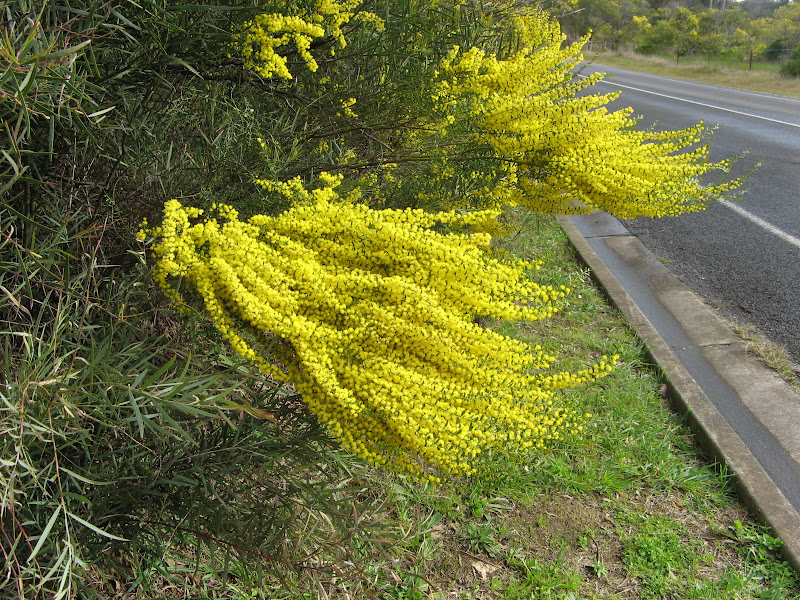
Below is a picture of an unusual wattle planted by a local resident who has a large variety of wattles. I don't think I have seen this one before and I think the long sweeping branches have great ikebana possibilities.


A couple of weeks ago I bought some orange roses to use in a demonstration for my new  students. They have a lovely touch of green on the outer petals. Here is a single bloom in a small vase I brought in Seto City, Aichi Prefecture Japan, a few years ago.


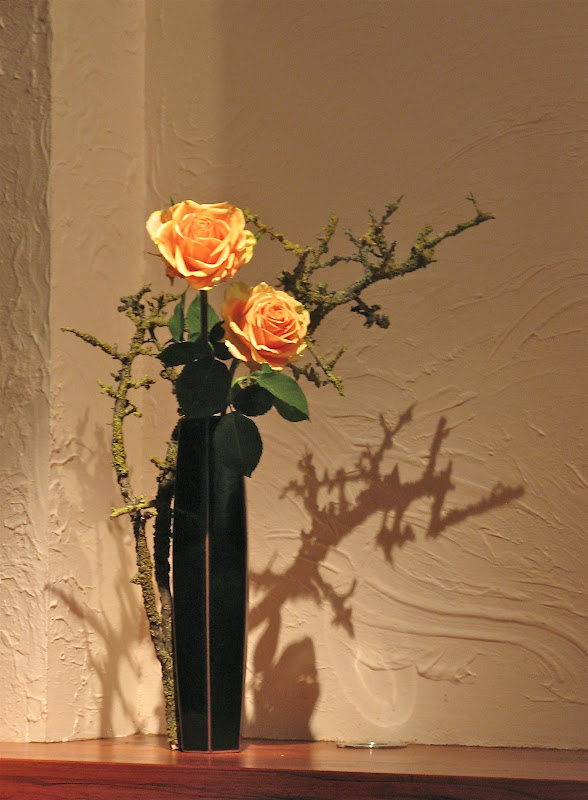
I made this freestyle using the roses and a dead boxthorn branch that was heavily encrusted with yellowish lichen. (Boxthorn is not native to Australia and is a problematic weed.)


Here is the work again after I removed a leaf on the left side that was interfering with the space created by the boxthorn. The six sided ceramic vase has a temoku glaze and is from Japan. 


A visitor really liked it on this shelf because of the shadow made by the boxthorn.


Greetings from Christopher 
8th September 2012.


JAPONICA

Recently I came across this wonderful mass of Japonica in a garden near my office. It continues for about eight metres along the fence line of a 70 year old house and is over three metres high. This  must have part of the original planting in the garden. Japonica is a joy to see in the depths of winter, having such beautiful simple flowers and delightful lines on the leafless branches.


In our garden we have a darker red Japonica, that is has finally begun to spread and have enough mass for me to pick some branches.


We now have this white one also, which is flowering for the second time.


This next photo' is a 'basic upright' arrangement, reversed. That is, the materials are placed in the righthand side of the suiban. I have added some Camellia leaves to give some mass in the centre of the work.


The correction for this arrangement is that I have not allowed clear enough spaces between the three principal lines. Also the leafless branches in the photograph disguise the fact that the right and left branches extend forward toward the viewer. (text added 5th Sept).

This freestyle below is made with a single long branch that had a really beautiful shape. I have only done a little pruning of some of the smaller branchlets to emphasise the main line. It looked very striking in this black vase at the end of a corridor.


Greetings from Christopher.
1st September 2012


SOME WORKS FROM I.I. EXHIBITION

From Wednesday to Saturday of the past week the Melbourne Chapter of Ikebana International held an exhibition at the Kazari Gallery. The works were varied being from different schools and looked lovely set against Japanese furniture, artefacts and antiques. Unfortunately, this setting made it very difficult to photograph the works and I can only show a limited selection. 

This first ikebana is my me in a vase made by the ceramic artist Sergio Sill from New South Wales. As you can see I have used the birch branches I demonstrated with in my blog entry on 8th July. I have also used 'Dancing Lady' orchids for the bright yellow that complements the vase and a single green monstera leaf by way of contrast. I think the space beneath the leaf really gives this arrangement a good feeling of lightness. 


This moribana is by Naomi Cullen from the Ichiyo School.


Eugenia Chudacek a fellow Sogetsu School member made this work in an interesting round vase which has a hole in the centre.


This work is by Qui Nguyen from the Ikenobo School.


Glenys Beissel, a Sogetsu School member, made this freestyle using some curled bark and Geraldton Wax Flower.


Jennie Stuart, a Sogetsu School member, made this double shin arrangement.


Eiko Roskam from the Ohara School made this late winter arrangement in a large suiban.


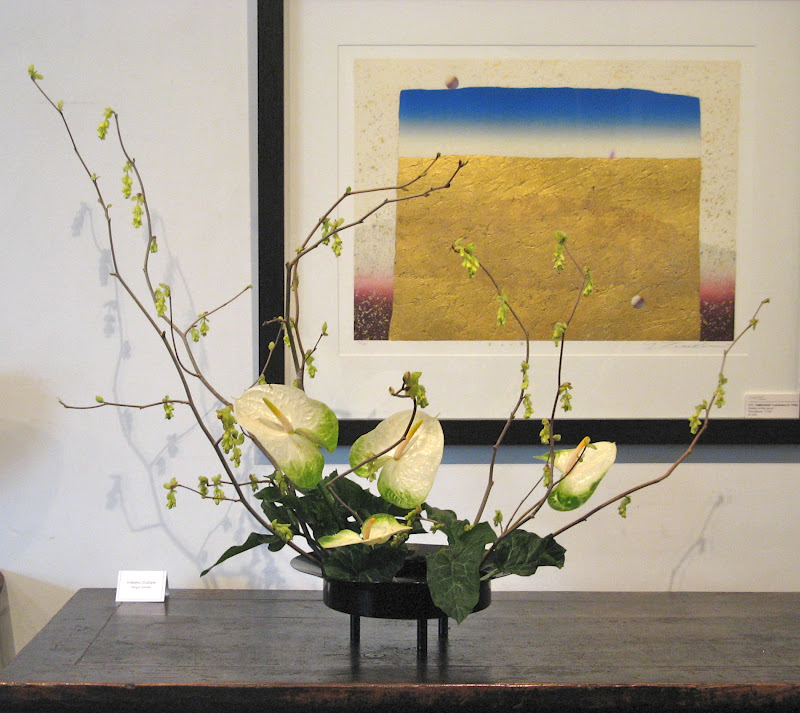
This freestyle is by Helen Novic, Sogetsu School member, using a large blackened branch, red anthuriums and asparagus fern.


This freestyle is by Joan Norbury, a Sogetsu School member, she has used a gold painted branch, Gypsophilia and exquisitely coloured dried lotus leaves in a vase by a Japanese ceramic artist.


Greetings from Christopher
26th August 2012


WAVES, WILDLIFE and IKEBANA

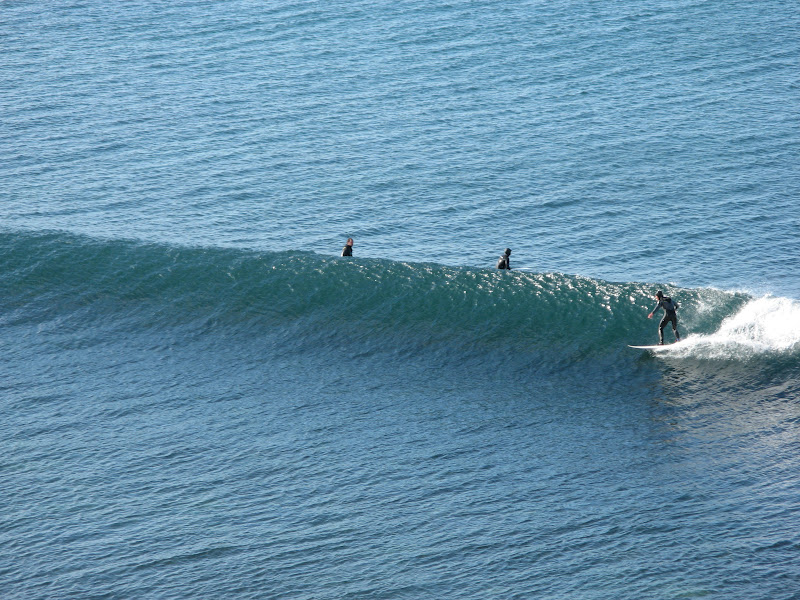
This week we have had some visitors from Barcelona in Spain. We took them to Bells Beach and to see some kangaroos. The day was really cold (10 degrees C) and felt much colder because of a strong icy wind. In spite of that, the sun was shining brilliantly.


These pictures are for the son of my friend Takako in Tokyo


Here is the wild life, observe the wattle in the background,


 and the tourists enjoying the spectacle. 


I made the ikebana below to welcome our guests. I have used some arum lilies and leaves in a circular blue ceramic suiban. The arrangement was placed on a shelf on the very left hand side of a wall in our living room. This meant that it was viewed from directly in front and from the right hand side. Paying attention to the viewing angle of ikebana becomes very important when it is placed in a room. Below is the direct front view.


This view is when the work is seen from further to the right.


I was particularly happy with the wavy lines on the edges of the leaves and the space that showed between them in the 'front' view. The right hand leaf dips into the water which looked fine in the house but not good in the photos.

Greetings from Christopher 
18th August 2012


BEAUTIFUL BANKSIA

This week my friend Heather gave me three beautiful Banksia's from her garden. They are banksia ericifolia, a native plant of New South Wales, that have large orange coloured flowers about 20cms long (see: http://en.wikipedia.org/wiki/Banksia_ericifolia). 

I have taken some close-up photo's to show you a strange feature of the flowers. Their 'styles' which connect to the seed making part are very wiry and hooked like a hairpin. This means they get caught on each other if the flowers are pressed together. Like velcro. It can be an advantage to an ikebanist wanting to make a massed arrangement! 


These two flowers are actually interlocked. 


Here is the arrangement I made with the flowers using a ceramic vase made by Graeme Wilkie.


Here it is again in the entrance of our house.


Greetings from Christopher
12th August 2012

D I Y Vase

Last week my teacher set us the exercise of making a 'vase' out of natural materials. I decided to use the bark of the tree pictured below. It is one of the Melaleucas (M. linariifolia, I think) and grown as a street tree near my office. In summer the whole tree is covered in masses of fluffy white 'bottle brush' type flowers.


I have often noticed the large sheets of bark that are shed from it especially after strong winds. These may be over a metre long and as wide as 400cms.


As you can see it grows in paper thin sheets laminated together that are beautiful shades of pale orange-pink .


I wrapped some sheets around a broad plastic tub leaving one sheet to create a loose loop on the left and curve forward on the right. I made a separate smaller cylinder that I have set at an angle inside the lower cylinder. This gave some additional height and hid the plastic tub. 


To my surprise the vase I had created was visually stronger than I had expected in spite of the lightness of the bark and its pale colour. Because of this I found placing these chrysanthemums low in the vase better than sitting higher above the rim of the vase.   

Greetings from Christopher
4th August 2012

MORE ACACIA

Since last week a second Acacia Baileyana in our garden has started to come into blossom. This is a prostrate form that has only been available in recent years. The shrub shown below has curving branches, is about 60 cms high and 2 metres across. It looks wonderful cascading down a wall or steep slope.


The photo' below shows some new branches spreading beneath some other bushes and across the ground.


Usually wattle does not last well in a vase so I have been surprised and pleased that the ikebana I made last week is still looking good. I think it is because after cutting them under water I scraped the bottom of the stems for about 3cms. I have also kept it in a cool room.

The work below is a single camellia and stem of Abelia. The small leaf in the middle of the stem picks up the colour of the flower. The eccentric vase is black glazed ceramic which I brought at the Spring Pottery Festival in Mashiko in 2011.


Greetings from Christopher 
29th July 2012