REFLECTIONS


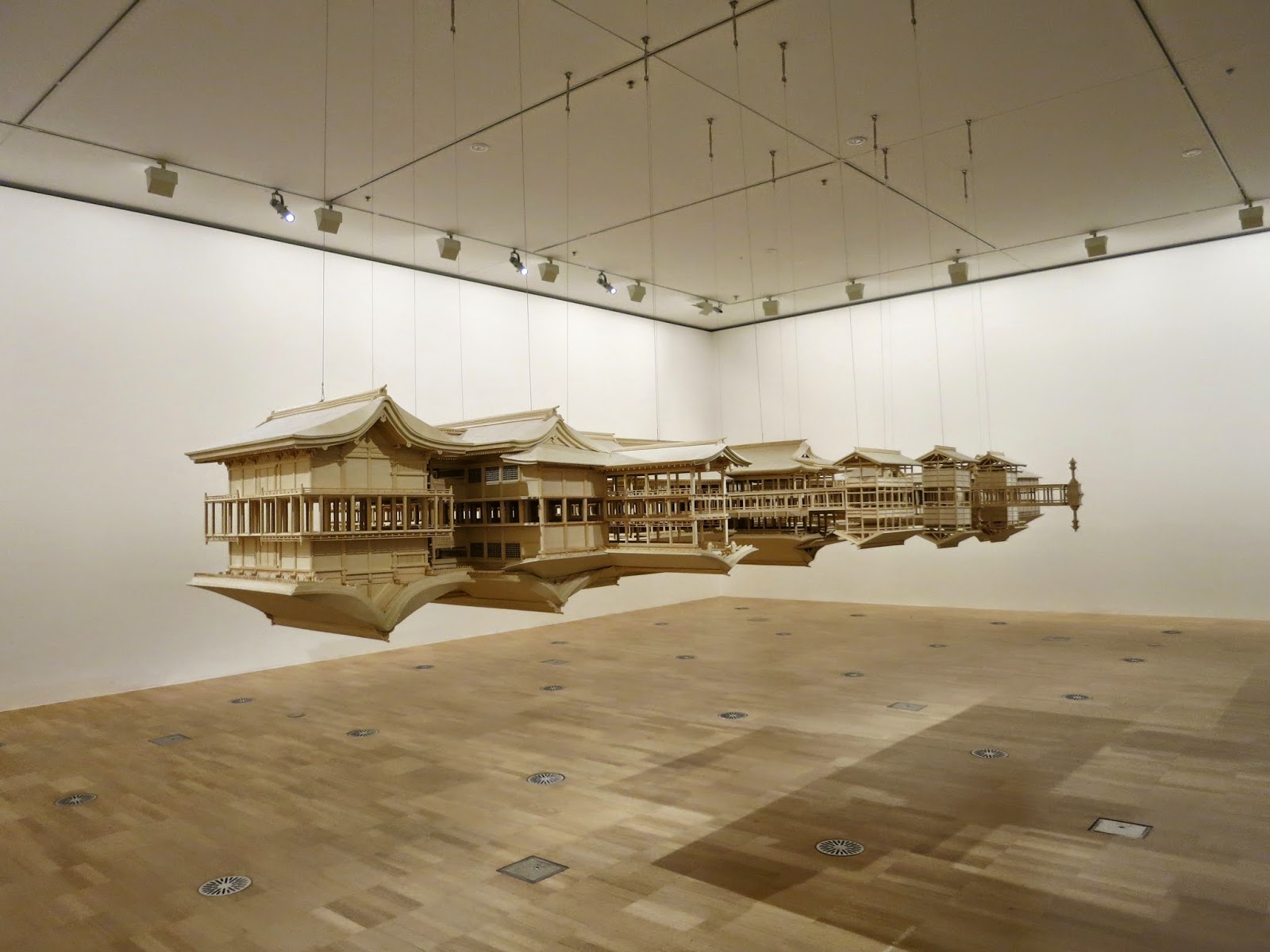
On Thursday evening I attended a viewing in the Rio Tinto Gallery, temporary exhibition hall, of the Asian Art Department at the National Gallery of Victoria. The subject of the viewing was a sculpture, newly commissioned by the NGV, created by the Japanese artist Takahiro Iwasaki *. It is called 'Reflection Model (Itsukushima)'. The sculpture is of the Shinto Shrine at the island of Miyajima in Japan's Inland Sea. Wayne Crothers, curator of Asian Art, has written an excellent essay about the work which is on the NGV website *  and spoke about the work at the event. The large sculpture floats suspended in the gallery space, revealing the shrine and its own reflection like some etherial object from another dimension.


This first photo shows the whole of the sculpture including the iconic Torii gate through which, in the past, pilgrims approached the shrine by boat. I really love the way the sculpture inhabits the space. Because it is not attached to anything, it is as though it there and not there at the same time, as though it could suddenly disappear leaving a shrine shaped void.


I visited Miyajima Island when I was in Japan in 2011 as the recipient of the Norman and Mary Sparnon Endowment Scholarship. Below are a night time and early morning photo I took of the Torii.


Next, some more general views of the shrine.


The last photo is of the reflection of part of the shrine on that day.

             *      *      *      *      *      *      *

This week's ikebana does not involve reflections. However, the space between the two vases and the line of the flower stem defines the relationship of the two elements of the ikebana. 


Two blue glass vases with pink, double flowers and leaves, of Oleander  * (nerium oleander).

Greetings from Christopher
31st January 2015

* Click on the coloured text for further information.

'RED IS THE COLOUR...'

The photo below is a Corymbia ficifolia * , growing in the street near our house. These are very popular ornamental trees because they are quite hardy and because of the intense colour of the flowers that are borne in clusters at the end of its branches. Their colour varies from rich red through orange and pink to white.


Above is a close-up photo that shows the flowers have no petals and are made up of hundreds of brightly coloured stamens. I think their colour is intensified by the sunlight passing through the stamens.


This shows the flower buds with their caps still covering the stamens.


Here you can clearly see the cap lifting. 

I associate these flowers with summer and so thought I should arrange some while I had the opportunity. I have used a spherical ceramic vase I bought from an Adelaide gallery in about 1972; I still clearly remember being drawn to it from across the room when I went into the gallery for the first time.  It was made by very skilled ceramic artist, Don Jones, who was working in Adelaide when I lived there. 


This first photo is 'viewed from above', one of the Sogetsu School curriculum exercises.


This second photo shows the flower cluster on the longer stem balancing against the mass of the vase. I have removed most of the thick leaves and carefully rotated the flower heads so that the flowers are not drooping.


Over the last couple of weeks Lennart Persson who writes the, Nordic Lotus Blog, has shown images of ikebana he has created in a collaborative exhibition with some ceramic artists in Oslo. I think his work beautifully complements the ceramics. Here is a link: Nordic Lotus * .

Greetings from Christopher
24th January 2014

* Click on the blue text from further information.

FLOWERS AFTER RAIN

This last week has seen some unusual, very welcome, drenching summer rain that persisted for a day and a half and really refreshed the garden. The rain was especially welcome because spring had been unusually dry. This evening, as I watered the garden from our rainwater tank, I was surprised to see some plants had flowered following the recent rain. 


I was particularly surprised to find an out of season Hellebore flower.


This sweet little rose grows on a wire fence. The flowers buds are usually eaten, before they get a chance to open, by possums walking along the fence. 


It occurred to me while I was in the garden that many northern hemisphere readers of this blog may have never seen the flowers of New Zealand flax (above). They are not large, however they do grow along very long stems.


This photo shows some seed pods that, as the season progresses, will become black - as does the stem. The stems with their seed pods make very striking ikebana material.

I made this week's ikebana in Florida back in October last year. It was an experiment using a vessel from my friend Michael's ceramic collection. The vase being particularly tall and having a narrow base is not very stable. 


So I thought one solution to using it would be to place material outside it in such a way that the material would provide additional support. My choice of material was not good as it was too flexible. I should have used a stiff branch. The material was a large philodendron leaf which I stripped leaving the veins only. I drew the ends of the veins together creating a circular shape. I then added a small sunflower as an accent, shown in the photo below.


Thanks to Michael for the materials and the loan of the very striking vessel.

Greetings from Christopher
17th January 2015


FLOWERING BRANCHES


This week two friends living through the depths of winter in North America have written to me following my posting last week; Lynn commenting that it was lovely to see '...growing things and bright sunshine!...' and Leonora that '...at the moment (it is) too cold to even buy flowers, they would freeze instantly!...'. I must admit to being a little shocked at the thought that flowers from the florist would freeze. The possibility had never occurred to me. It was minus 20 degrees Celsius in Ottawa at the time ( - 4 Fahrenheit). I 'take my hat off' to ikebanists who keep their passion alive under such circumstances.

Leonora sent the photo below of the view through her window. It shows another kind of natural beauty being revealed.


Through the ice crystals on the window, 
on the right is the tortuous willow in her front garden, and in the centre of the photo, a spruce in the garden of the house opposite. Here in the south of Australia we are being blessed with rain following a week of extreme heat, with serious bushfires near Adelaide in South Australia.

One of the indigenous plants blossoming here at the moment is a small tree, Bursaria
 * , which has clusters of small creamy-white flowers at the end of it's branches. I really like the odd angles that often occur in the branches that make it a good material for ikebana.


Above is a small bush I photographed this morning that is in full flower.


This next photo shows a larger tree that finished flowering a couple of weeks ago. I used some of this material to make a free standing 'no kenzan' arrangement in a shallow suiban.


To emphasise the asymmetry of the work I have used fresh, flowering, branches on one side and a bare branch opposite. This has also contributed to the open space within the arrangement.

Greetings from Christopher
10th January 2015

* click on the blue text for further information.

HAPPY NEW YEAR FROM THE SOUTH COAST OF VICTORIA

On New Year's Day I walked along the clifftop track to Bell's Beach, about 4 kms west of Torquay.


This photo is looking toward Bell's Beach and shows the heathland of low growing shrubs and grasses on the left-hand side above the clifftops. Flowers in this landscape are mostly small and only look spectacular when they flower en masse in spring. However, I had some fun taking some photos including trying to take some close-up images.


These are the fruiting bodies of the Prickly Tea-tree * (Leptospermum continentale). Although they are quite small there are so many of them the branches seem covered in the rich red berries.


A long time ago my friend Fermi identified this sweet little flower, which was growing along side the path, as Centaurium erythraea * . When I discussed it with him recently he pointed out that it is, in fact, an introduced species that has naturalised. However, he pointed out that it is not a particularly invasive weed and can fairly easily be removed. 


This prostrate Banksia marginata * was also growing beside the path. In this very exposed situation, where it is subject to strong and salty southwestly winds, it only grows as a small dense shrub. Inland it may grow to tree height.


The small stems remind me of cherry tree bark because of their colouring and shiny surface.


Another favourite is this Spyridium (S. vexilliferum) that is known locally as Propeller Plant. It is interesting to note that the silvery white 'propellers' are actually new leaves, in the centre of which is the multiple flower head.


 In the photo above a minute yellowish flower can be seen in the red circle. 

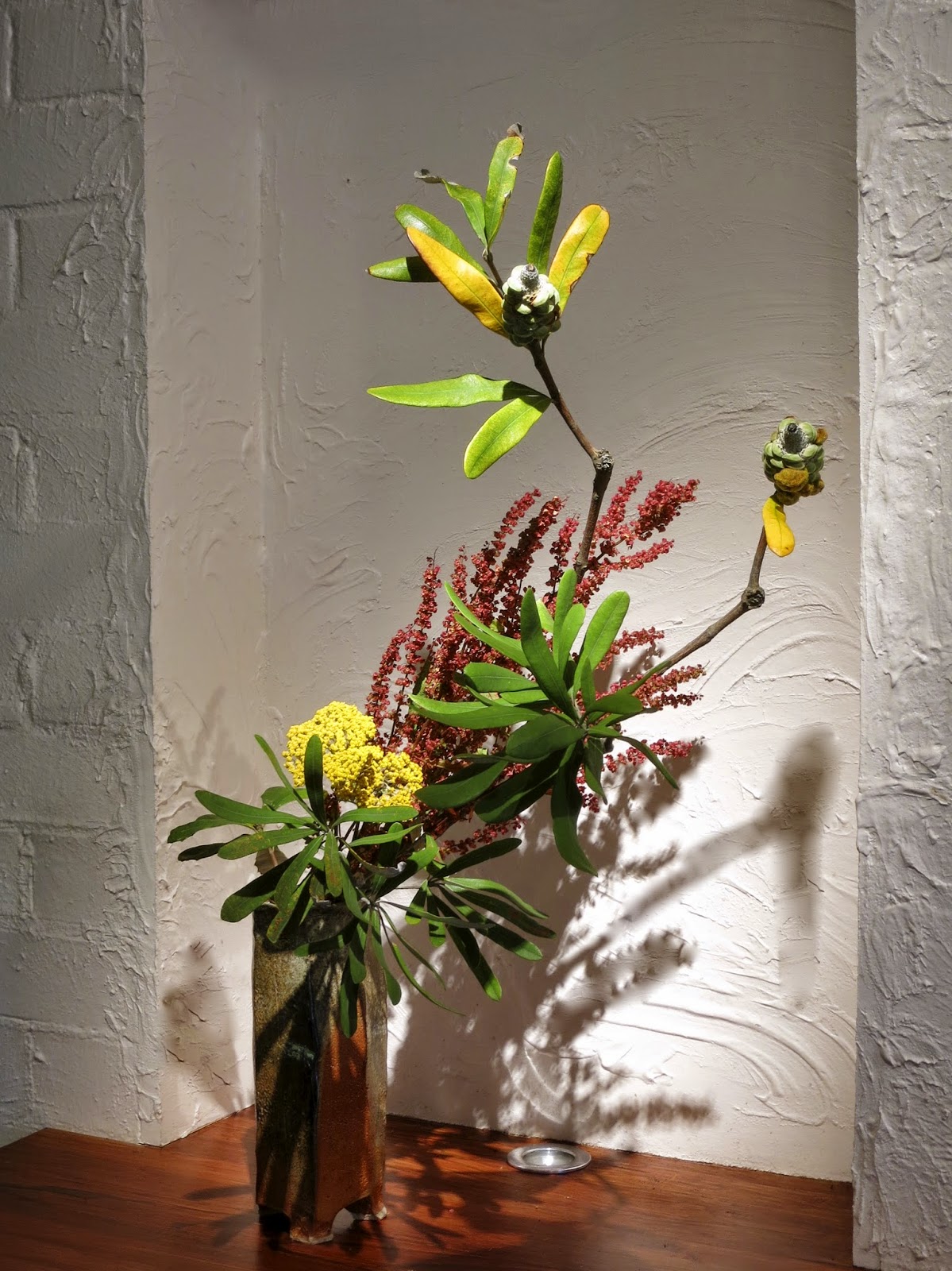
This week's ikebana has a Banksia (B. oblongifolia, [I think]) from the garden), some Dock weed, and a small yellow everlasting multi-headed flower from Western Australia. The beautiful wood-fired, Shino glazed vase is by the Canadian ceramic artist Don Goddard * from Lachine.  


Here it is again with some red and white mizukiki strings added, to wish you a happy New Year.


Greetings from Christopher
4th January 2015

* Click on blue text for further information.

COLOURFUL BIRDS at CHRISTMAS

Thanks to my friend Shirley, the un-identified pea-shaped flowers in the first arrangement (by Alana) of last week's posting, have been correctly identified as Erythrina crista-galli, (Cock spur-coral-tree); from South America, not Africa as I had said. While following up Shirley's lead, I was interested to discover this plant has been named as a potential weed * in the northern coastal regions of New South Wales and Queensland.

I do hope you have had a good Christmas. Here on the south coast of Victoria the summer weather has begun and many families have come to the seaside for the long school holidays. Among the sights I have noticed in recent days have been some beautifully colourful birds .


This Rainbow Lorikeet * was feasting on the nectar from a eucalypt in our garden.


Here are two Galahs * feeding on seeds in the grass in front of a neighbours house.


I was especially delighted to capture this photo of a male Blue wren * (malurus cyaneus)   in the heathland above Bells Beach. It is a very small bird, shy and very quick in its movements and so hard to photograph.

At the last class with my teacher, our exercise was to make a Christmas arrangement. I wanted to make something a little understated and was pleased when I found two Goddess Lilies * (Zantedeschia aethiopica). I inserted two small red Christmas baubles in the throat of each. I have arranged them with some deites leaves in matching black suibans (shallow ikebana vessels) so that they could be placed on a buffet or as a table decoration.


With best wishes and seasons greetings from
Christopher.

27th December 2014

* Click on the blue text for further information


LAST CLASS FOR 2014

We have almost come to the end of another year that has been wonderfully full with ikebana and other activities. The major highlight for me on the ikebana front, which took up a lot of energy at the time, was the exhibition to celebrate the 50th anniversary of the Victorian Branch of the Sogetsu School, 'Autumn in Melbourne*

On Thursday this week my students and I gathered for an end of year celebration. We met at my house and each person brought a gift of food to share. 


Then our ikebana activities began. The advanced students drew a number from a 'hat' which corresponded with a specific location in the house. Their task was to make an ikebana arrangement with materials they had brought and make it complement the space they were allocated. Additionally they had to work in an unfamiliar vessel that they chose from my collection of vases.


This first work is by Alana who used unusual flowers (from an unknown South African tree, see photo below) with two types of fern the massed one on the right being a form of asparagus fern. 


I photographed the tree in the Royal Botanic Gardens Melbourne this morning but couldn't find a marker with its name.


Maureen used some fine white flowers, red berries and strappy leaves in a circular vase placed on its side. 


I have re-photographed the arrangement as it was difficult to see well against the vertical blinds. 


The challenge for Christine was the confined space of this corner at the end of a long corridor. She has used a palm spathe, white painted branches and white agapanthus.


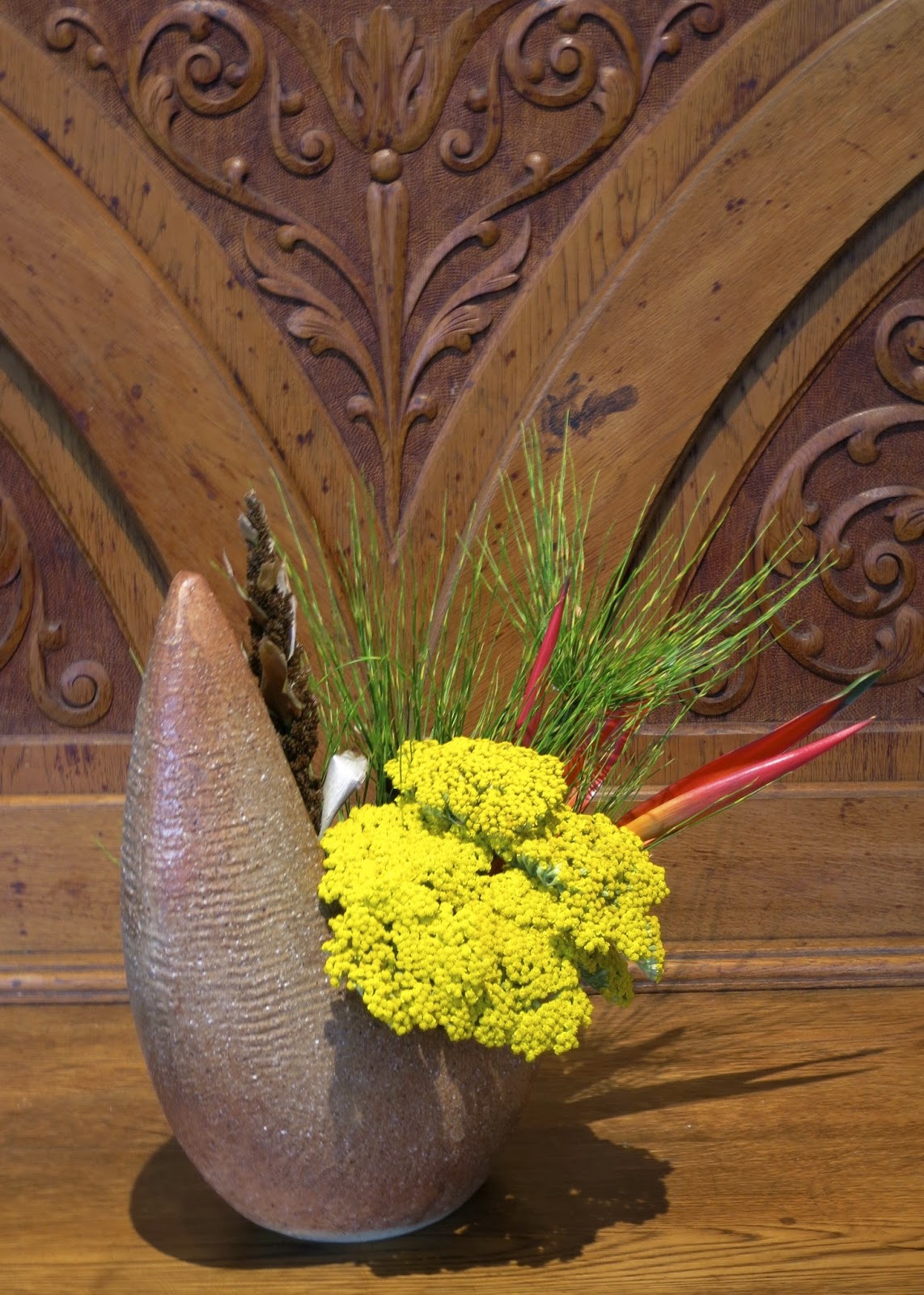
The challenge for Ellie's arrangement was the very busy background of the carved sideboard. This situation diminishes the impact of lines in an arrangement.


She massed small yellow flowers, red heliconia and horse tail in a crescent shaped ceramic vase.


I am afraid I did not even try to photograph Helens work in situ. Her location was a low glass topped table standing on a dark red patterned rug.


She used succulent fruits and two dried leaves from a 'fiddleleaf fig' * (ficus lyrata). This photo shows the work as an arrangement 'To be viewed from above', one of the set exercises from the Sogetsu curriculum.


The last arrangement is by Vivien. She has used a form of 'Sea Holly' * (Eryngium Maritimum), and for contrast a large pink hydrangea and two leaves of acanthus from our garden.

As usual we enjoyed the fellowship of our class and the joy of making ikebana with the added challenge of working in an unfamiliar location and unfamiliar vase.

Wherever you are reading this, I hope you have a safe and happy Christmas.

Greetings from Christopher
21st December 2014

* Click on the blue text for further information.

WHAT THE WEATHER BRINGS

I mentioned last week that we were hosting some friends visiting from the United Kingdom. Their visit coincided with an unusual weather event. Warm, moist air coming down the east coast of Australia was swept in a southwest flow across Victoria. This weather pattern results in easterly winds and persistent rain that will last, on and off on this occasion, for several days. From the point of view of gardening the rain was most welcome and has topped up our 13,500 litre garden water-tank.
For our visitors it was not the version of Australia they usually see on their TV screens. However, one of the interesting sights was a huge number of small bluebottle jellyfish * being washed up on our beach because of the unusually choppy seas and easterly swell.


To me the two most surprising features of these organisms are their intense blue colour and their extraordinarily long tentacles, as you can see above.


The photos above show a small number, among the hundreds, of jellyfish we saw on the beach scattered among little brown pea-sized air-bladders that have detached from seaweed in the stormy weather.

Speaking of the sea reminds me that I recently gave a class about 'focusing on water' in an arrangement. My student, Leonie, made this work in a glass cylinder using shredded New Zealand Flax leaves and a single yellow iris-like flower of dietes bicolour.


At the same class I made the work below, to show how two arrangements may be combined to create a single arrangement. In this instance I used suibans, shallow tray-like vessels, but any two vessels may be used. This work also 'focused on water', in this case the surface of the water.


Greetings from Christopher
13th December 2014

* click on the blue text for further information