A SMALL LANDSCAPE ARRANGEMENT

Two years ago at an Ikebana International meeting our guest speaker was Mr Peter Leigh, from the Post Office Farm Nursery north west of Melbourne, a specialist in hellebores. At the time I was surprised that he described these plants as being 'hardy', even drought tolerant. Taking him at his word I bought four plants. This week I was very pleased to notice that one of the hellebores was flowering, in spite of some neglect in the dryer months last year. I think the plants have appreciated the increased layer of mulch I applied recently.


This photo reminds me of the description of hellebores being the 'heroes of the winter garden'. Probably a fair description for short stemmed flowers and they do look fresh and perky. 


A couple of days later I was delighted to see these little hands pushing through the mulch. I had thought I had lost two of the original four plants, not so. I am hoping this one will be a different colour.

At the beginning of last week I attended the July meeting of Ikebana International. The guest speakers were from the Waverley Bonsai Group * , who gave a fascinating presentation about their passion. Unsurprisingly, a number of principles that guide design in the creation of Bonsai also apply to ikebana design. For example, asymmetry, pruning to reveal linesemphasis on the trunk and shorter lines at the back to give a sense of depth. I.I. Members at the meeting made small and landscape ikebana to complement the subject of the guest speakers.


I chose a small leaved native, the Costal Beard heath * Lucopogon paviflorus, that grows on the cliff tops as the material for my ikebana. This medium sized shrub has very tiny white flowers that are just beginning to come into bloom at the moment. Its form, bark and the smallness of the leaves lend it to being interpreted as a tree in a miniature landscape.


This is how my ikebana looked. I have deliberately left some of the leafless twiggy branchlets on the main stem to imply a sense of age to my little tree. More images from the meeting can be seen by following the links at: I.I. July meeting 

Greetings from Christopher
19th July 2015

* Click on the blue text for further information

CHEERFUL WINTER COLOUR

The temperature gauge was measuring 8 degrees Celsius today, a rather cool day in this part of the world.  


So I was surprised when I went for a walk along the clifftops to see a small group of enthusiastic surfers out from the beach waiting for a good wave to catch. There was little wind and an occasional set of good waves did appear.

In the garden two of my favourite plants have come into bloom.


The first is the Cootamundra Wattle Acacia Baileyana * . In the photo above, the sun was shining through the blossom making it glow.


I photographed it again today when I noticed that the rain-soaked branches hung heavily as though weighted by gold.


The second plant is the Japanese Flowering Quince (Chaenomele) that I also used in last week's arrangement. As more branches have blossomed this week I was able to make an arrangement to welcome my niece and her husband when they visited on Friday night. 


First I made an arrangement that contrasted the sharp angles of the branches with the smooth form of the spherical ceramic vessel.


I then added a sprig of wattle high in the arrangement, which contrasts with the colour of the quince blossom, but matches the yellow of the quince blossom stamens.

Often wattle blossom does not keep well when picked. It tends to dry quickly, causing the blossom to shrivel. This thin stemmed branch is still doing well after 24 hours. I cut  two thicker stems at the same time. One of which I scraped and the other I bashed, but both of them shrivelled. All of the stems were first cut under water and then placed into deep water with a teaspoon of sugar and a little bleach for a few hours before arranging.

The spherical vessel is by Don Jones, an Australian potter who worked in South Australia in the 1970s.

Greetings from Christopher
11th July 2015

*  Click on the blue text for further information.

WINTERY BRANCHES

The theme at the class I attended this week was 'Winter Branches'. In Melbourne over the last few weeks the exotic, northern-hemisphere deciduous trees have lost their leaves, and the streets and gardens where they are planted have developed a wintery aspect. This is not the case in our garden which is predominately planted with native species. However, I had recently pruned the apricot tree which provided me with some suitable branches for the exercise.


I arranged the branches in a freestanding manner in the class and added a red camellia as a focal contrast. Because I wanted to re-work the arrangement on a narrow shelf at home I did not prune the branches in the class. So, in the photo above, the centre of the arrangement is too cluttered.


The narrow shelf at home occupies a corner at the end of a corridor.


Once I started to set the branches up I realised the space was indeed too narrow and I needed to reconfigure them for this space.


The camellia did not survive the journey home. So, when I was satisfied with the branches I added some Japanese flowering quince Chaenomele * which has just started to flower in our garden.

Greetings from Christopher
4th July 2015

(Happy Independence Day to Michael and Mike, Gail and my other readers from the USA) 

The ceramic vessel I used last week is by Nadine Spalter * .

* Click on the blue text for further information

TOWARDS VISUAL BALANCE

A couple of weeks ago I posted a photo of a heron wading in the Creek at Torquay. 


This one, however, I photographed in the Yarra River in the heart of Melbourne. Black Swans are a more common sight and I was a little surprised to see it there. By chance the photo seemed to capture the gracefulness of the bird's heavy, slow-flapping wings.

During the week I went to a class with my teacher Elizabeth. She had set an exercise of 'line, colour and mass'. I wanted to use a shallow, open ceramic vessel that I had recently bought in New Zealand. I thought it would allow me to show the lines of the long stems of some orange/yellow chrysanthemums. This would then allow me to create a mass above the vessel. To emphasise colour, I decided to use additional red lines in the form of a 'stick sculpture' I had made which harmonised with the colour of the flowers.


The red sticks provide the support for the flowers, which enabled me to avoid having to use a kenzan that would have been visible. The blue vessel, which has a pink interior, contrasts with the other colours in the arrangement. 

I was not particularly happy with the original version of this exercise and felt that the elements did not relate well to each other.


When I got home I added some more red sticks among the flower heads thereby making a visual connection with the base of the arrangement.


Here is the final version of the work installed in the niche in our living room. The ceramic vessel is by  Nadine Spalter * .

Greetings from Christopher
27th June 2015

* Click on the blue text for further information

WINTER SOLSTICE

This year the winter solstice occurs tomorrow, Sunday 21st June. Winter has been busy in our garden with a number of activities, including putting down a deep layer of mulch to suppress weed growth and to hold moisture in the soil when dry weather comes in Summer. 


While in the garden yesterday I noticed that the first of the Cootamundra wattle (Acacia baileyana) *  blossoms were opening.


The tree is beside the garden path, and the photo shows the blossom buds before opening, the blue-gray foliage and dark trunk and branches.

  
Here is the prostrate form beside some of the newly lain mulch.

  
Underneath the Cootamundra this small red flower has also just started to open. 


It belongs to a low spreading shrub called Swan River Pea, from Western Australia, that I have just discovered was re-classified as (Gastroloium celsianum) * in 2002. The next series of photos shows a local Banksia (B. integrifolia) * in three phases as the flower opens.


Above is a seed head.


photographed the flowers close-up on this tree. 


On a side fence is a vine pandorea pandorana * (sometimes called 'Wonga wonga vine'). I recently had to prune it quite hard as it had grown up into a tree. The vine was fairly thick and had beautiful lines.


I thought it would make a good ikebana subject. Because this single entangled piece was so long I needed to use two cylindrical vases to support the vine and explore its lines. The arrangement is 1.2 metres wide. As a contrast I have added three oriental lilies and two buds.

I have recently learnt that 14 members of the Victorian Branch of the Sogetsu School have had their work selected for 'Poetical Ikebana' the latest publication by Stichting Kunstboek in Belgium. Special congratulations to Robyn Unglik who had one of her images chosen for the front cover of the book.


Greetings from Christopher
20th June 2015

JAPANESE DAY at IKEBANA INTERNATIONAL MELBOURNE

This week I attended the monthly meeting of Ikebana International in Melbourne. (The meeting included a tribute to a former life member of the Chapter, Mrs Masumi Jackson, who died in March.) The theme of the meeting was Japanese Day and our guest presenter was Mr Sam Ito, a chef, who gave a wonderful and informative demonstration of how to make sushi rolls, which later we all got to practise. 


I discovered the importance of moistening one's hands before handling the sticky rice (it stops the stickiness). 


The sushi in this photo was all made by I. I. members. Not too bad, I suppose, for a first effort by some of us.

Before the meeting members were encouraged to make ikebana in tableware, in keeping with the sushi-making theme. 


I decided to use some interesting dishes made by Terunobu Hirata * , some of whose pots can be seen on this link. For more photos from the meeting, follow the links: Ikebana International * June meeting.

Greetings from Christopher
14th June 2015

* click on the blue text for further information

WINTER ON THE SOUTH COAST

A further 'holiday pics' indulgence. When I down-loaded photos from my camera this week I discovered a few from our last day in Queenstown, New Zealand, a couple of weeks ago. 


I was amused by the advertising gimmick of this landscape design firm. (They weren't just advertising plastic grass).


The depth of snow at the carpark on Coronet Peak, about 20 minutes from the centre of town, was sufficient for this child to have fun throwing handfuls of snow.


We were therefore rather surprised to see snow making machines operating.


For someone not much used to snow this view across Lake Wakatipu was really splendid. I was entranced by the bright patches of sunlit snow glowing through the layers of clouds. By comparison winter is much more mild on the south coast of Victoria. However, we regard it as cold when the temperature is less than 13 C at its maximum; as was the case earlier this week.


Today I spotted this Egret * in Spring Creek, Torquay...   


...and realised this was what made these lovely patterns in the mud a few weeks ago.


This week's ikebana has a wintery feel, and is a freestyle using lichen covered seed pods of Eucalyptus forrestiana * . I am not sure of the name of the greenish flower, which is also a Eucalyptus species. The silvery looking ceramic vase is by Arikawa Makoto, a young ceramic artist who had a temporary exhibition that I saw in Tokyo in 2011. 

Greetings from Christopher
6th June 2015

* Click on the blue text for further information.

TRAVELS IN NEW ZEALAND

Over the past three weeks I have published posts about workshops I have conducted in Wellington, Dunedin and Christchurch in New Zealand. Usually when I travel I include photos about the countryside through which I travel. For various reasons this has not been possible until now. So this week I am including a link to some of those non-ikebana-related photos. Travelling in New Zealand 


Laurie and I at the first bridge on the walk to the Hooker glacier on the southwest flank of Mt Cook.


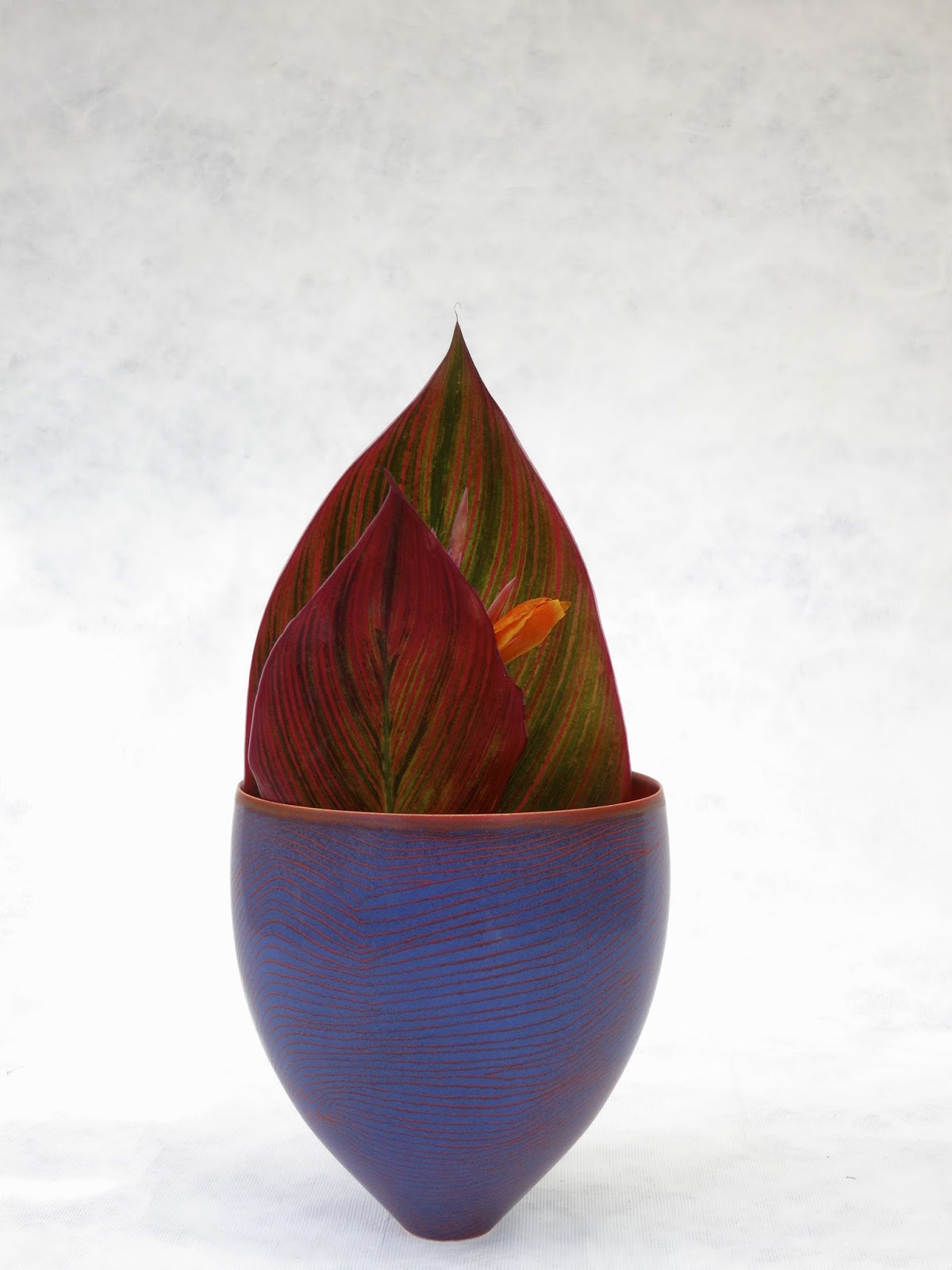
This week's ikebana is an arrangement of two Durban Orange canna lily * leaves and its orange flower bud. This ikebana meets at least three of the Sogetsu curriculum exercises: taking into account the 'shape of the vessel', taking into account the 'colour of the vessel' and a 'composition of surfaces using leaves'. Note that I have left some space between the front lip of the vase and the surface of the front leaf, as well as a space on the right hand side of the leaves.The vase is by Pippin Drysdale * .

On the right hand side of this blog I have added links to Sogetsu and Ikebana International branches in Wellington and Christchurch.

Greetings from Christopher.
31st May 2015

* Click on the blue text for further information.