JAISALMER TO AGRA

Last week, the northwest of Rajasthan was cooler and foggier than the previous two weeks of our tour. Consequently this atmospheric early morning view over Gadisar Lake, Jaisalmer.  


Gloom aside, colour is never very far away in India.


This man was watching the busy traffic at the entrance to the Jaisalmer Fort...


...and the combination of bougainvillaea and broccoli in the hotel garden was very eye- catching.


The cherry tree frieze, above, is from the tomb of Mirza Ghiyas Beg *, grandfather of Mumtaz Mahal.


As is this beautifully decorated ceiling. Painted with crushed stone pigments, lapis lazuli for example, it is still amazingly vibrant after nearly 400 years.


In the tomb of Akbar the Great *, to demonstrate the original appearance of the decoration, this wall panel in lapis and gold leaf has been restored recently .


But not the domed ceiling above in the entrance. Akbar was an enlightened ruler and tolerant of the religious plurality of his empire.


I was moved by the modesty of the unadorned room in which his grave is set.


This is the shadow of the only ornament in the room.

At last we came to one of the world's most iconic buildings, the Taj Mahal.


Here, seen through the entrance gate of the outer courtyard, it was created as the tomb for Mumtaz Mahal, the third wife, and favourite, of Shah Jahan - the fifth of the Mughal Emperors of north India.


One of the things that has surprised me in this journey of discovery in India has been the degree of two-way exchange of artistic ideas between India and Europe, over more than 2000 years. I have seen many mughal buildings with Florentine wall designs and also pillars with corinthian capitals * .


Taking this link in an odd direction, this week's ikebana is of two acanthus leaves and one acanthus flower-head.

    
Greetings from Christopher, in Agra
22nd January 2016

More Travel Photos * . * Click on blue text for further information.

FLOWERS ALONG THE WAY

In the past week we have travelled through the arid region of western Rajasthan. At a wayside stop I had a chance to photograph this large-leaved shrub that I later discovered was called Giant milk-weed Calotropis procera.


It has attractive but rather inconspicuous flowers.

Only after taking this photo did I notice the caterpillar at the bottom of the photo.


Much more noticeable in the desert was this small tree, Desert or Mawar Teak, tecomella undulata.


From the distance of our bus I thought these bright orange globes were fruit. However, at our next hotel, I found the tree growing in the courtyard where I could clearly see the clusters of orange trumpet-shaped flowers.


Above is the outer court of Castle Bijaipur. As we passed through this second gate we were showered from above with very fragrant red rose petals. A first experience for me. 


Here is the evidence after they were swept up, a little later.

I have had little time to make any ikebana, because our travel program is very full and all the gardens are exceptionally neat with very limited opportunities to scrounge fallen leaves or flowers. 


However I was inspired by the beautifully carved sandstone ramp at Castle Bijaipur, to which I added a single fallen yellow leaf. 


On a later occasion, at Jaisalmer, I found some yellowing frangipani leaves that I arranged on a sandstone balustrade with a single green leaf. 


At Nagaur our hotel is within the 16th century walls of the Khimsar Fort. 


Here I arranged Bougainvillea in a niche, using dried leaves and fresh flowers.


Greetings from Christopher
in Bikaner
16th January 2016


Click here for more Travel Photos. 


TRAVELS THROUGH INDIA: COLOUR

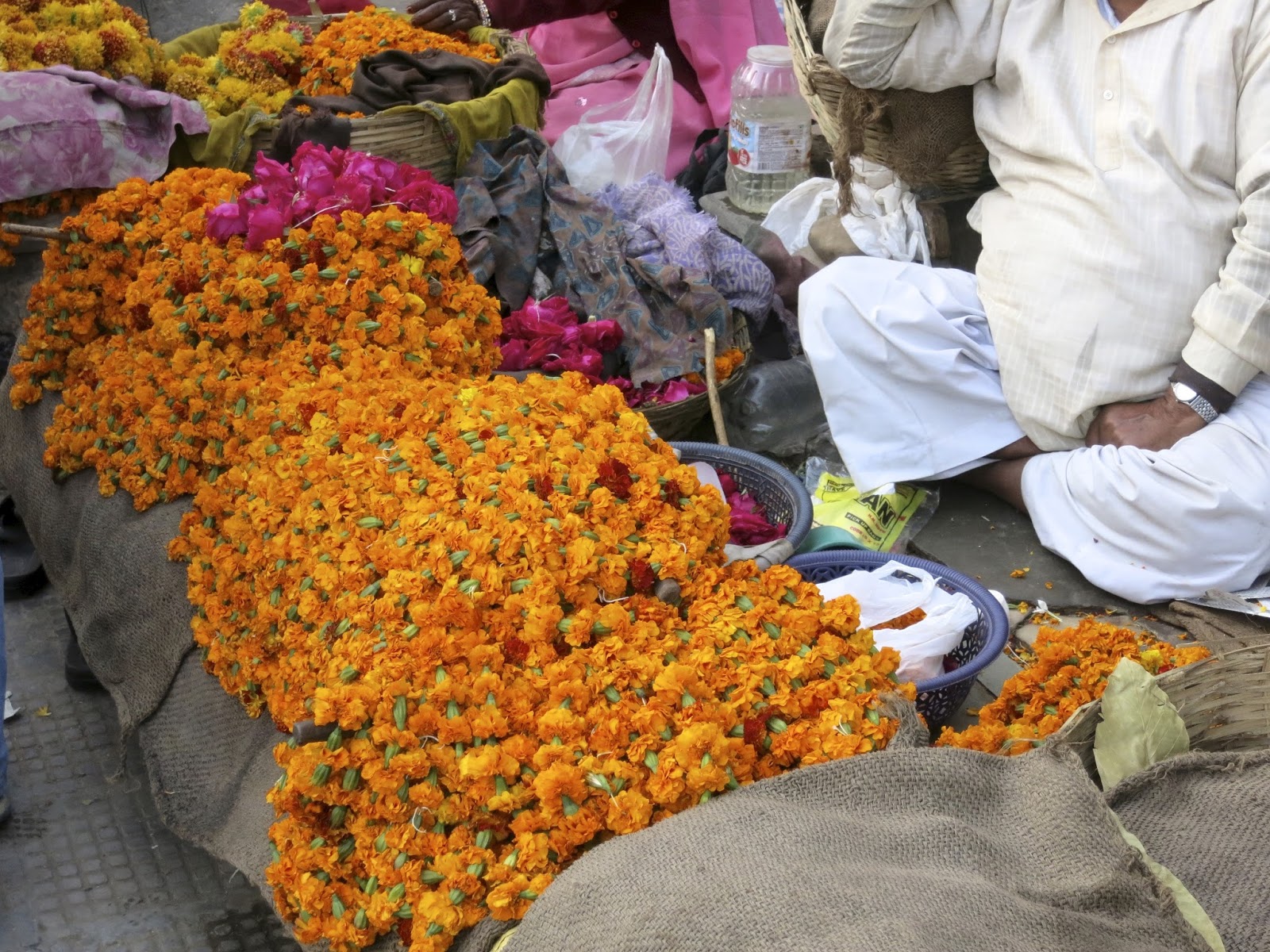
It is really not possible to walk through a market in India without being stimulated by the variety and intensity of colour, especially in fabrics. The artists who create these fabrics and garments have a unique feeling for colour combinations that westerners usually would not consider possible as harmonious combinations. The photos below offer a small glimpse of just one market in Jaipur, as an example of the wealth of India's saturated colours.


The photo above doesn't do justice to the richness of this display of shoes. When it comes to flowers as well, the impact of saturated colour also seems to be the first attraction. These two photos below are of flowers sold for offering at a nearby temple. 


They are sold strung in garlands of the flowerhead only; in this case, the intense yellows of marigolds and deep pink-red of fragrant roses. Such garlands have also been hung around our necks as we have arrived at our hotels on a number of occasions.


Here is a floral offering that greeted us at our hotel in Jaipur. I have deliberately added the slightly dried green leaf to the right of the basin to provide a colour contrast. My interpretation of this in ikebana terms is that it is a work that subtly 'emphasises water'.  Although we cannot see the surface, it is clear that the flowers are a floating arrangement. It might also, at a stretch, be an example of colours in the 'same tonal range', both of these being Sogetsu School curriculum exercises.

Greetings from Christopher.
(late on) 10th January 2016. 


INCREDIBLE INDIA

Just to explain the photos below:  this week Roadside Ikebana comes to you from India. We are on a study tour focussing on the Mughal Empire in the period 1526 to 1720. 

 
 We started the tour in old Delhi. In this photo Laurie and I are at the tomb of Humayan, second of the six great Mughal emperors. There are subtle influences of the Hindu craftsmen who worked on this building, such as the characteristic four small pavilions on the top of the building. However, the aesthetic values of Islam predominate in features such as the symmetry of the building, the distinctive arches and the surmounting dome.


In the garden of the Red Fort, I was amazed to see the aerial roots of this Banyan tree.


It reminded me of the decorative surface carving I have seen in photos of Hindu temples. With such a writhing surface it is easy to understand that people should come to believe that a tree like this is inhabited by a spirit.


In the same fort are the most beautiful white marble palace buildings with extensive use of decorative inlays.


The detail above is from the bottom left hand corner shown in the previous photo.


This weeks 'ikebana' is a flower arrangement I noticed on the reception desk of our hotel in New Delhi. I was fascinated by its asymmetry, as that does not seem to be usual in this culture.

Wishing you a Happy New Year from Christopher, in Jaipur.
3rd January 2016

SEASONS GREETINGS


I was recently advised of a website that has excellent information about the flora and fauna that occupy the transitional places along the coast of south-west Victoria, between the sea and inland. It was created by the 'Friends of the Bluff' *. The bluff in question being a feature at the mouth of the Barwon river about 20kms to the east of Torquay. On the righthand side of the website are three, free, downloadable booklets with great content and photographs. (Thank you for the information, Margot). There are similar environmental niches along the beaches and cliffs at Torquay.

A week before Christmas we experienced a dense morning fog that resulted in some lovely lighting effects on the beach.


Here you can see sunlight silvering the water while some early morning surfers wait to catch a wave.

Looking from the eastern end of the beach the sun was spotlighting the yellow of the cliffs. 

Below two photos from the O'Keefe Family Christmas luncheon organised by Laurie's sister, Margaret.


Tables set for 28 family members and friends in the Flemington Community House.


Nola's Christmas tree in a vase.

I am writing this post on a pleasantly cool Boxing Day following a Christmas Day with 35 Celsius temperatures. The heat has finished-off most of the hydrangea flowers. So the photo below is a re-working of last week's arrangement with some additional material, Bursaria spinosa.


I have used the lines of the bursaria to make an elevated focus above the vessel thereby creating the Sogetsu curriculum exercise 'showing lines at the base' of the arrangement.

Wishing you peace at Christmas-time and in the New Year
Christopher

26th December 2015

EARLY SUMMER

I took the garden photos below, over the last few weeks. They show some of the annual flowering plants at their peak.


I am delighted that the Scabiosa is tending to go a little wild-looking. Though, in fact, I removed a lot of seedlings at the beginning of Spring, before I put down a heavy layer of mulch.

These two poppies were a beacon of bright yellow to my eyes, as well as to a bee.


One of my greatest gardening successes recently has been two pots of hydrangeas that I have been able to keep well watered in the shelter of this south facing wall, which is also protected from the west. I say for the moment, because the really hot dry weather of summer has yet to come. Today we are expecting 41 Celsius, the first of the really hot weather. 


I love the fullness of these large flower-heads.  They also remind me of a huge bed of them at my maternal grandmother's house in Melbourne


Here they are in a 'one kind of material' arrangement, in a bowl by Isabella Wang that I used two weeks ago. I wanted to contrast their generous mass by the line curving to the left that accentuates the space in the arrangement.

Greetings from Christopher
19th December 2015

END OF TERM CHRISTMAS PARTY

Now that we are approaching the end of the year, my Geelong based students and I have held the final ikebana class for 2015. The class took the form of a celebration by sharing food and friendship at my house with Laurie co-hosting. The students were required to create their ikebana in our house in a location of my choosing. For the advanced students I selected more challenging locations and they had to choose one of my vessels. This meant they could not do too much planning. 

The photographs below are of the students work. The first two are by two students who began classes this term. They made the curriculum exercise: 'Slanting Varitation No 1, moribana ' using strelitzia flowers. 


Jo has skilfully concealed the kenzan with clivea leaves.


Andrea used ornamental grape leaves to conceal the kenzan. Unfortunately there is some foreshortening in these photos and as a result the proportions are distorted.


Karen created an 'Upright Variation No 1, nageire ' using New Zealand 'mirror bush' (coprosma repens) and roses. In this difficult exercise she has used a particular fixing technique for the principal branches for the first time.

The following photos are all freestyle arrangements by the advanced students who have had to adapt their work to fit into and 'relate to the space in which the work is set'. This is an advanced Sogetsu curriculum exercise.


Helen created a simplified, horizontal arrangement on a corner bookshelf using beautifully marked Gymea leaves and a single banksia flower.


Christine created a tall arrangement in a narrow space on a plinth between a doorway and a heater, out of view on the right. She used weeping elm branches and the flowers of carrot gone to seed. 


Ellie also had to contend with a narrow space on a small pedestal beside a door. Her work is in the form of a 'double shin' arrangement. 


Maureen created this straight and curving line arrangement using a cockscomb flower and leaves and the curving lines of leeks, from her own garden. The corner space is slightly wider than the others shown above and at the end of a corridor between a window and a door.

I must thank all my students for another delightful year of sharing the joys (and frustrations) of creating ikebana together.

Greetings from Christopher
12th December 2015


FOUR MASTERS - FOUR SIGNATURE STYLES

Last week I attended the final workshop of the Sogetsu School, Victorian Branch, for this year. It was lead by Lara Telford, one of the Melbourne based teachers. She challenged us to choose one of the four Iemotos (Heads of the School) and create an ikebana work based on his or her style. 

In her preamble Lara made some observations that I found particularly interesting. This included that: 

  • an artist's style is that 'thing' which makes you recognise a particular work as being by a particular artist even when viewed from a distance; 
  • that material is not the same as style; it is the way an artist uses material that reveals their style; and 
  • artists express something of themselves in their work.

I chose to take the present Iemoto, Akane Teshigahara, for my inspiration because I think two things that characterise her ikebana are, the use of abundant materials and her focus on fresh floral material. The question that arises is how do you do this and maintain a feeling for the intrinsic qualities of ikebana?


I have used some branches of Bursaria spinosa  that has masses of very small white flowers. These branches were just coming into flower, so they were not quite ready. I have added some dark mauve and white chrysanthemums and dietes bicolour. The mass on the left is balanced by the line on the right and spaces within the arrangement. See more photos from the Sogetsu Melbourne * workshop.

The deep potbellied vessel is by Isabella Wang * a Melbourne based ceramic artist.

Greetings from Christopher

5th December 2015

* Click on the blue text for further information