FLOWERS FOR A WEDDING


This morning I was greeted in the garden by the arrival of a single Sulphur-crested cockatoo. I think I startled the cockatoo while it was drinking at the birdbath. These birds usually appear in flocks but have not been around so much over the winter months. Perhaps there will be more arriving soon.


The weather turned chilly in the middle of the week and I needed to wear a windproof jacket and gloves when we went out for a walk. It was windy, wet and 14 degrees Celsius. Then I received an email from Leonora in Ottawa who said it was '...minus 14 and already lots of snow...'. Chilly is a such a subjective experience.

A few weeks ago I was asked to make some ikebana arrangements for a wedding taking place in a friend's house. The ceremony is tomorrow and today I put my plans into action to create a table-centre ikebana and a larger work on an antique sideboard.


For the table centre I arranged some prostrate banksias in a ceramic holder made by an ikebanist friend, Kid-Ching Ong. The vessel looks rather like a log or piece of curled bark which harmonises well with the banksia. As the leaves of the banksia are stiff and stand upright I have softened their appearance by curving them and catching the ends in the slits in the vessel.


The second work is a massed arrangement in a very large bowl by Graeme Wilkie that Laurie bought some years ago. I have used some branching driftwood within the bowl to fix the King protea Protea cynaroides, and arranged it with branches of Cootamundra wattle Acacia baileyana. In the photograph I have covered the mirror with a white cloth to better show the arrangement.


I chose a massed form of the ikebana  because it was to be placed on a large sideboard with a mirrored back. This meant that any lines would appear to be doubled by the reflection and the back of the arrangement also had to look good in the mirror. 

I want  to advise regular readers of this blog that since I was overseas in September/October I have not been notified when people have written comments at the bottom of the page. I have since fixed this problem, however I cannot reply directly to the writer of comments as the system protects your address. I can be contacted directly at: roadsideikebana@bigpond.com 

Greetings from Christopher
2t5h November 2018

EXOTIC FLOWERS and LEAVES


In the garden the spring growth is very apparent, especially on a sunny day like this one.


We have two varieties of strelitzia. This one above is Strelitzia reginae  and has flowered for the first time this year. I planted this strelitzia especially so that I would eventually have a supply of its beautiful leaves. The flowers are welcome also. Its growth is a little slow in our garden as it does best in a 'rich loamy soil', not our hydrophobic sand over heavy clay.


Our other Strelitzia juncea is doing very well now, after probably 20 or more years, and is almost at its flowering peak for this season. Often the flowers are damaged by late spring rain, so I was keen to pick some to make an ikebana arrangement. Last year I was not fast enough. The flowers go very well with New Zealand flax leaves so I didn't need to cut any from the Strelitzia Reginae.


This year the flax has only put up one flower spike so far. I am not really expecting more at this stage. I felt therefore I could take a couple of the older leaves from the back of the plant for my ikebana.


I have used the flax leaves to make irregular elongated loops to give a flat surface facing forward. In the arrangement the loops show both the back and the front of the leaves. The two flowers rise above the flax and face in opposite directions. Placing them in 'profile' maximises their impact. The asymmetric vase was made by Graeme Wilkie and fired in his anagama kiln in 2001.

Earlier in the week I attended the last meeting of Ikebana International Melbourne Chapter for this year.  Follow the link to see photos.

Greetings from Christopher
18th November 2018


MASSES OF FLOWERS


Spring is such a time of floral abundance one cannot help but feel uplifted.


This large mass of foxgloves and other annuals were in a flower box outside the Melbourne Town Hall on Monday last week. They were in place for the parade before the famous Melbourne Cup horse race. The race was the following day and, sadly, there were massively heavy rains that morning which left the foxgloves lying horizontally in the flower box.


In our garden the neighbour's climbing rose has cascaded through the fence. Because of the angle of the fence there is more sun on our side and therefore the blooms face into our garden.


In a bed I planted two years ago, are these other exotic flowers which I grew specifically to use when demonstrating the basic Sogetsu exercises to students. They have the advantages of being long-flowering, prolific and having straight stems.


On a recent walk I noticed some Everlasting Daisies, a native helichrysum flower, on the clifftop heath.
 

These Everlasting Daisies cephalum apiculatum, were planted in our garden two seasons ago. This is their best year so far. I am hoping they will spread further.


At this time of year the melaleucas are also in bloom. This one is melaleuca armillaris that I referred to last week as being the source of my short sticks for making the small sculpture.


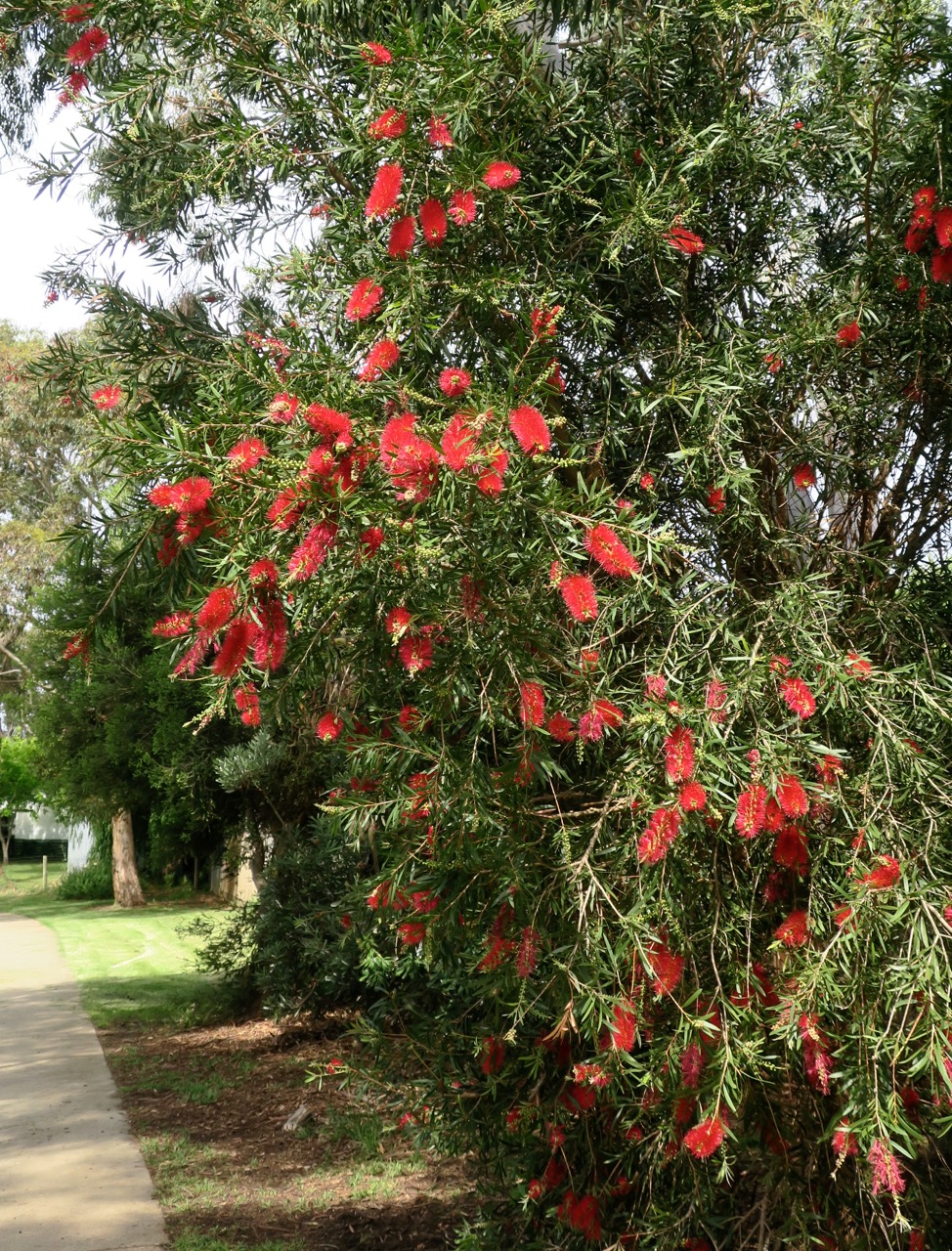
And here is the eye-catching red callistemon, closely related to the melaleucas. Apparently, some experts think they should be in the same genus. We have a couple of red callistemons in the garden.


I have used flowers from our garden for this arrangement in a blue ceramic trough. I wanted to mass the flowers to emphasise their intense red, so I stripped off all of the leaves. This left me with some interesting lines to then contrast with the mass.

Greetings from Christopher
10th November 2018


DIY SMALL SCULPTURE


After last weekend's workshops I had a chance to relax, then re-work the arrangement I had made from wiring chopsticks together to create a small sculpture. This time I used some fresh materials from the garden. I have used dieties grandiflora leaves and two racemes of tubular flowers of Natal Glory Bush Makaya bella. It is native to 'mixed forests' of South Africa.


I took this poor quality photo against a rather intense blue wall so that the form of the chopstick sculpture is clearly visible.


This photo is of better quality and the colours are more accurate. 

In re-working the arrangement I liked the idea of contrasting the flowing green lines of the dietes leaves with the irregular lines of the sculpture. 


Here is another example of this method of making a small geometric-looking design from a number of short lines/sticks. In this case the 'sticks' are from a small forest of self-sown 
melaleuca armillaris that grew in our garden. The miniature forest was in the wrong place and had to be removed, which turned out to be an opportunity to use what would otherwise have been garden waste. 

Because these sticks are from the garden they are irregular in length and thickness. I painted them red and, in this ikebana arrangement, have contrasted them with two agave leaves and a lemon. For readers of this blog with good visual memory, yes, you have seen the above photo before, in November 2013.


Greetings from Christopher
4th November 2018

Click here for posting of the Sogetsu Victorian Branch Saturday Workshop.


CHOPSTICKS (in Japanese) HASHI


At the beginning of August I set some students the exercise of making a freestyle arrangement using narcissus. These are such a popular early flower of spring which really lift our spirits at the end of winter.


Helen used a mass of yellow and orange flowers only, without leaves, with a large heavily textured piece of dried branch material.


Rather than massing a lot of flowers, Margaret made an arrangement emphasising the upright growth habit of the narcissus. She did this by cutting stems at different lengths and placing them vertically; and then created a contrasting curving line with a branch of Japanese flowering quince, chaenomeles japonica.


In a more recent class, Kyoko's exercise was an arrangement 'Emphasising lines at the base', using the strong clean lines of chrysanthemum and dried globular material. She also added a contrasting curving line that helped define the space in the left-hand side of the arrangement.


At our last class, Kyoko made this freestyle arrangement, the curriculum exercise, 'Using flowers only'. This was the last ikebana Kyoko made at my class. She is due to return to Tokyo soon having spent 4 years in Melbourne and will be missed by her many friends in Melbourne.

On Friday this week I attended a Sogetsu Branch workshop given by Ursula Pagels, the Director of the Western Australia Branch of the Sogetsu School. The exercise was to learn a particular wiring technique to make a structure from disposable chopsticks. 


Once the structure is completed it can be used in a variety of ways, including without any vase. This is my completed work to which I have added dried aspidistra leaves and dwarf nandina leaves.

Click here for photos from the workshop.

Greetings from Christopher
28th October 2018

UNCONVENTIONAL MATERIALS

   
This week I gave some of my students the Sogetsu curriculum exercise of making an arrangement using 'Fresh and Unconventional Material'. Unconventional in this context means anything other than fresh, dried or coloured botanical materials. It includes man-made synthetic materials, processed botanical materials or other inorganic materials.

The Sogetsu curriculum has a number of exercises in which the student is required to use man-made objects in ways for which they were not necessarily intended. These exercises lead the student into the discovery of unexpected qualities in the object or materials. Such creative experiments open the ikebana student's mind to also look differently and carefully at botanical materials. This means that, when they approach their ikebana, they are open to exploration and not simply using materials in ways they have done before. 


At the class Róża used partially shredded, packing cardboard, to create a saddle-shaped curtain beneath which we glimpse a cluster of small white roses in a ceramic vase.


I challenged Val by rejecting her original material and presenting her with some 'bubble wrap'. She then folded it into an open form and teamed it with a single orange coloured rose.


Helen cleverly arranged two pieces of green nylon gauze to look like a single length cascading from pandanus baskets. She has used purple statice to contrast with the green.


Kim used a sheet of black wire mesh to create this windblown form in a black ceramic vessel. He has added three gladiolus nanus at the front and two stems of them behind the mesh on the right side.


The previous week I demonstrated this exercise for the students in a modern Japanese ikebana vase. My unconventional material was rusty fencing wire that had a lovely curving form. I added a purple iris flower and two buds, courtesy of Helen.


Here is how it looked at home. 

For this exercise the unconventional material does not have to dominate, as it does in all the examples shown. However, it should not be merely a decoration but essential to the ikebana arrangement . This means that the work would look incomplete without the unconventional material.

Greetings from Christopher
21st October 2018 

FIRE GARDENS


During the week we attended a Melbourne International Festival event at the Royal Melbourne Botanic Gardens. This is a place with which we are very familiar. I remember visiting this 36 hectare garden in the 1960s with my childhood friends and the excitement of discovery that occurred with every visit.


This is a view west across the ornamental lake, which was created by closing off a bend in the Yarra River, when it was straightened in the 1880s. The western boundary of the garden shares a border with the precinct of Government House.

The nighttime festival event was called 'Fire Gardens', in which multiple installations of braziers, candles and pots of flaming wax were placed in a variety of locations around the gardens. What a total transformation of a familiar location.


This view is across the ornamental lake with the tower of Government House visible in the background. Flaming pots were set above the water in the foreground and arranged on the two large spheres seen in the middle distance.


In this and the next photo charcoal braziers were set above one of the other ponds in the garden.


Fire and water always make a fascinating combination when cleverly combined.


What we hadn't expected was the additional dramatic effect of the rather cold wind that sent sparks flying.


My favourite installation was in the 'fern gully'. Dozens of candles hung overhead and a smaller number of flaming pots beside the path cast a warm glow. It turned out to be a playful installation, as the shades were all singlets stretched over wire frames.

Experiences of art work like these installations make me think about how sometimes we may transform materials into unrecognisable forms in ikebana. However, not so this week.


Today's ikebana is an arrangement I made at the meeting of Ikebana International Melbourne this week. I have used a modern Japanese lacquerware vase I bought in Kiso-Fukushima last year. I chose this vase as the meeting's theme was 'Japanese Day'. Because the vase is unusual and visually strong, I wanted to emphasise it by keeping the arrangement small and simple. I used just two acanthus leaves and a spray of Viburnum tomentosum.

Greetings from Christopher
13th October 2018

TWO TALL FLOWER STEMS


Earlier in the week Laurie and I were walking in the Botanic Gardens in Melbourne when we came across this Gymea lily Doreanthes excelsa in flower. The plant is a favourite of mine and I have a small one in my garden, a gift of Emily Karanikolopoulos. It is such a spectacle when in flower and the flower head is wonderful in a large arrangement. However, it is the leaves that many ikebanists use more often.


Interestingly, the gardeners have left last year's flower on the plant, perhaps to allow seeds to form. I thought I should show a photo with Laurie in it to give you a sense of scale. This is not at all the tallest one I have seen.


Today, Saturday, we went for a walk in 'Iron Bark Basin' -  a nature reserve a few kilometres west of Torquay. This small hanging valley above Pt Addis beach has a forest of mostly 'Ironbark' eucalyptus tricarpa and Messmate. Both of these common names are given to a number of similar eucalyptus species.


In this view the sea is visible between the trees.


We also came across another spectacular flowering plant, a Grass Tree xanthorea. Again, Laurie provides a sense of scale.


The flower spike is covered in numerous small starry white flowers.


From the high cliffs overlooking the sea, Point Addis sits at the end of a long, beautiful and sheltered beach.

On Tuesday I attended a class with Elizabeth Angell, who had set the exercise of making an ikebana arrangement for a specific place.  Earlier in the day I had raided my sister-in-law's garden where I had found a beautiful 'White myrtle' hypocalymma angustifolium, from Western Australia. It is a low bush with arching branches that were covered with rich pink buds that opened to white flowers and small narrow leaves. 


The space I had chosen is a low 'entertainment unit' with a painting above that constrained the height of the work. Above, is the ikebana as I made it in the class. I added three looped dietes leaves to one side to emphasise the sense of asymmetry and movement.


Here it is in situ on the unit underneath the Moon and Star ochre painting by the indigenous artist Mabel Juli


As you can see, I also added a single pink camelia to give the ikebana a more solid mass near the centre to ground the work. The celadon vase is by Anne Geroe.

Greetings from Christopher
6th October 2018