A DIFFERENT APPROACH


Early last summer we planted some new Correa bushes in an area of the garden that had become rather bare as older plants reached the end of their natural lives. These Correas are fairly small shrubs and make good ground covers under the partial shade of some larger trees. Although most of these are cultivars we are happy to have the new additions to our garden which also has indigenous Correas which are not bothered by our hydrophobic sandy soil.

The following photos show first the rather small bush, then the dainty bell-shaped flower belonging to that bush.


The protruding stamens from this flower create a colour contrast to the pink of the flower.


This bush has been planted by the garden path where it is filling in an empty space left by an earlier shrub.


The more open flower on this bush is the most open of the new plants and is less pendulous that the others, allowing the centre of the flower to be seen. 


As you can see with this orangey-coloured flower, the inner side of the petals are much lighter.


The same is true of this pale pink flower...


...which also has reflected tips to the petals.

Now to ikebana. A month ago the Victorian Branch of the Sogetsu School held what has turned out to be the last meeting prior to the regulations against gatherings of people in groups. The theme of the meeting was the Sogetsu curriculum exercise of making ikebana 'Taking into account the shape of the vessel'. 

Unfortunately our presenter Aileen was unable to attend the meeting and, at short notice, I had to do the demonstration. I was able to show photos of two examples that Aileen had prepared in advance which are on the Victorian Branch website, (16th March 2020).

My thinking about this was that the two most obvious options would be to contrast the ikebana with the shape of the vessel or to complement the shape of the vessel.


In my first demonstration example I have contrasted the round shape of the vessel with a geometric design of straight lines made with agapanthus stems. I used the spent flowers with seeds removed to create a focal point in the work. Using just green material has also contrasted strongly with the black of the vessel.
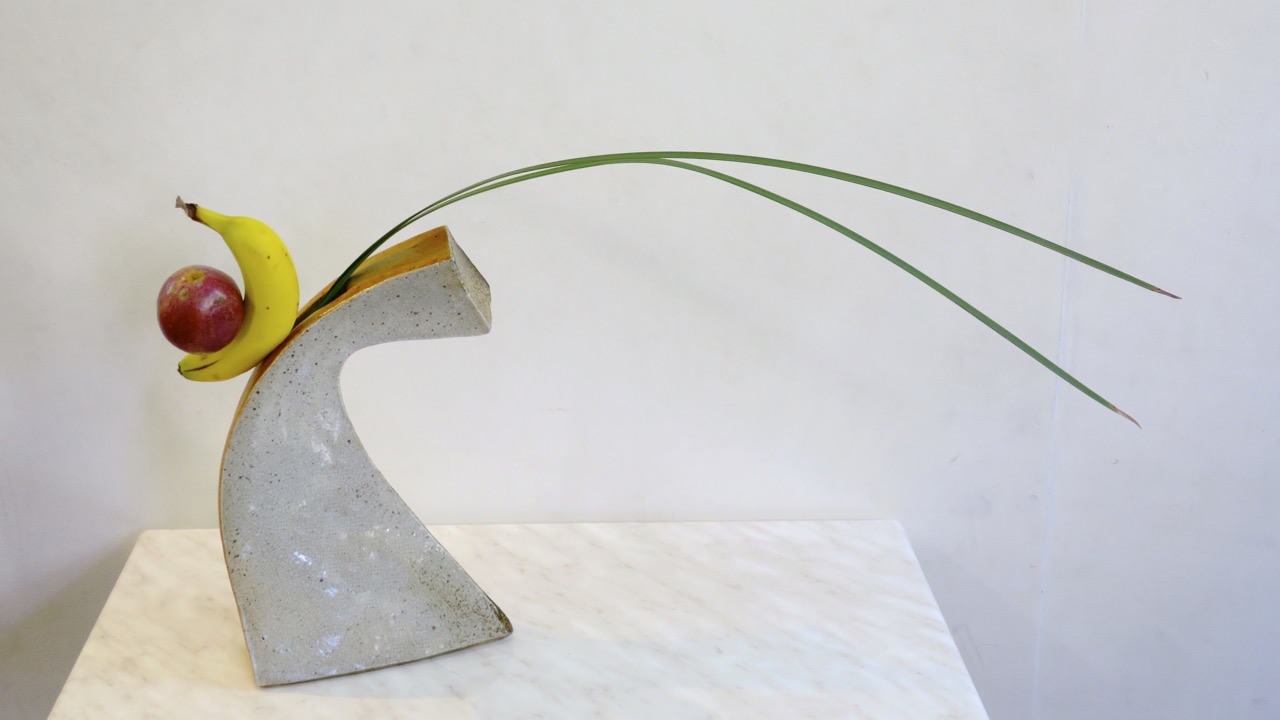


In my second demonstration I have complemented the strong curving lines of this unusual vessel. The banana and passion fruit emphasise the vessel by make curving lines that move in the opposite direction. I had actually tried to make the two dietes leaves curve the same way as the banana. However, they would not cooperate so I quickly changed my plan and followed the curve of the vessel.


I was particularly interested to see the ikebana by Akemi Suzuki, above. She took a different approach. She used a round red glass vessel with a closed top and a hole in the side. She arranged her materials to appear to be issuing out from the side of the vessel. This is yet another way of interpreting the theme: 'Taking into account the shape of the vessel"

Greetings from Christopher
19th April 2020


AUTUMN PINK


During the last couple of weeks we have had some days that were quite warm and dry. I have taken advantage of the weather to repaint the garden bench and the table on the terrace. Yesterday, I managed to paint a small deck at the back door before the rain that arrived overnight.


On one of the warmer mornings Laurie and I had a walk on the beach before breakfast. I took this photo of a rock pool in a cave that passes right through a large rock at the end of the beach. The water from the previous high tide was still dripping from the roof of the cave.


In the garden a Japanese Windflower anemone huphensis has flowered for the first time. It was a given to me by Margaret L., an ikebana colleague. The flower is very small probably because the soil is so poor and I planted it in the shade to protect it from the summer sun. 


None the less, it looks charming like its common name.


One of the last Lorraine Lee roses to escape the ravages of the possums this year has just opened. Its survival can be attributed to being on the end of a long thin branch that could not support the weight of a possum. And the Albertine rose, which is being buried by a pandorea pandorana vine, has produced an out of season autumn flower. 


I decided to use these flowers in a small arrangement on the dining table because their fragrance is so beautiful. By placing the small black egg-shaped vessel on a larger celadon platter, the soft pinks had a more suitable background than the wooden table surface. For the purpose of the photograph I have put a white card underneath the platter. 


The Hydrangeas, which I have to grow in pots, have started to take on their autumn colouring. This one, above, has a large pink flower when it first comes out it then slowly goes green and then develops autumnal colouring. Last week I used one of the unexpectedly-late-forming fresh pink flower-heads with some of the fading flowers. Today I picked the last of the fresh pink flower-heads and arranged it with the blue-grey foliage of the Cootamundra Wattle Acacia baileyana. 


I have created a horizontal ikebana with these materials in a large slab-construction vessel made with soft-pink marbled clay. The ikebana is dedicated to the memory of Doreen Schofield, a Sogetsu practitioner who studied with Norman Sparnon in the early days of his teaching in Melbourne. Doreen was an active member of Ikebana International Melbourne for 55 years and a committee member for 39 of those years. She donated many of her ikebana vessels to Ikebana International and the one shown was from her collection. The vessel was made by the New Zealand ceramicist Keith Blight.

Greetings from Christopher
11th April 2020


FRESH AND FADING FLOWERS


While we were having a mid-morning cup of tea today we were visited by a pair of Crimson rosellas. 


They came into the garden to feed on the seeds of the Rosemary Salvia rosemarinus bushes.


These are adults, the plumage of juvenile birds is mostly green.

It was warm and sunny a couple of days ago, so we took our daily walk in the Ironbark Nature Reserve.


This view through the trees is on elevated ground and in the distance the sea is visible.


Further along the path, the conspicuous headland of Point Addis, about two kilometres away, was bathed in sunlight.

I was curious to see what wild flowers would be out as we are now into autumn.


This is a small patch of Common Heath Epacris impressa, the floral emblem of Victoria state. It can be anything from white through to a rich red. 


Nearby was another bell-shaped flower, Correa reflexa. Correas are a favourite indigenous plant and we have a number in our garden.


Above is a particularly healthy looking bush in full flower that was beside the path. 

In these days of physical distancing and our government's instruction to 'Stay at home' I have noticed that many ikebanists have taken to sharing their passion for ikebana and the botanical world on-line. I can only approve, having started my weekly blogging 9 years ago when I was in Tokyo as the third recipient of the Norman and Mary Sparnon Endowment scholarship.

In recent days I was pleased to receive these photos from two of my students.


Eugenia took this photo of a Dahlia beginning to open...


...... and here it is fully opened three days later. What rich colour.


Marisha created this freestyle slanting arrangement with garden 'prunings'.

In the garden at Torquay I had noticed a couple of late-forming pink Hydrangea flowers; and was pleased that the first came into full bloom before the onset of colder weather. On another bush, the old flowers had started to develop autumnal colour. I decided to use both in one ikebana because of the interesting contrast between the new and fading flowers. When I picked two of the old flowers I also noticed the leaves colouring beautifully. 


I arranged the two fading flowers with the fresh pink one and a twisting Moonah Melaleuca lanceolata branch in a tall woodfired ceramic vase by Graeme Wilkie.

I was somewhat frustrated and dissatisfied with the result. It took a little while to realise my mistake. My original intention had been subverted because I was distracted by the beauty of the leaves. They were not the intended subject and the contrast between the two stages of the flowers had been diminished.
  

This is the second working of the materials. I think this ikebana is more harmonious and stronger. The contrast between the two stages of the flowers is much clearer.


Because I placed the ikebana in the niche in the living room it is seen through a wide angle. I have rotated the vase to show this view from the righthand side, which is usually the first view of the ikebana. The fresh new flower becomes the principal subject and the autumnal colouring of the other two flowers is revealed slowly. Usually, I think that to be successful ikebana should have only one principal subject, idea or focus.

My good wishes go especially to the members of the Wellington Branch in New Zealand where I would have been today had our circumstances not been changed by the Covid-19 virus.

Greetings from Christopher
4th April 2020


(almost) ALONE ON THE BEACH


8.30 am Saturday 28th 'social distancing' on the beach. 


I didn't really need to stand on the rocks to avoid the crowds. It was just fun to watch the waves surging through the tunnels under these rocks. 

I suppose in other parts of the world there may be other expressions for maintaining distance between people to prevent the transmission of the Covid-19 virus. We are now required to stay at home and not engage in unnecessary travel. Fortunately our home includes a garden. Exercise away from home, for example walking along the beach with members of one's household, is permitted. 


Earlier in the week we noticed this Gang gang cockatoo feeding in a small tree by the side of the path. Compared to most other wild cockatoos they are surprisingly unafraid of humans and it is fairly easy to get a close-up photo of them.


I took this photo of one of the three Haemanthus coccineus flowers in the garden ten days ago. My neighbour, who gave me this plant, is a skilled gardener. She grows further Haemanthus plants in pots from the seeds she gathers from the spent flowers.  


This is the sight that greets you as you walk down the path beside her house. Very uplifting during the flowering season.


One of the plants from Canada and northeastern USA that delighted me, when I first came across it in 2014, was Golden Rod Solidago. This particular patch above was in the Herbaceous Border of Royal Melbourne Botanic Garden and photographed at the end of January. So lush and exuberant looking.


This morning I photographed the more modest clump in our garden. This is its third season in the garden and it has flowered without being seriously battered by the dry heat of summer. As you can see, both Haemanthus and Solidago can survive in our garden. However, it is a struggle because of our hydrophobic sandy soil. They have shown me that they are tough plants and rewarding to grow. I decided a couple of days ago that I would use the Solidago as an ikebana subject.


I have created a freestyle ikebana using three flowering stems of Golden Rod. To emphasise the yellow of the flowers I have added two orangey leaf clusters of umbrella grass cyperus alternifolius, and one green cluster at the back. The radiating lines of the umbrella grass compliment the form of the creamy white spherical vessel. It is by the Tasmanian ceramic artist, Sallee Warner.


Finally a special 40th Birthday greeting to members of the Christchurch Branch of the Sogetsu School. I wish I could have been with you as planned.


Greetings from Christopher
29th March 2020


AN EVERYDAY OBJECT


My Torquay students attended their final class for this term in the week before last. The theme for the class was to make an ikebana arrangement using 'An everyday object' as the vessel. The 'everyday object', in this case, is something that can be found around the house. This is an exercise from the Sogetsu curriculum that challenges the students' preconceptions and requires them to take an imaginative approach to their ikebana. One of my suggestions to the students was that the 'everyday object' should be used in such a way that it did not simply look like an unusual vase.

Lovely ikebana was created, even though at times there was some amusement and laughter in the class room.


Marta used a cake tin and rack, a small bowl (obscured) and a pair of tongs to arrange a branch with a small mandarin and a stem of lemon with a single flower. 


Val arranged three limes, a branch of acacia aphylla and some buds of anemome tomentosa. Her vessel is a teapot and lid.


Judy's quirky ikebana of nasturtium, marjoram and a lemon was arranged on a stainless steel lemon squeezer.


Kim's simple ikebana of two chrysanthemum flowers used two latex gloves and a nylon kitchen scourer as the vessel. He had to get creative when I rejected his handless cup as being too like a vase.


Marion arranged garlic chive flowers, a stem of vine and some bracken fern. Her vessel was a basket that is placed on its side showing the weaving of the base. This placement was to prevent the basket from looking too like the traditional use of a Japanese lacquered basket.


Helen T. arranged four Clivia leaves and a stem of Fuchsia with two pink flower buds. Her vessel was a galvanised metal watering can placed on its side.


Róża made a geometric arrangement using umbrella grass cyperus alternifolius in a highly colourful teapot.

Róża is a professional photographer who took the photograph of the 'finished' strelitzia flower-heads on last week's posting. At the same time I also re-worked the Bushy Yate ikebana I had made at the beginning of March, for her to photograph.


Above is the photo I took of the first version I made three weeks ago...
  

... and here is the second, studio-version Röża photographed. This time I reversed the principal branch to reduce the strongly curving line in the branch. I have also brought the separated flower buds further forward in a curving line. Röża has skilfully lit the ikebana. More of her photographic art can be seen by following this link, Geelong Photography.

Greetings from Christopher

22nd March 2020


OBIJIME

   
On Tuesday I attended the monthly meeting of Ikebana International Melbourne, which was the 61st birthday of the Chapter. The theme of the meeting was Japanese Day with a focus on the kimono. Members were encouraged to create ikebana on that theme.


In my ikebana I arranged flowers from a cane- stemmeBegonia, Crocosmia and a single leaf of Dietes grandiflora in a black ceramic vase. In keeping with the theme I wrapped two obijime around the vase. These are the ties that are used to hold the obi (sash) around the waist on a woman's formal kimono. The obijime were given to me by Kazuko Suzuki, the wife of Minoru Suzuki - one of Laurie's former students from his year in Japan in 1978.

The advent of autumn in our garden has brought two particularly conspicuous plants from Southern Africa into bloom. Both of these plants grow from bulbs that are dormant over the summer, flowering at this time of year before their leaves appear. They survive well in our climate of dry summers when the rainfall is lowest.


The first of these to appear in our garden is the Belladonna lily  Amaryllis belladonna.  This is a plant that is seen in many places where there are remnants of an old farm garden that survives after the farmhouse has gone or is derelict.


The second is Haemanthus coccineus, which was a gift from a neighbour who successfully grew this plant from seed for us.


As you can see its short stem is very fleshy, as are the petals.


Another Southern African plant in our garden is this Strelitzia juncea. It is particularly notable for its minute leaves that are mere ridges along the ends of the stems, making them quite spear-like. It had passed its flowering peak and I have removed the spent flowers.


When removing the old flowers my attention was caught by the intense pink at the base of each flower. At their prime the flowers are striking because of the intense orange and deep blue of the stiff looking petals. As I looked at the flowers even the dried petals showed subtle beauty in their colouring and twisting lines. However, the pink was so intense I decided to focus on it for an ikebana. One of the characteristics of ikebana is to try to reveal some aspect of the materials that otherwise would not be immediately apparent to the casual observer.


I have stripped off the green covering of the stems in all but one case. Six flowers are carefully arranged in a triangular mass inside a large glass vase. They are seen from the 'back' to show the maximum amount of the pink colouring thus showing their beauty even though the flowers are finished.  

More photos from the Melbourne Chapter meeting.

Greetings from Christopher
14th March 2020.

Thanks to Ròźa Marciniak for the photo of the Strelitzia ikebana.