SOME AUTUMN COLOURS


A week ago there was a strong cold front that swept up from the Southern Ocean. It produced very cold weather for a couple of days and a large swell on the sea. I was really surprised to see the large volume of water that washed over the sand bar into Spring Creek at Torquay's surf beach, when there was a particularly high tide. The next three photos show a wave washing into the mouth of the creek that had been blocked for a couple of weeks by the sand bar.


The weather brought by the cold front had a distinct feeling of the coming winter. The autumn has been fairly mild with some extra rain, so there has been some out-of-season growth; and the autumn colours, such as they are, have been slow to develop. In our garden it is only a few exotic plants that develop autumn colour. None of the native plants, which are the majority in our garden, lose their leaves in winter.
  

This is a later-flowering scabiosa atropurpurea that I couldn't resist photographing this morning.


However, here is true autumn colouring on a small self-sown apple that caught my attention in the late afternoon sun yesterday afternoon.


This is a Pomegranate punica granatum that I have covered with a net so that the birds do not eat the bright red flowers which they mistake for berries. Unfortunately, the net also prevents insects from pollenating the flowers. So no fruit! Once it is big enough I will remove the net and see what happens. I am not optimistic.


The Hydrangea, that originally came from Laurie's family home, does colour beautifully and may feature in an ikebana if I get my timing right. 


This Hydrangea flower, from Rosemary and David's garden, was late forming and as a consequence has been slow to colour. It may become quite a bit more red.


Here is a simple ikebana which is not strongly suggestive of autumn. However, it is an interesting combination of a delicate flower and a large leaf surface which provides a background for the curving stem of a hybrid Abelia, Abelia x grandiflora. The vessel is a small, shino-glazed, ceramic suiban.


In this Ikebana I have used the only large Hydrangea flower that survived last summer's hot days. The leaf is from a Strelitzia reginae plant and has a maroon central rib that matches the deeper reds in the flower.


This second photo shows the line and mass of the arrangement as well as the profile of the vessel more satisfactorily. The vase is by the USA ceramic artist Mark Bell from Maine.

Greetings from Christopher
17th May 2020


THE BEAUTY OF AGEING

  
There are two varieties of ornamental grape vines, Vitis coignetiae, in our garden. Both grown for their beautiful fresh green leaves during the summer and their rich colouring in autumn. Neither of them like the soil in our garden, it being hydrophobic and alkaline. The consequence of this is that they struggle to grow well.


This first photo shows a smooth-leafed variety that I grew, initially, in the forlorn hope that it would shade the terrace. As you can see it colours to a beautiful claret-red.


This second ornamental grape has a thicker leaf with a beautifully textured surface. It colours to rich oranges and reds in autumn. I grew this plant to screen a wall and to use in ikebana.

A few weeks ago I noticed a couple of out-of-season flowers on the Broom bush which had striking angular lines which I wanted to use in an ikebana arrangement. I then thought to team them with a couple of the ornamental grape leaves. I have arranged them in an angular Bizen vase by Hiroshi Toyofuku. 


I set up the ikebana on the table as the late afternoon sun was still coming through some high windows, creating a pattern of light and shadows. When I noticed this I positioned the Broom flower on the left so that it was silhouetted against a small patch of light. 


Here is the ikebana in the living room niche with an additional long-stemmed flower adding height to the arrangement.

A second plant in the 'grape' family (Vitaceae) that we have in the garden is Boston Ivy, Parthenocissus tricuspidata, which also colours beautifully in autumn.
  

Here it is towards the end of its glorious blaze of red just before the leaves fall. 


This week's ikebana is a re-working of last week's material. I have changed the angle of the Umbrella Grass lines and used a different vessel. When I first created the surfaces with massed lines, I deliberately used two stems that had already started to yellow with age. Now, a week later, the process has extended to some other stems. I really like this tonal change and think it works especially well with the autumn theme. These beautiful leaves were what I originally had in mind when I began to make the structure last week.

Here is the arrangement on the shelf in the entrance. The shino-glazed ceramic bowl is by the New Zealand ceramic artist Elena Renker.

Greetings from Christopher
9th May 2020


MAKING A SURFACE FROM STRAIGHT LINES


This last week we have gone from sunny autumn weather to winter. Yesterday the maximum here was 11 Celsius which to us feels pretty cold, especially when the wind and rain-showers are coming across the sea straight up from the south.  


As we went for our daily walk my attention was caught by a large number of Galahs digging up grass roots outside my childhood family home.


They know nothing of 'social distancing' and were surprisingly unfazed by my taking this photograph at relatively close range. 


The surfer in the water at the bottom of this photo had no trouble with the 'distancing' requirement being the only one in the water on the Torquay main beach. I really took the photo for the large swell with breaking waves much further out to sea.

At the beginning of the week I made a brief visit to Melbourne and had the opportunity to visit my ikebana mentor and friend, Kath.


I was delighted to see her ikebana of massed red dwarf nandina domestica and two white Spathiphylium flowers. The parallel lines of the flower stems contrast interestingly with the undulating mass of the nandina. Kath had made it specifically for ANZAC Day, which was the day before my visit. 

Meanwhile back in 'isolation' at Torquay I spent some time making a lattice frame to support the longer stems of the Umbrella Grass cyperus alternifolius in the conservatory, which were hanging over adjacent plants and the deck. The process necessitated cutting out a lot of stems which I then used to make this week's ikebana.


I have created a strong, angular design of massed lines arising from the curves of a ceramic bowl. Contrasting with the straight lines are two masses of bright pink geranium flowers. The bowl is by Graeme Wilkie of Qdos gallery.


Here is the ikebana on a shelf in the entrance of our house.


The inspiration I had in mind as my starting point was this photo, above, from the old Sogetsu text book that I used in the early 2000s.The exercise it illustrates is making a 'surface made by the massing of lines'. This image is one of my all-time favourite examples of Sogetsu ikebana. It is so strong I find it easy to recall to my mind's eye and it does not loose its impact with the passage of time.

Greetings from Christopher
3rd May 2020


PINCUSHION HAKEA


The subject of my ikebana today is from a small tree that is endemic to Western Australia, Hakea laurina. It is a very tough plant and is used as a garden ornamental in other states of Australia, as well as overseas. I have vivid memories of this Hakea growing in the play-ground when I was in primary school. Its most distinctive aspect is its red globular flower. The flowers have yellow pistols that extend beyond the red globe of the flower. Hence the common name 'Pincushion Hakea'. It can grow into a small tree of 3 - 5 metres. 


This specimen is about 3 metres tall and has had lower branches removed so that it has developed a single trunk.


When the flowers start to form from the bud the yellow pistols curve back into the flower. I have observed this characteristic in Banksias and Grevilleas which are in the same family, Proteaceae. In this photo you can see that the lance-shaped leaves are flat and have a dull surface. They are also quite firm and have a leathery feel. 


Here is a close-up of a fully opened flower. To my child's eyes it looked like a bomb burst or a firework exploding. Above this flower is one that is still developing and which is not in sharp focus.


The seed pod is like a very woody nut and often in small clusters. 


This one has opened and ejected its seed. I have always been fascinated by the very flat surfaces when these seed split open. They are so smooth they almost look like they have been polished.


Here is today's ikebana on the Sogetsu curriculum theme: Using only one kind of material. In spite of the fact that the leaves are fairly stiff, they actually have created a strong sense of flowing movement to the ikebana. Below is the arrangement in the niche in the living room.


I was especially interested in contrasting the red of the flowers against the turquoise glaze of this modern ikebana vessel. In this final version I have added an extra flower in the group at the front. 


The 'modern' ikebana vessel would have been made in the 1960s as there is a photo of one of the same design used by Norman Sparnon in his book: 'The Magic of Camelias' (page 134-5) that was published in 1968 *. The photo above was across a double page spread in the book. When scanned it resulted in the dark line through the middle of the image.

I acquired my vessel from one of Norman Sparnon's students, now a senior member of the Victorian Branch of the Sogetsu School. 
  
Greetings from Christopher
25th April 2020

* 'The Magic of Camelias'.  Ure Smith Pty. Ltd. Sydney 1968


A DIFFERENT APPROACH


Early last summer we planted some new Correa bushes in an area of the garden that had become rather bare as older plants reached the end of their natural lives. These Correas are fairly small shrubs and make good ground covers under the partial shade of some larger trees. Although most of these are cultivars we are happy to have the new additions to our garden which also has indigenous Correas which are not bothered by our hydrophobic sandy soil.

The following photos show first the rather small bush, then the dainty bell-shaped flower belonging to that bush.


The protruding stamens from this flower create a colour contrast to the pink of the flower.


This bush has been planted by the garden path where it is filling in an empty space left by an earlier shrub.


The more open flower on this bush is the most open of the new plants and is less pendulous that the others, allowing the centre of the flower to be seen. 


As you can see with this orangey-coloured flower, the inner side of the petals are much lighter.


The same is true of this pale pink flower...


...which also has reflected tips to the petals.

Now to ikebana. A month ago the Victorian Branch of the Sogetsu School held what has turned out to be the last meeting prior to the regulations against gatherings of people in groups. The theme of the meeting was the Sogetsu curriculum exercise of making ikebana 'Taking into account the shape of the vessel'. 

Unfortunately our presenter Aileen was unable to attend the meeting and, at short notice, I had to do the demonstration. I was able to show photos of two examples that Aileen had prepared in advance which are on the Victorian Branch website, (16th March 2020).

My thinking about this was that the two most obvious options would be to contrast the ikebana with the shape of the vessel or to complement the shape of the vessel.


In my first demonstration example I have contrasted the round shape of the vessel with a geometric design of straight lines made with agapanthus stems. I used the spent flowers with seeds removed to create a focal point in the work. Using just green material has also contrasted strongly with the black of the vessel.


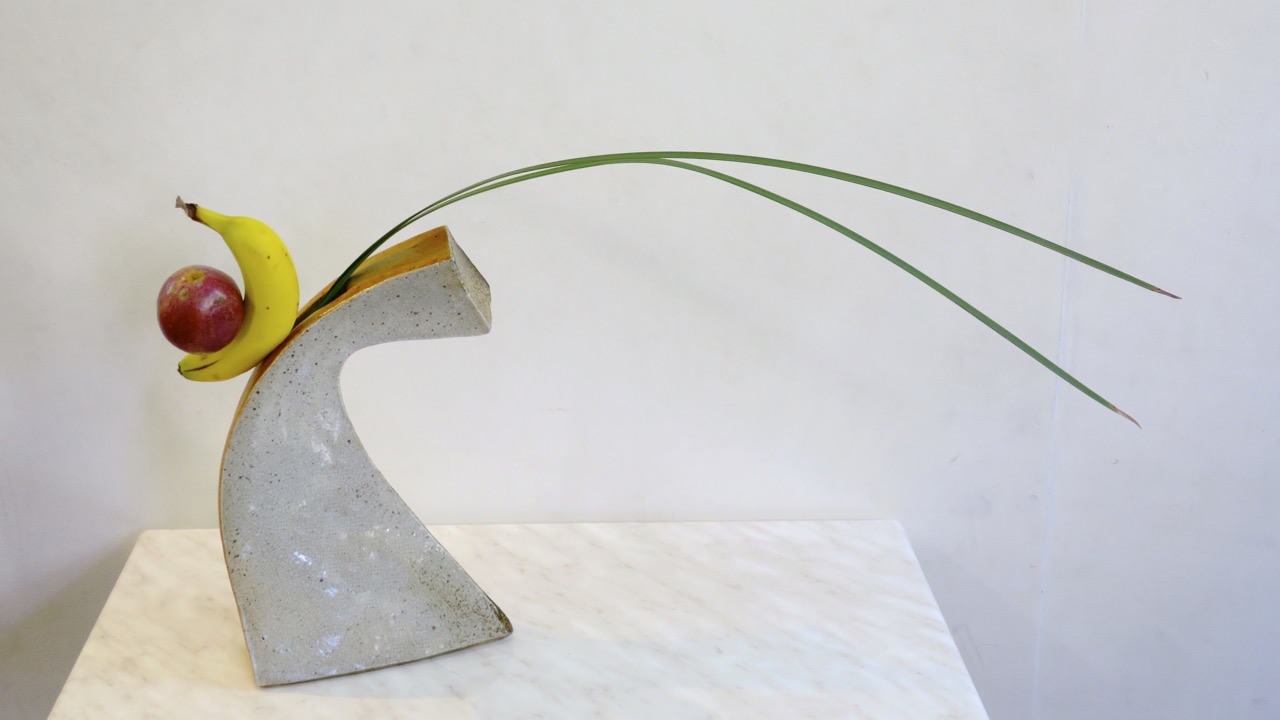
In my second demonstration I have complemented the strong curving lines of this unusual vessel. The banana and passion fruit emphasise the vessel by make curving lines that move in the opposite direction. I had actually tried to make the two dietes leaves curve the same way as the banana. However, they would not cooperate so I quickly changed my plan and followed the curve of the vessel.


I was particularly interested to see the ikebana by Akemi Suzuki, above. She took a different approach. She used a round red glass vessel with a closed top and a hole in the side. She arranged her materials to appear to be issuing out from the side of the vessel. This is yet another way of interpreting the theme: 'Taking into account the shape of the vessel"

Greetings from Christopher
19th April 2020


AUTUMN PINK


During the last couple of weeks we have had some days that were quite warm and dry. I have taken advantage of the weather to repaint the garden bench and the table on the terrace. Yesterday, I managed to paint a small deck at the back door before the rain that arrived overnight.


On one of the warmer mornings Laurie and I had a walk on the beach before breakfast. I took this photo of a rock pool in a cave that passes right through a large rock at the end of the beach. The water from the previous high tide was still dripping from the roof of the cave.


In the garden a Japanese Windflower anemone huphensis has flowered for the first time. It was a given to me by Margaret L., an ikebana colleague. The flower is very small probably because the soil is so poor and I planted it in the shade to protect it from the summer sun. 


None the less, it looks charming like its common name.


One of the last Lorraine Lee roses to escape the ravages of the possums this year has just opened. Its survival can be attributed to being on the end of a long thin branch that could not support the weight of a possum. And the Albertine rose, which is being buried by a pandorea pandorana vine, has produced an out of season autumn flower. 


I decided to use these flowers in a small arrangement on the dining table because their fragrance is so beautiful. By placing the small black egg-shaped vessel on a larger celadon platter, the soft pinks had a more suitable background than the wooden table surface. For the purpose of the photograph I have put a white card underneath the platter. 


The Hydrangeas, which I have to grow in pots, have started to take on their autumn colouring. This one, above, has a large pink flower when it first comes out it then slowly goes green and then develops autumnal colouring. Last week I used one of the unexpectedly-late-forming fresh pink flower-heads with some of the fading flowers. Today I picked the last of the fresh pink flower-heads and arranged it with the blue-grey foliage of the Cootamundra Wattle Acacia baileyana. 


I have created a horizontal ikebana with these materials in a large slab-construction vessel made with soft-pink marbled clay. The ikebana is dedicated to the memory of Doreen Schofield, a Sogetsu practitioner who studied with Norman Sparnon in the early days of his teaching in Melbourne. Doreen was an active member of Ikebana International Melbourne for 55 years and a committee member for 39 of those years. She donated many of her ikebana vessels to Ikebana International and the one shown was from her collection. The vessel was made by the New Zealand ceramicist Keith Blight.

Greetings from Christopher
11th April 2020