EXPERIMENTING WITH PAPYRUS


Two weeks ago I set my senior Melbourne students the fairly traditional exercise of making an ikebana using Autumn grasses, arranged in a basket.
 

Eugenia collected all the materials from her garden, which has quite a number of Australian native species. However, her ikebana also has exotics including variegated New Zealand Flax Phormium.

Jacqueline collected her materials from the wayside. The grass with the plume-like flowers on the right looks like Fountain grass Cenchrus setaceus, a native of Africa, the Middle East and South-western Asia. Her 'basket' is woven from Pandanus leaves and can sit flat, or the edges can be lifted and held by toggles at the corners.

In the garden, the Haemanthus coccineus recently produced five flowers. I decided I could afford to pick three. I justified this to myself as it would encourage the relatively young plants to put more energy into root and leaf development instead of making seeds.


I placed three flowers in a black ceramic vessel from Seto, in Japan, which looks to me rather like a strange cast-iron cooking pot. The flowers needed some green materials, so I used two Papyrus flower heads. 


Earlier in the year I had transplanted the Papyrus into a small 90cm diameter garden pond in the conservatory. By the early summer the tallest stems were 3.5m long, touching the ceiling glass. Two of the stems had bent and collapsed, so I used them in my ikebana. 


This was the first version of the ikebana. I had to tie up the rays (the fine filaments) at the top of the smaller stem on the  left because they hid the flowers completely. Having done that, the papyrus stems looked too different to each other.
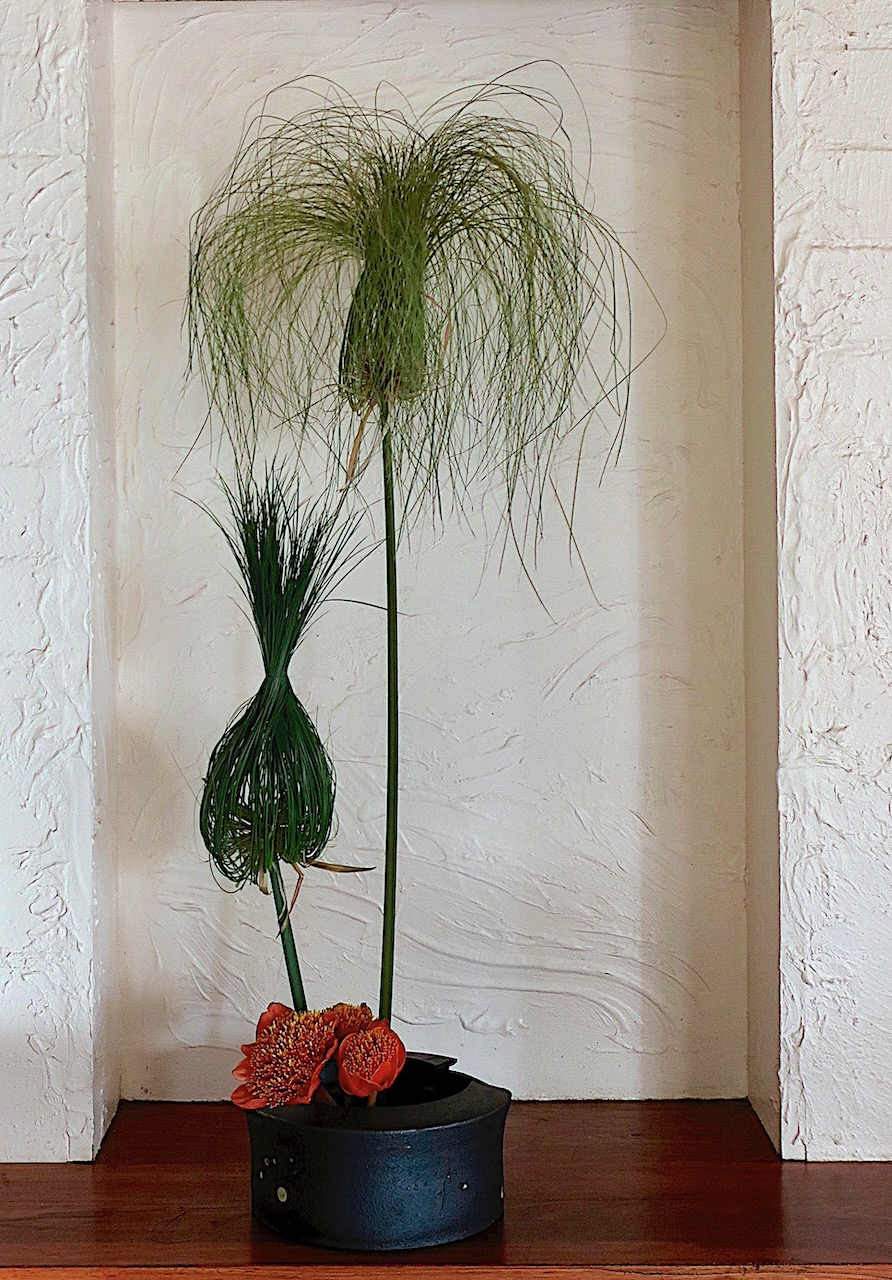
I then loosely tied the rays on the taller stem to create a more coherent appearance in the arrangement. Standing back, I felt the idea of using the Papyrus made an "interesting" experiment but not a successful ikebana. 

Since then I made another ikebana arrangement where I was happy to let the rays of a drying Papyrus flowerhead cascade over other elements.


This is my third version using a Papyrus flowerhead in this way. I made the arrangement for an Ikebana International Melbourne workshop last Saturday. The workshop theme was "Using roses in ikebana". I find hot-house grown roses a very difficult material because of the stiffness of the stems and the weakness of the leaves. In the ikebana above I used roses bought from a florist with which I created a mass in the centre. The fine rays of Papyrus cascade over the three pale pink roses. The dried parts in the centre of the Papyrus closely matched the soft pink of the roses. I placed a dried, sun-bleached branch of Moonah Melaleuca lanceolata curling around the vessel and extending to the left. The roses have become a small colour focus that contrasts with the strong line of the dried branch.

The vessel is by the Victorian ceramicist Terunobu Hirata.

Greetings from Christopher
12th April 2025


GOLDEN ROD (The Canadian weed)

In my Melbourne class recently ...

...my student Chen has advanced from Moribana ikebana arrangements in a Suiban (shallow vessel) to the next stage in the Sogetsu curriculum. That is, arranging materials in a tall straight-sided vessel. This requires the mastering of fixing techniques so that the materials remain in place and at the correct angles for the particular exercise. In the photo above he has used only one kind of material, Crepe myrtle Lagerstroemia. Technically, the flowers should be a different kind of material to the branch lines at this stage.

The exercise I set for the advanced students was to make an ikebana using "summer flowers and unconventional (artificial) material". 


Jacqueline arranged three Sunflowers Helianthus, and  two Camellia branches so that they protruded from a picture frame.

Marisha arranged Eucalyptus branches and Alstroemeria flowers in a shallow boat-shaped vessel. The "unconventional" material she used was white mizuhiki *.

Eugenia, arranged a single, cerise Dahlia flower in a flat-fronted vessel. The unconventional material is a wide ribbon of thick, malleable metal that has been painted black.

In the garden at Torquay I have been growing Golden Rod Solidago canadensis, in an old concrete laundry trough. 


This year I started watering it with a full bucket of water on most days. It has survived the few very hot days and grown shoulder high, as the above photo shows. Interestingly, when I was in Japan in November 2023 I saw that it had indeed become a significant environmental weed; true to my Canadian ikebana friend Leonora's description of it as 'the Canadian weed'. As a result I am taking care to remove dead flowers before they set seed.


I made this ikebana to express the strong upward movement of the Golden Rod. A mass of pink Bella Donna flowers anchors the vertical line and connects it to the vase made by Mark Bell from Maine USA.

Greetings from Christopher

6th April 2025 


* Mizuhiki are strings made from rolled Japanese Washi paper

"FLOATING" LEAF


In my Geelong class, Maree's exercise was a continuation of the fixing practice necessary when using a Tsubo (spherical) vase. 

In this case, the very long branch on the left side has been stabilised by securing it with a screw to the branch on the right side of the vase. The main branches are Banksia, a mass of Nandina is placed at the front, and the flowers are Gladiolus.

I had given my senior students the task of making a slanting ikebana in a tall vessel and asked them to then make a complementary moribana (literally, heaped flowers) arrangement in a low vessel.

Eugenia used two stems of Banksia and some Everlasting daisies Xerochrysum bracteatum, for her Slanting ikebana. In a low black trough she then arranged branches of semi-prostrate Cootamundra Wattle Acacia baileyana and more Everlasting daisies.


Marisha used Camellia branches in both vessels,  Chrysanthemum and Asiatic lilies Lilium in the tall vessel, and  only Chrysanthemum flowers in the low vessel.

Jacqueline set two Clivia leaves and a stem of Alstromeria in her "tall' vessel. In the lower vessel she used Carnation Dianthus caryophyllus, and Alstromeria flowers.The mass volume was increased with Nandina leaves. 


Maureen used a tall vessel in the centre behind the small suiban at the front. The tall vessel 
is hard to see against the background because it is very dark. She has used Pin oak Quercus palustris branches and Asiatic lily flowers in both vessels.


Christine has used branches of Manchurian Pear Pyrus ussuriensis, with Nerine sarniensis flowers. The autumnal red in the leaves harmonises closely with the Nerines. 

My own ikebana this week was inspired by the bright yellow of a fading leaf from our Tree Philodrendon Thaumatophyllum bipinnatifidum. The plant is growing in a pot close to the table where we usually have our lunch. 


Because of 
the angle of its stem, the leaf would have leant forward if I had set it upright in a vase. My solution was to place it across a shallow bowl by Phil Elson which has a golden brown inner surface and a black underside. The leaf almost appeared to float across the vessel as it extended over the rim on all sides. B
ecause it was dying and would soon start to wither and become brown I felt that I was justified in showing the stem out of water. The addition of a single white incurve Chrysanthemum makes this a bold ikebana in the "One leaf one flower" style

Greetings from Christopher
30th March 2025

CASCADING COOTAMUNDRA WATTLE


After last weekend in Sydney, I am back in Torquay. When I get further photos from Sogetsu Sydney's 65th anniversary I will present them or provide a link. 

This weekend's ikebana shows recent work of my Geelong and Melbourne students. 


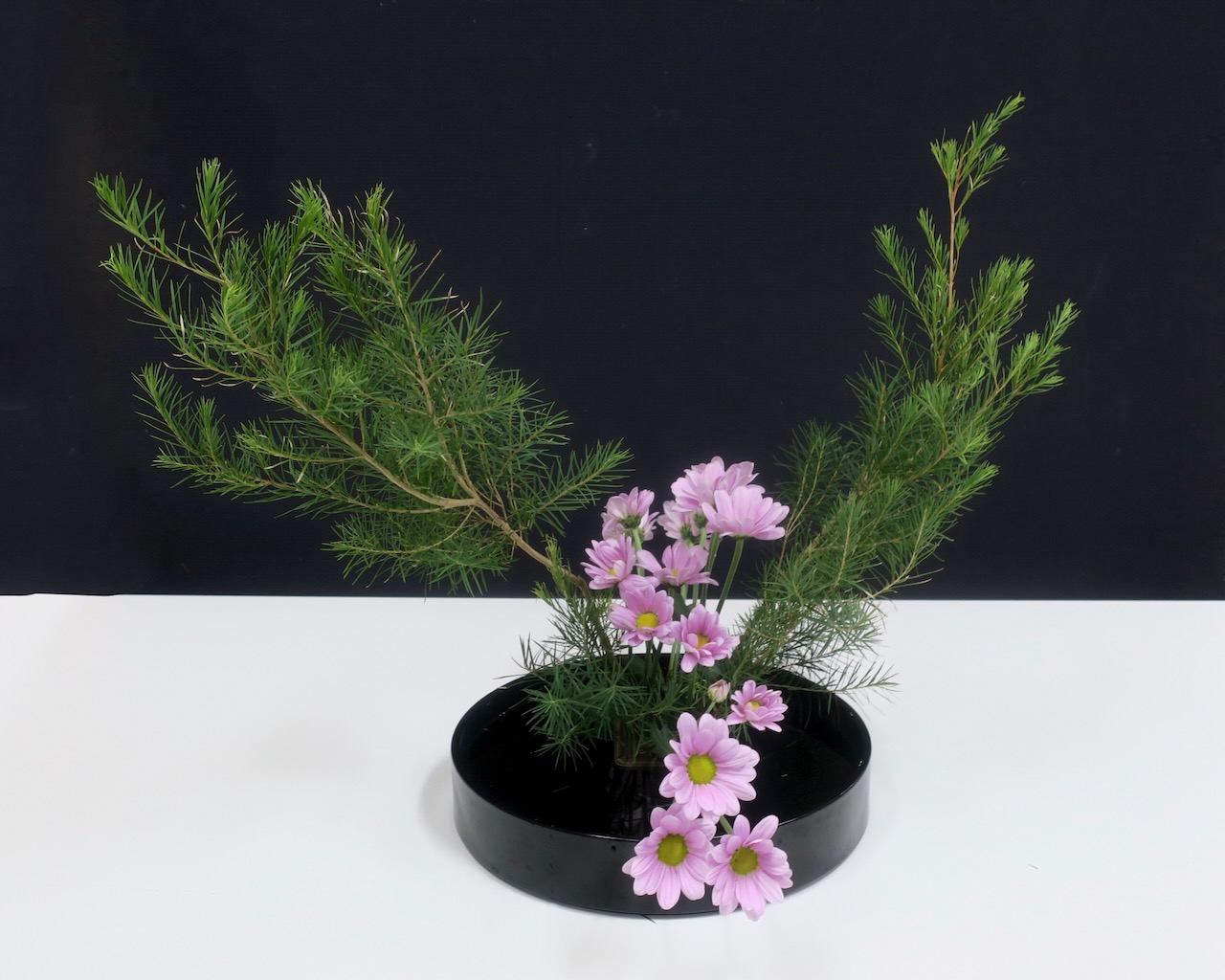
Anne is now working her way through the second book of the Sogetsu curriculum. This exercise above is Slanting Variation No 3 in a suiban. The branch material may be Melaleuca armillaris, the pink flowers are Chrysanthemums.


Maree's exercise was to practise one of the fixing techniques in a spherical (Tsubo) vase. The form of this ikebana is, by coincidence, also Variation No 3. She has used Fig Ficus carica, branches with the leaves cut-off, and two white Chrysanthemums 


Jo's exercise was to make an "ikebana complementing an art work"; in this case, a piece of fabric printed with a design based on a painting by Claude Monet. Her suiban matched the blue of the fabric closely, and she floated three pink Geranium flowers on the water. The stem of tortuous willow salix responds to the branch lines on the fabric.

The senior students' exercise was to make an ikebana "inspired by music"


Helen said her ikebana was inspired by the idea of musical bells. She used stems of New Zealand Flax Phormium to represent rope from which the bell cups are 'supported'. Succulent rosettes and one geranium flower sit in the tops of the bell cups.


The inspiration for Christine's ikebana comes from the idea of the music of the sea. She placed three bivalve shells on the corner of her turquoise-glazed suiban and added Sea Holly Eryngium.


Ellie's ikebana was inspired by Arvo Pärt's music Spiegel im spiegel   In three narrow glass cylinders placed on a mirror, she has arranged small sections of Autumn Joy Hylotelephium Sedum pieces. This link is to YouTube and the music of Spiegel im Spiegel


Aileen's ikebana is more abstract visually representing the rhythms, flow and space in music.


Similarly, Eugenia's ikebana represents the swirling melody, movement, space and rhythm of music.


Marisha was also thinking of the flow of music, with the flowing lines of sound. Her materials are: Maple Acer branches, Aspidistra leaves, Match-stick Bromeliad and Bougainvillea 
flowers


Jacqueline was inspired with the notion of Water Music, as of course she mentioned Handel's Water Music. She set a single Water lily Nymphaeaceae bud on the rim of a clear glass dish with three small leaves floating on the water surface.

My own ikebana this week was actually made in early February. I have set some semi-prostrate Cootamundra Wattle Acacia baileyana, in a cascading arrangement with two pink roses as the floral focus. The narrow six-sided Japanese vessel has a Tenmoku glaze.


Greetings from Christopher
23rd March 2025

SYDNEY DEMONSTRATION AND WORKSHOPS

 
This week I am sending a brief blog post, having just arrived back from three days in Sydney where I was invited to present a public demonstration on Saturday and two workshops today.

This photo shows left to right; Hiroko Prado, Director of Sogetsu New South Wales,  me, and Margaret  Hall Treasurer of the NSW Branch.

The next photograph is of my demonstration examples from the workshops.  


In the morning an idea my colleague Aileen Duke, came up with for an online exhibition during the Covid lockdowns was the theme I used. It was to use man-made materials to create an ikebana, with an emphasis on translucence. I used plastic file covers, clear tubing, two glass vases and a small floret of Celosia.  


In a second example I used white and yellow tissue paper and Dried Aspidistra leaves.


In the second workshop I borrowed an idea from my colleague Akemi Suzuki who presented a workshop on the theme of using an "old object which has memories for you and make it fresh with an ikebana". In this instance I used an engraved wooden picture frame, two altered Gymea lily Doryanthes excelsa leaves and some Lisianthus Eustoma flowers.

Greetings from Christopher
16th March 2025
 

EXPRESSIONS OF SUMMER


In a recent Geelong class, Jo's exercise was to make a freestanding structure with bare branches. Then she had to re-position the structure with, or in, a vessel. Finally, she was required to add fresh materials. This is the "Two step approach" which requires the student to practise fixing techniques and makes them observe the materials closely.


Jo's branch material was a bit tricky to work with as it was heavy as well as being very dry and brittle. However, the task was completed when she created a focal point with three Oriental Lilies Lilium

I recently set my advanced students in both Geelong and Melbourne the task of making an ikebana on the theme: "Expressions of Summer". By not setting a Sogetsu curriculum exercise, my intention was to encourage the students to use their imagination. The exercise allowed for free interpretation of the theme.


Eugenia brought an unusual plant she found growing by the wayside. It has very weak, but rich-pink succulent stems and pale green leaves. It appeared to have been growing in a very shaded situation. My subsequent investigation suggests that it may be Basella alba. Because of the weakness of the stem, Eugenia borrowed a tallish celadon-glazed vase by Anne Geroe, so that the stems could trail. She then added two branches of Hawthorn Crataegus, with deep red berries.


Jacqueline's ikebana represented summer roses, with longed- for rain drops and a cooling breeze blowing. The materials are: roses, Gypsophylla and Dietes leaves.


Marisha imagined the heat of the Australian summer sun and the robust plants that have developed characteristics to survive the heat and low rainfall of summer. The materials are: Banksia prionotes with unidentified Eucalyptus branches.

  
Aileen brought a number of dried pieces of twisting vine which she interlocked to create a writhing mass. She then added some inflorescences of Pineapple lily Eucomis comosa. The original vessel she brought to class was too small, so she borrowed this vessel by Tom Cockram


After returning home, Aileen reworked the ikebana in two vessels from her own collection; thereby creating a more dramatic result.

In the garden at Torquay... 
 
 
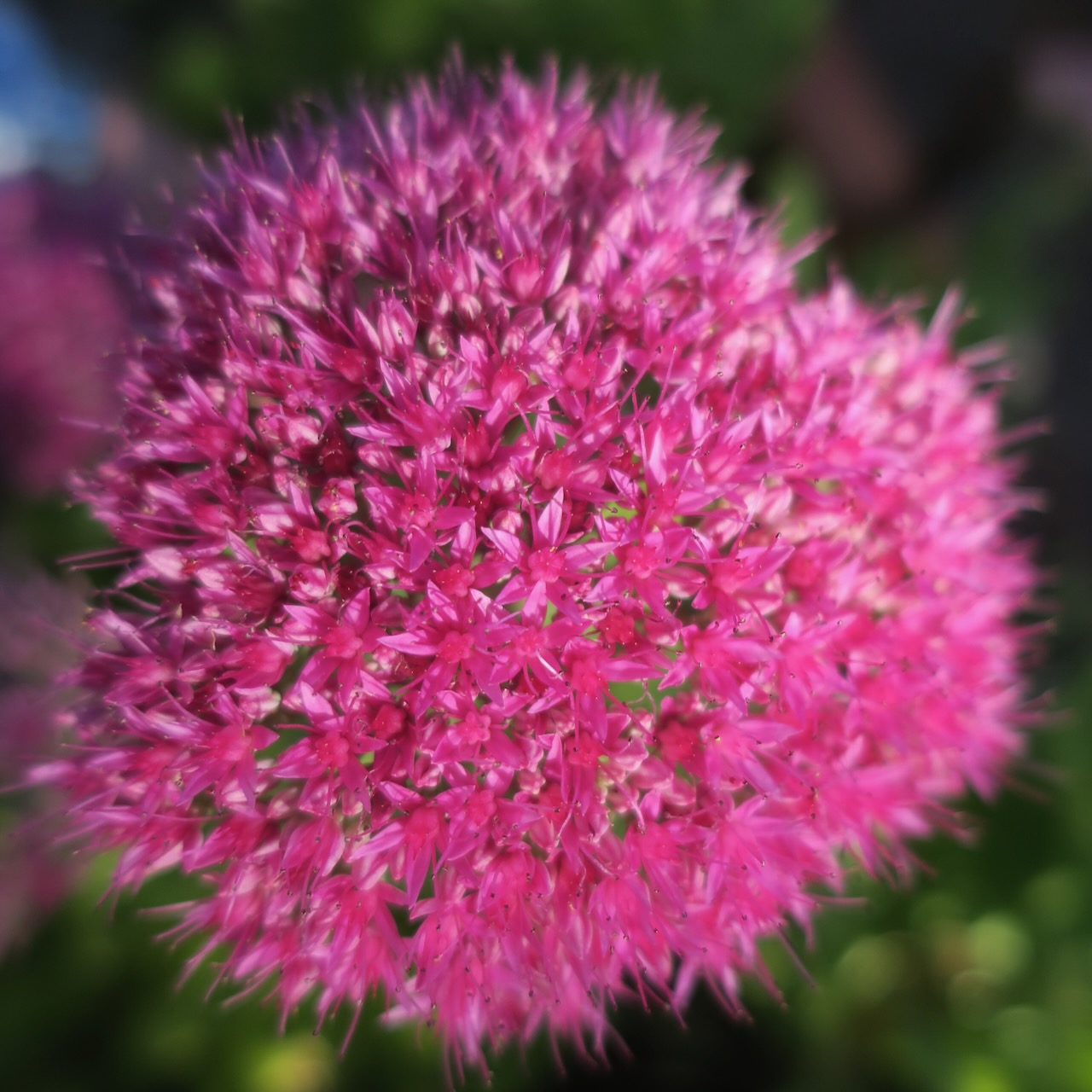
... one of the two sedums plants has flourished. This may be a Sedum spectabile  cultivar called "Brilliant". If so, it is well named...


...as this close-up shows. 

About a week ago, I gathered some Dock weed from the creek because it had turned a quite rich pink on the side facing the sun. I did not have the time to arrange it immediately and was surprised yesterday to find that it had retained its colour.


I thought these two plants would make an interesting combination for my ikebana. I have arranged them in a triangular-shaped, tall black ceramic vessel that has openings on two sides. The materials hug the vessel, which has become a backdrop to them, thus helping to emphasise their colour.

Greetings from Christopher
8th March 2025
 

ASPIDISTRA LEAVES


On Friday afternoon I had some free time before going to a concert and had a walk around Johnstone Park in Geelong. In the bright afternoon sunlight I noticed that some of the large Brachychiton's were in flower.


These are tall trees with the flowers scattered along the branches. Often I first notice the flowers on the path.  I was pleased to be able to get these photographs with some ease as they were only a few metres above the ground.


This cluster of flowers is among the newly-formed seed pods from flowering earlier in the Spring.

In my Geelong class...


...Anne's exercise was a to make an Upright Variation No. 3 ikebana. In this variation the Shin line and its support, the Soe, are on opposite sides of the Hikae flower line.


Maree's exercise was to make a celebratory arrangement. The student is asked to take into account the circumstance of the celebration. She prepared this ikebana for a friend who was becoming engaged, who loves roses, and whose favourite colour is pink. She added Sea holly Eryngium to the central mass and joyously radiating lines of Maple Acer.

The senior students' exercise was to make an ikebana on the theme: "Expressions of summer".


Ellie placed a dried branch and added summery yellow flowers, including a small Sunflower and some colourful Hellichrysum flowers; yellow being a typical colour in an Australian summer.


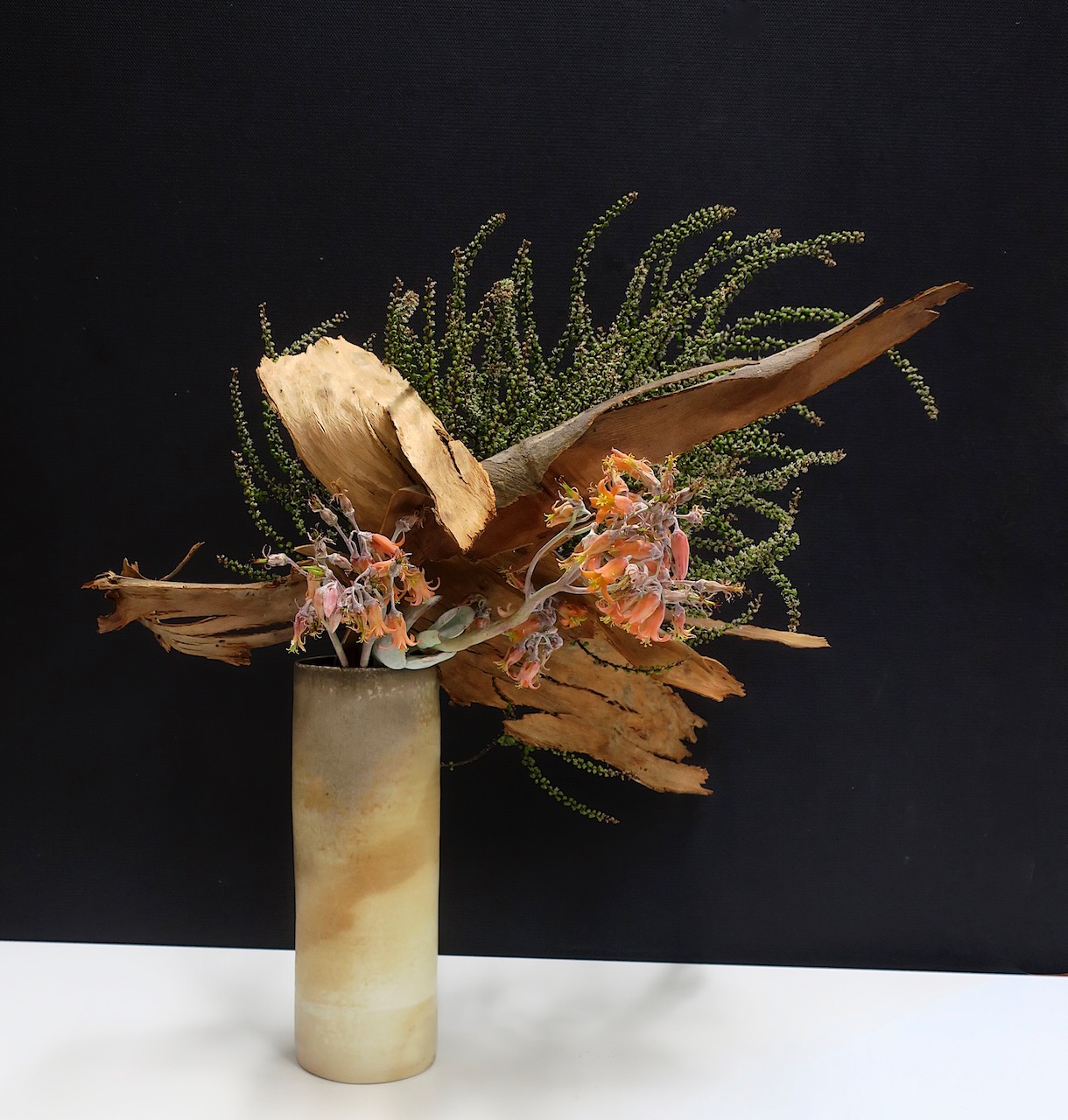
Helen arranged dried bark, a large Cordyline infloresence and some Cotyledon orbiculata flowers. She wanted to represent the hot strong winds we have experienced recently, which brought down strips of bark from many of the Eucalyptus trees.


Christine used the last of her Summer Hydrangeas. The two bare dry branch lines represent the dryness of summer.

Maureen arranged twisting black-painted lines of vine and Plumed Cockscomb Celosia argentea. 

At the first meeting of the Victorian Branch of the Sogetsu School this year, the theme was 'using Aspidistra leaves only'. Aileen Clarke, who presented the workshop, used the following quote from Sofu Teshigahara's Kadensho: 

"Try setting leaves. You can fake nice arrangements with flowers, but not with leaves. Leaves are the proof of a plant's dimensionality."

We were also invited to explore the material, and to try something we had not done previously.
 

I was interested to try to create an over-all sense of flowing movement that I had previously seen other ikebanists achieve. I have used six variegated leaves and tried to created a flowing movement to the right. I found the task surprisingly difficult (Sofu Teshigahara was quite right) and was running out of time at the end. With more time I would have liked to shorten the upward curving leaf on the far right side of the ikebana. 

I enjoyed the learning experience and was impressed with the strength and variety of ikebana that my colleagues created. Follow this link to Photos from the Aspidistra workshop.  


Greetings from Christopher
2nd March 2025