AUTUMN BERRIES

This week I had my advanced students do the exercise of creating a mass out of leaves at the end of a branch by intertwining the finer terminal branches. They used a variety of different materials and the results are interestingly varied. Each of the images below are of corrected work. My correction to the students as they were working on each of these works was to strip more leaves off so that only those at the very ends of the branch were left.


Ellie Welkamp used an unknown material that had some berries on it. Once she started stripping the leaves she decided to make a feature of the berries as well. So, she managed to separate the leaves and berries in the design.


Nola Bird used a branch of Callistemon, an Australian native. Although seemingly stiff the branches were able to be interwoven to make the mass.


Christine Denmead used a 'Pincushion' Hakea, another Australian native. Her branch had flowers at the end that created an additional point of interest.


After the class she sent me the 'photo below of the material stripped of all the leaves creating a further expression of the material. 


It is now autumn here and we have had some quite wintery weather in the last week. I set my students the exercise, below, of an arrangement with berries or fruit with an autumnal feeling. The colour in this image is distorted as the lighting was not very good. (The vase is actually a very deep blue.)


Greetings from Christopher
28th April 2012


VARIATION No6 (Nagiere)

At my most recent class my teacher set us the revision exercise of the title. I love the simplicity of the 'variations' and the elegance of nagiere in particular. Variation 6 is a 'horizontal' arrangement with the shin line at 85 degrees from the vertical. I realised that the banksia (Banksia Integrifolia) growing in our garden would lend itself admirably to the exercise. Here is a branch on the tree with the sun coming from behind.


In these pictures you can see the lovely silvery underside of the leaves. Also, as is the characteristic of this plant, there are all stages of flowering visible at the same time, from the beginnings of the flower spike through to the cone with its open seed capsules having ejected the seeds. Unfortunately the full length photo I took of the tree did not come out. It is about six metres high. This particular species of banksia was one of four that were collected in 1770 by Joseph Banks. It grows all along the east coast of Australia to the south coast of Victoria and flowers from Autumn through to the Spring. 


In this arrangement the shin line extends to the left at 85 degrees, the soe is the highest line at 65 degrees and the hikae to the right front is at 75 degrees (Correction 24th May. When I initially posted this page on 22nd I incorrectly said the Soe branch should be at 45 degrees. The highest branch in the image below is actually a little too high.). The three lines radiate from the centre of the vase like the spokes of a wheel making it suitable to be seen from all angles and therefore able to be placed on a low table in the middle of a room. The ceramic cylinder is by Graeme Wilkie of Qdos Gallery.


Greetings from Christopher
21st April 2012.

MASS MADE WITH LEAVES

I was inspired to try this technique after seeing a beautiful arrangement by Ping Block at the workshops I recently attended in New Zealand. Ping had used one of the vases for visitors that I had coveted. When I saw her work I realised what she had done was much more beautiful than my arrangement would have looked in that particular vase. (I think there is a lesson in here for me.) The technique is creating a mass from leaves at the end of a smaller branches on a longer branch. It requires some judicious stripping of leaves and much manipulation of the branchlets. I spent an hour creating the mass illustrated below and was fascinated to discover that the branchlets became more pliable the longer I worked them. Below is the first version.


I subsequently tightened up the mass and added a single red anthurium for contrast placed in among the leaves. The anthurium is in a plastic water phial.


This is how it looked on the side board. I felt it worked rather well with the red and green being highlighted by an overhead halogen spotlight. The busyness of the back of the sideboard makes this a difficult location for most ikebana, so I rarely place them there.


The ceramic vase is by Graeme Wilkie.
Greetings from Christopher 
14th April 2012

ROSES and EUCALYPTUS

On the weekends Laurie and I usually walk to a coffee shop in the main street of Torquay. Last weekend we passed a large flock of Galah's, a species of Australian cockatoo. They were eating grass seeds. I have always loved their pale grey feathers contrasting with the strong pink of their breast feathers.


Here is a close up of the picture above.


They started to walk away as we approached, you can see a Plover in the background, on the right. They are unusual birds as they lay their eggs on the ground and not in a nest.


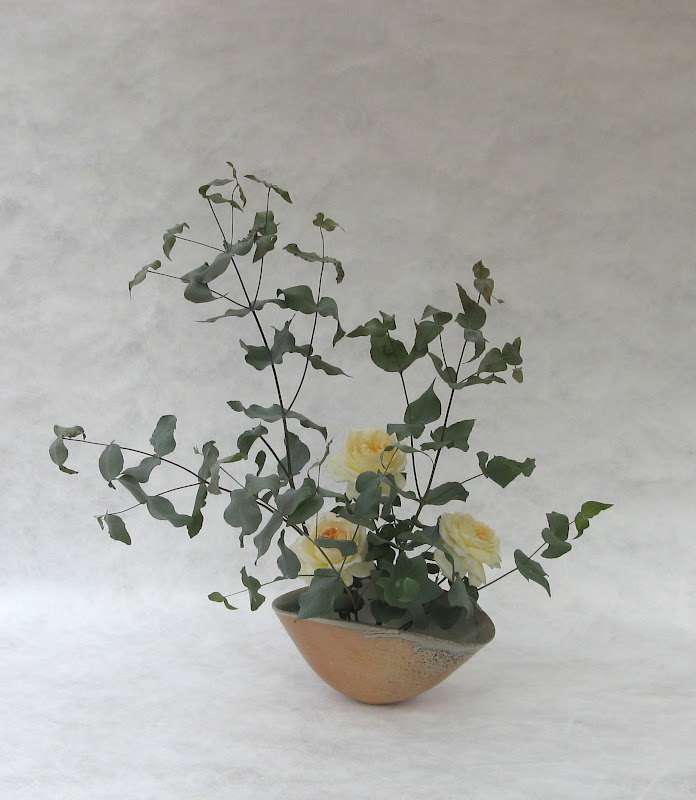
I recently set my students the exercise of making an arrangement using roses and some other branch material. I tend to find roses difficult in ikebana because the flowers are so often very strong. Also, I do not have much experience with them as they are hard to grow in my garden. I had originally intended to use pine. However, when I saw these new eucalyptus branches I realised they would go well with the roses I had bought from the florist. I decided to place the flowers in among the branches rather than separately as I thought they would dominate the work. The soft bluish-grey of the leaves complements the pale cream of the roses. It also works well with the bowl (by Graeme Wilkie of Qdos Gallery) because it has a pale celadon interior and warm light terracotta outside.


Greetings from Christopher
7th April 2012


MELBOURNE INTERNATIONAL FLOWER and GARDEN SHOW

Last Wednesday saw the opening of the Melbourne International Flower and Garden show. It is the seventeenth year of this annual event that takes place in the historic Royal Melbourne Exhibition Buildings and surrounding gardens. The buildings  were erected in 1880 for the first international exhibition 1880-1881 (see: http://museumvictoria.com.au/reb/history/the-building/). For this event the gardens are used for trade exhibitions, including designs of model domestic scale gardens created for the five days of the event. Within the Great Hall building the focus is on all aspects of flower arts and cultivation. This year the Victorian Branch of the Sogetsu school participated, as usual, in association with Ikebana International and some ikebanists created individual exhibits.

In the gardens there are musicians as well as street theatre performances taking place throughout the day. These two giant women with baskets of flowers and watering cans ready to do business in their garden, created amusement among the crowd.


This is the view down the length of the Great Hall. In the foreground on the lower floor are mannequins dressed in 'garments' made of flowers and other botanical materials designed by students studying fashion design.


This image shows the transept of the great hall. You can see some of the paintings high up that decorate the arches.


Below is a section of the Ikebana International exhibit. Unfortunately I was unable to photograph it front-on because of the crowd. On the left side is the Sogetsu School work. In the foreground is the Ohara School and straight behind the Ikenobo School with the Ichiyo School to the right. Out of view is the Shogetsudo-koryu arrangement.    


This is an individual stand by the Ohara School. (My sincere apologies for mis-labeling it initially as Shogetsudo-koryu school [corrected 4th April]).


This dramatic 'shop window' exhibit is by Emily Karanikolopoulos a Sogetsu School teacher (see: www.emilykara.com.au). She has used two very large branches of white painted corky elm supporting glass bowls containing red anthurium lilies. Her work was awarded third prize.


This work is by Emily's sisters-in-law Toula and Betty Karanikolopoulos and features a strong framework of horizontal bamboo with variagated New Zealand flax and masses created with smaller bamboo, red anthurium lilies and dancing lady orchids. Their work received a 'highly commended' award.


This work caught my eye because (I'm fairly sure) it was by a student of floristry in Geelong. 


Here is another piece by students of western floristry where the influence of ikebana is very apparent. Think 'line mass and space'.


Now to my own domestic scale work this week. I have been noticing the bullrushes in the creek over the past month and wanting to make use of them. In particular I wanted to try to repeat a work I made at a workshop with Mr Katayama four years ago, see the picture below. The photo' I took at the workshop was not good because the work went outside the photo' frame.


Unfortunately, when I tried to repeat the work I had left it too late and the heads of the rushes were beginning to 'seed'. Also the stems were much weaker than those I perviously used. I was unable to use the same technique as above and instead tried to create a mass from the lines of the flower heads coming from two groups within the vase. At the last minute I had to add more stems to the righthand side so it is rather messy where the stems come out of the vase.  


The vase is by Graeme Wilkie of Qdos Gallery, Lorne.

Greetings from Christopher 
1st April 2012


YELLOW and or ORANGE

This week's ikebana is my work from a recent class that I attended with my teacher in Melbourne. The subject of the class was an arrangement that includes fruit and/or vegetables that are yellow and/or orange. Using fruit or vegetables is difficult. I remember the advice of Mr Umemura at a workshop in 2008 saying that this exercise should be 'playful'. With this in mind I decided a simple and non-naturalistic approach was necessary. 


I have used a branch of pittosporum with some berries attached from which I removed all but two leaves. A banana and orange have been placed to bring strength to the centre of the design and to counterbalance the curves of the unusual ceramic vase made by Graeme Wilkie of Qdos Gallery Lorne.


Greetings from 
Christopher
24th March 2012

MY STUDENTS WORK

This week I gave the second last class for term one, 2012 to my students. I hold classes in a community centre in  the city of Geelong. We use the 'art classroom' which is a fairly large space. Because the walls are coloured and there are some notice boards on them we place use a large white board as a back-drop when I give correction to the students and to photograph the works. 

The class is a mixed one with some students working on the first half of the curriculum and other, advanced students, who have completed the Sogetsu curriculum. For these students I create a term program with different exercises each week. This program includes, among others, seasonally relevant exercises, work in preparation for exhibitions, work for particular settings and others using combined exercises from the Sogetsu curriculum books 3 and 4.

The first two pictures are nageire 'variations' by beginning students, Sayuri Gilmore and then Wendy Marshall. 


I set the advanced students the exercise of 'emphasising water - using a glass vase'. The pictures below were taken after 'correction'. The first work was made by Maureen Duffy, she has used the Australian Fire-wheel Tree (Stenocarpus Sinatus)
in a trough shaped vase. My correction was to raise the level of the water to the top of the trough and to remove a small side branch that was in between the two larger branches on the left.


The second work is by Christine Denmead. The 'correction' involved separating the two vases and adding the middle branch that joins them to improve the space within the work.


The third work is by Ellie Welkamp. The 'correction' was to raise the level of the water and mass the material in the bowl. This was necessary to stabilise the work and created a contrast between the two designs below and above the water.


The fourth work is by Nola Bird. This work initially only contained the material below the water level and was too minimal considering the size of the very large vase. So, we added the wire and flower above the surface of the water.


I was very pleased with the work of my students and it is always a pleasure at the end of the class to consider the wonderful range of expression in the room even when the students are doing he same exercise.

Greetings from Christopher
16th March 2012

REMEMBRANCE

Today is the first anniversary of the Great East Japan Earthquake. One year ago on Friday 11th March at 2.46 pm the most powerful earthquake ever to have hit Japan, since modern records began in 1900, struck the Tohoku region northeast of Tokyo. Over fifteen thousand people died and more than three thousand are still missing.

It is in the nature of the human spirit that when communities are touched by suffering that people join together in support and compassion. I saw this many times during the three months that I spent in Japan during last year after the earthquake. Many stories of courage have been told and many stories will forever go unrecorded.
Today I have made an ikebana arrangement from the first lesson of the Sogetsu curriculum. I love its timeless, simple beauty. It is arranged in a suiban so that we are conscious of the surface of the water enlivening the work. The branch material I have chosen for this special day is rosemary from our garden because it is symbolic of remembrance. The flower is pink hibiscus.


Greetings from Christopher
11th March 2012