AN UNEXPECTED VISITOR

I was surprised recently when I looked for the source of an odd piercing noise outside the bathroom window to see this colourful Australian King Parrot. It was eating seeds from a Billardiera heterophylla. In recent years there has been an increasing number of parrots in our garden because in the 1970's and 80's many people started planting Australian native plants in their gardens. When we planted this twisting vine about 25 years ago it was known as Sollya heterophylla. This particular one has a pale blue flower.


The parrot was startled by my movements and flew to the top of our pergola. 


In the following week I had set my students the exercise of using vine in an arrangement and, coincidently, Christine used some of the same vine in her arrangement. The first photo below is before correction.


Here it is again after correction. As you can see the irises have been neatened up. Christine wanted the flowers to make a mass contained within the volume of the vine.


She has created a good feeling of space both within the vine and around the work.

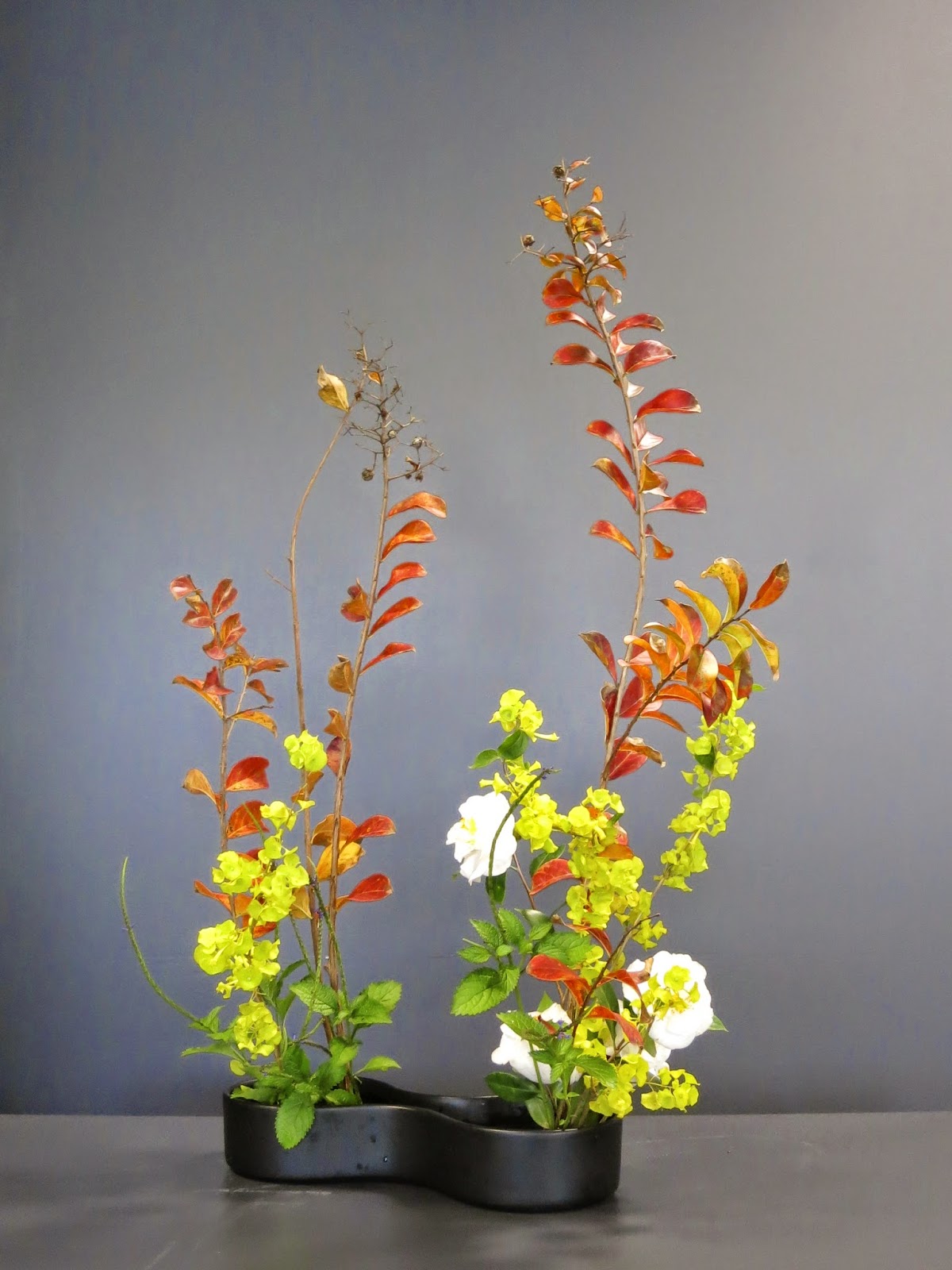
Ellie used a very different approach, emphasising the vine by using only one length with a beautiful curve. She has thus created a sense of the space above the vase. The lines are off-set by intensely red autumn leaves.


This weekend the Victorian Branch of the Sogetsu School has been very busy with two days of workshops given by Mr Yoshiro Umemura from Sydney. I will post some photos from the workshops next week.

Greetings from Christopher
27th July 2014


WINTERY WEATHER

On the south coast of Victoria it is very wintery at present. Two days ago the maximum temperature was only 7 degrees Celsius. I write this for the benefit of readers from the northern hemisphere who may think that Australia is perpetually sunny and that we all go to the beach every weekend. The nearby creek at Torquay has a small flow. It is really an intermittent creek because it has a small catchment area and the rainfall is fairly low.  Recently it has been blocked by a sandbar so that the water level came slightly over the boardwalk. In the photo below you can see the waves breaking beyond the sandbar.


Our shoes got slightly wet when we crossed the boardwalk.


Then there was rain overnight and the sandbar was washed away.


At the workshop of the Victorian Branch of the Sogetsu School last week the theme was to use corky Elm to make a framework to support other material, in a suiban. Below is the structure I made.


 I have posted a few other photos from the workshop that you can see on the Sogetsu website under the heading "Recent Workshops" (click on the blue text). A couple of days later I went to my teacher's class where our exercise was an arrangement with 'red and green'. It proved to be a good opportunity to re-work the materials more to my satisfaction. As you can see I have trimmed the branches, added a lot more cotoneaster berries to make a more dense mass and contrasted the straight lines with the soft curves of two sedge leaves.


I think this arrangement also suits the season of winter that we are enjoying(?) at the moment.

Greetings from Christopher
19th July 2014

P.S. My colleague, Emily Karanikolopoulos, who recently returned from Tokyo, will continue to post on her blog. There is a link on the righthand side of this blog.

MORE ABOUT SOFU'S SCULPTURE

In my posting on 31st May I showed a photograph of a sculpture by Sofu Teshigahara that I used in the Sogetsu School Victorian Branch 50th Anniversary Exhibition (click on the blue text to see that posting). Below is a photo from a booklet of Sofu's 1967 visit to Australia in which he has used several similar sculptures together in an arrangement. 


Some visitors to the exhibition from Sydney told me that these sculptures were assembled to create a large single assembled work. Below is a photograph of similar sculptures that are described as being from Sofu's 'Kojiki' series. The sculptured wood in the photograph appear to be in a natural state and do not seem to be covered with aluminium sheeting. They have been set in the Plaza in front of the Imperial Palace in Tokyo.


At the beginning of last week I attended the monthly meeting of Ikebana International in Melbourne. The guest speaker was Jane Sawyer, a Victorian based ceramic artist who, as a post graduate art/craft teacher, served a two year apprenticeship at the Shussai-Gama pottery in Shimane, Japan 1985 - 1987. She gave a wonderful presentation about her work and the aesthetic of the 'mingei' movement that forms the philosophical basis of that pottery.

At the meeting members created ikebana in ceramic vessels from their own collections that had special meaning for them. Below is my ikebana in a ceramic bottle made by Akutsu Tadao that I bought in Mashiko in 2011.


To see images of other ikebana at the meeting click on the blue text Ikebana International.

Greetings from Christopher
12th July 2014

CONSTRUCTION TECHNIQUES in BRISBANE

On the second day of the workshops I gave in Brisbane recently the focus was on construction. A variety of techniques were practised depending on the type of material the individual attendee wanted to use. In the morning each person created a sculptural form which then became the basis of an ikebana work in the afternoon session. I must say I am always quietly amused when ikebanists get out their power tools to start their flower arranging!


The next two photos show finished works after the critiquing process. In the first photo gymea leaves only, were used in loose and open loops to keep a light feeling to the work and not to distract from the texture of the woody branches. 


In the next example flowers were added. However, the shallow vase was rotated so that the wooden sculpture was clearly the subject of the work rather than the flowers. 


The next few photographs show the development of the sculptural work in the morning session and then its final use in the afternoon session. The fine bamboo shown below was fixed with dowels made from fine skewers.


The bamboo sculpture was brought to the front of the design and the arrangement simplified in the final version of the work.


Below partially charred lengths of melaluca (paperbark trees) were secured to nails driven through a red painted board. 


As you can see below, this work reminds the viewer of the aftermath of a bushfire. A single stem of curly poinsettia flowers has been added.


The bamboo below had sufficiently thick walls that doweling has been used to invisibly secure short pieces.


The result is an abstract sculptural form to which some lotus pods were added for colour and textural variation.


Three lengths of branch were secured with dowels in the example below. 


Unfortunately the photos do not show the beautiful texture of the wood which was the principal point of interest. A single New Zealand flax leaf was added to the side of the work which provides a strong contrast that does not interfere with the woody material floating above the cylindrical vase.


In the example below magnolia branches have been doweled and wired together together to create a spherical mass. This was a deliberate choice to avoid simply relying on the natural beauty of the lines of the material. 


In the final work a strong line has been added to one side and a white camellia budflower and some leaves to create textural and colour contrast. 


This week's posting is a continuation of last week's that you can view by scrolling down further. It may be necessary to click on the 'archive' for June. I would like to thank the participating members of the Queensland Branch of the Sogetsu Teacher's Association (click blue text to view their website) for letting me share their workshop experience with you.

Greetings from Christopher
5th July 2014

P.S. You can see Emily Karanikolopoulos' final blog posting of her three months at Sogetsu Headquarters by clicking on the blue text: Emily in Tokyo.

KABUWAKE, LINE and MASS

I was recently invited to give two days of workshops for the Queensland Branch of the Sogetsu Teachers' Association. The workshops were in Brisbane which is the capital city, where the climate is subtropical and therefore warmer at this time of year than the south coast of Victoria. The first workshop was on the theme 'Ka-bu-wa-ke', an arrangement using two or more kenzans in a shallow, suiban, vessel. Below is a photo of my demonstration for the exercise. Emphasising the space between the groups is the most important aspect of the exercise and the materials of one group needs to be stronger than the other(s).


Illustrations of the exercise are usually done with only two kenzans, so I have deliberately used three kenzans which is clearer in the next photo. Although it is not apparent, because of the camera angle, I have used a large oval suiban that extends away from the camera.


Below is a selection of the arrangements by the attendees of the workshop


The second exercise was 'Mass and Line'. In this exercise either the mass or the lines need to dominate, so that the asymmetry of the arrangement is maintained. I used some ornamental peach branches for the lines and made them the main subject of the arrangement, to which I added some camellia leaves as a small contrasting mass. The forward movement of the lines is not apparent in the photo below.


The participants concentrating on mass and line...


…and a selection of the finished work. 


Below the participants at the end of the first day.


I will post more photos next week of the second day of the workshops.

Greetings from Christopher
28th June 2014

You can see Emily Karanikolopoulos' latest blog posting by clicking on the blue text: Emily in Tokyo.

WRAPPED UP WITH FUROSHIKI

Last week I attended the monthly meeting of Ikebana International in Melbourne. The theme of the meeting was an annual event of the chapter: 'Japanese Day'. To celebrate a unique aspect of Japanese culture, some of the Japanese members of the chapter gave a demonstration of how to use furoshiki and, after the formal meeting, Japanese food was served. Furoshiki is the term for fabric squares of various sizes that have been used traditionally in Japan to wrap objects for presentation or simply as a utilitarian carrying device. The fabric may be cotton, silk or, these days, synthetic material. There are multiple techniques for wrapping that vary according to the shape of the object in consideration. Click on the blue text to see images of the activity and arrangements. I.I. Melbourne:Japanese Day. 

In keeping with the activity, members were asked to use the idea of wrapping in the ikebana they made at the meeting. Many used furoshiki in their arrangements or around their vases. I thought it would be interesting to use some of the Coastal Sword Sedge (lepidosperma gladiator), that I used in last week's blog, to wrap around my vase. I chose an irregularly angled bizen vase for the purpose and because it was 'wrapped' I used a single camellia flower and one leaf peeping out from  the vase's opening.


Greetings from Christopher
22nd June 2014 (mid-winter in the southern hemisphere)

You can see Emily Karanikolopoulos' latest blog posting by clicking on the blue text: Emily in Tokyo.

EXPERIMENTS IN THE CLASSROOM

During the week I gave a class in which a student, Margaret, used a charred branch in the exercise 'Using dried and fresh materials' The first challenge was how to position the branch. I suggested creating a 'cradle' using two forked sticks inserted into a kenzan. This allowed the branch to float above the vase.


To this were added three arum lilies. Unfortunately they had not really opened sufficiently at the time. But we were confident they would do so over the next couple of days. 


In the same class Niki created an arrangement to be '...viewed from all angles…' in this interesting footed vase.


For another class this week I selected some Coastal Sword Sedge (Lepidosperma gladiator click on the blue text for further information), to demonstrate to students that freely available material can be used to striking effect in creating ikebana. In researching this plant that grows naturally close to our house I was delighted to discover its name. Clearly it was called 'l. gladiator' because of its long sword-shaped leaves. Below is a photo of a dense clump.


This photo shows a close-up of the brown flowerhead which grows on a broad bladed stem.


I have found the leaves can readily be curved into graceful shapes. On the class-room table the strong forward thrust of the right-hand line looked quite dramatic but too long for the over-all balance.


I drew the long line back into the arrangement to create a swirl of lines floating above the vase with a satisfying sense of movement. 


Greetings from Christopher
14th June 2014

Emily Karanikolopoulos returned home yesterday from her three months in Japan as the fourth recipient of the Norman and Mary Sparnon Endowment Scholarship. You can see her latest blog posting by clicking on the blue text; Emily in Tokyo.


AUTUMN BERRIES and LEAVES

Since last week winter seems to have arrived rather suddenly in our part of the world, following a very mild autumn. There was a late burst of warm weather recently that has confused many plants in the garden which have now started putting forth spring leaves. Our ornamental grape vine is in 'bud burst' at least two months early. In the meantime there is still some beautiful 'autumn colour' to be seen. I noticed these colourful leaves among some escalonia in a neighbour's garden. I think they are from an ornamental peach.


In another garden a pittosporum (click on the coloured text for further information) with orange berries was cascading over the fence. This particular pittosporum is from the east coast of Australia and is regarded as an invasive weed in some places.


I thought the leaves and berries would make a lovely subject for a small naturalistic autumn arrangement in an irregularly shaped vase made by Barry Singleton. The vase has a very thick shino-type glaze and some orange from the iron in the clay shows through the thinner parts of the glaze.


Greetings from Christopher
7th June 2014

Don't forget to check Emily Karanikolopoulos blog. (Click on coloured text to link to Emily Karanikolopoulos' Tokyo blog)