NAGOYA and SHIRAKAWA

At the beginning of this week Laurie and I went to the World Heritage town of Shirakawa Mura in Gifu Prefecture north of Nagoya. Laurie had stayed there 39 years ago, when three of his students at that time took him there. I was delighted to be able to visit this village while the snow was still quite deep even though it is early spring.


Shirakawa is sited on a narrow river plain in a steep sided valley and...


...is famous for its manyGassho Zukuri-style, traditional farm houses with very steep thatched roofs.


The snow had begun to melt and there was the sound of running water everywhere.


We were able to stay in the same guesthouse where Laurie had stayed in 1978.


This is the large central room with its open hearth fire place. Breakfast has been laid out for the guests.


I was quite fascinated by this sight. The snow has melted around all the trees on the steep hillside.


On Thursday, Nagoya castle seemed to float above the first cherry blossoms, where some people were celebrating O Hanami.


Here, a cascading branch hangs down into the moat. 


The castle and palace buildings were destroyed in bombing raids in 1945. The castle was rebuilt in concrete in 1959. Starting in 2009 a major project was begun to reproduce the palace as it was in 1634. The same materials and techniques that were used at that time are being employed. 

Many of the original room dividing screens and decorative panels had been removed and safely stored during the war. Also there was extensive photographic documentation of the building. This has been invaluable to the skilled crafts people for their meticulous reproductions. 

When we were in Japan in 2011 we were able to view the building in its early stages from the outside within a huge construction shed. On this visit we were able to walk though two completed sections. We were amazed at the opulent beauty and grandure of  this still incomplete project.


On Friday, in spite of rain, we visited Atsuta Jingu, one of the three most important Shinto Shrines in Japan. It is believed to have been established during the rein of the Emperor Keiko (71 - 130 CE).


This photo shows the buildings of the inner shrine which have been renovated since I first saw them in 1992.

*          *          *          *          *
During the last week I have had two opportunities to create some ikebana. 


This first, freestanding work, is made from last year's flower stems of some Yucca plants. I have used seven stems in all and was delighted that they looked like a miniature winter forrest . 


Here you can see that they are sitting on a high shelf in our friends' house in Onjuku.


This second, early spring arrangement is of 'roadside gathered' materials. I made it in the house of friends near Nagoya.

Greetings from Christopher
2nd April 2017


SPRING-WINTER JAPAN. AUTUMN IN MELBOURNE.

This week Roadside Ikebana comes to you from Japan where, three days ago, there were early cherry blossoms in Zojo-ji, Shiba Koen in Tokyo.


For those of you who are heading toward Japan for the Ikebana International Conference: don't panic, we are back to winter, so the blossoms won't be finished. 5C in Tokyo today, 0C in Hakone and snowing! 

At Onjuku, where we are visiting friends for the weekend, it is 8 C and raining. 


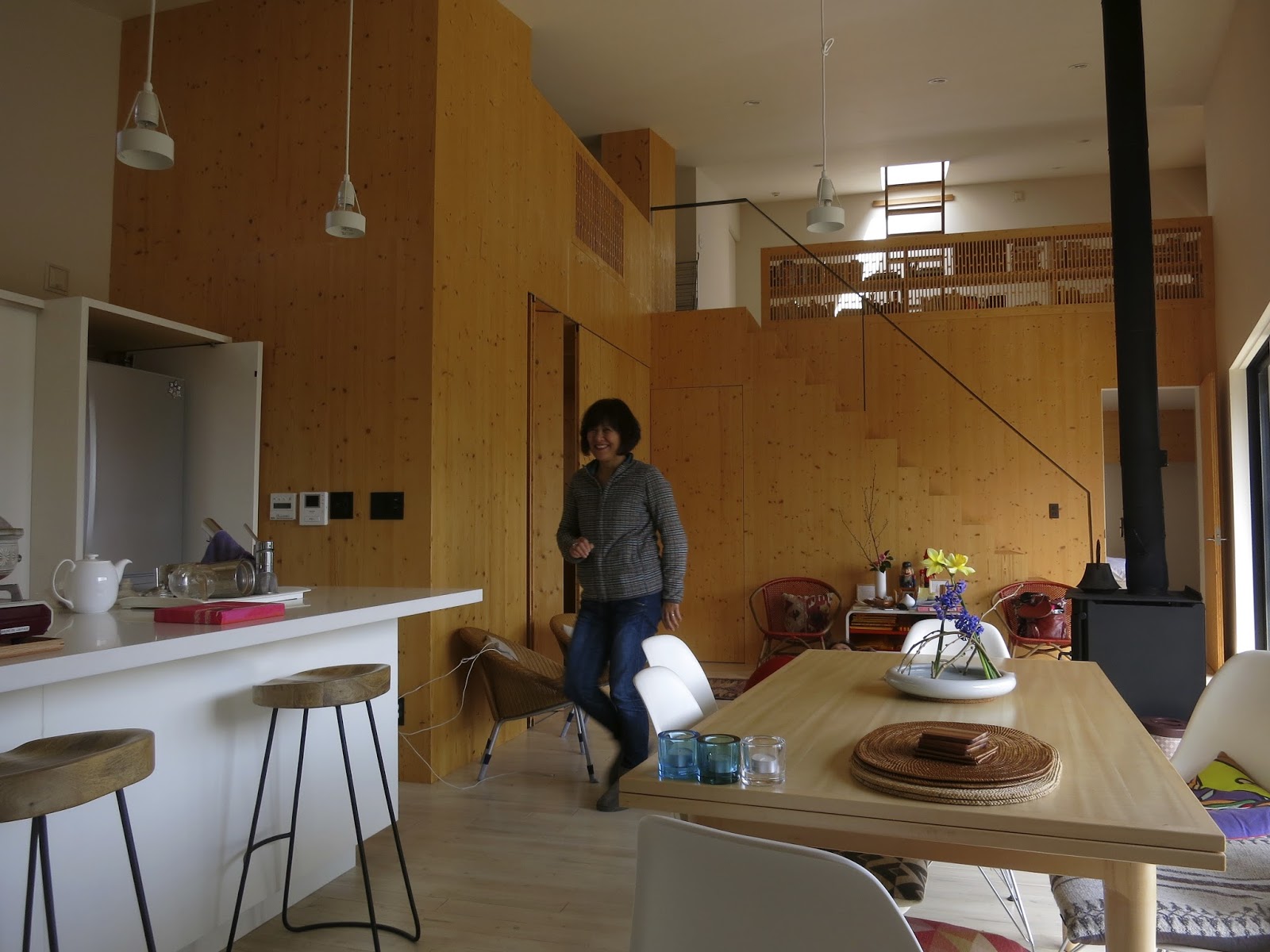
We came here six years ago when the foundations of this very modern weekend house were first laid.


Here is the finished house.


The house has one very large living space and a multi-use mezzanine loft over the bedroom.


Our friends enjoy coming to the beach on weekends where Joe gets to do some surfing.


Yesterday it was about 10C and still a large number of die-hards were out there. We were rugged up in hat, gloves and scarves.


Even the white heron looked hunched up against the cold to me.    


*          *          *          *          *

Last weekend at the Sogetsu Victoria Branch workshop the presenter was Sandy Marker, a Sogetsu Teacher from Sydney, who has been the most recent recipient of the Norman and Mary Sparnon Endowment scholarship.

Sandy gave a 'slide-show' and spoke about the three months she spent at the Sogetsu Headquarters in the first half of 2016. Following her presentation she conducted a workshop on the theme of Discovering New Opportunities. The members brought materials and vessels to the meeting which were exchanged; so that each member had material from one member and a vessel brought by yet another member. 


My exchanged vessel was modern, very narrow and bone coloured. The botanical materials, from a different member, were  a bunch of beautiful variegated miscanthus and some red dracaena leaves, as well as purple statice and some geranium flowers.

I decided that if I arranged the miscanthus in a naturalistic way it would look beautiful but I would not challenge myself. I therefore have tied the tips of the miscanthus randomly making a tighter more vertical form. I have massed the new flower-heads among the leaves to the right of the middle to increase the density of the volume. The dracaena leaves accentuated the verticality of the arrangement and provided a sufficient colour accent that I did not need to use any floral materials.

Greetings from Christopher
26th March 2017

EARLY MORNINGS

In recent weeks, when we have been in Melbourne, we have taken an early morning walk around the Royal Melbourne Botanic Gardens before breakfast. This is in an effort to maintain our fitness levels for when we walk along the Nakasendo in a couple of weeks. On one particularly bright morning I took the photos below.


Laurie at the 'Temple of the Winds' which is on a bluff that overlooks the Yarra River.


I thought the pattern of sunlight and shadows across the 'Oak Lawn' looked especially tranquil.

At the meeting of Ikebana International Melbourne Chapter last Tuesday Ms Keiko Haneda, the Consul-General of Japan, was our guest speaker. She has been our patron for the last three years and is due to return to Japan this coming week. 


In this photograph Cheiko Yazaki, the president, is on the left, then Ms Haneda and on the right is Rosemary Farrelly - a long standing member who was the subject of a 'mini-talk'. Another member of the Chapter had interviewed Rosemary and then presented a brief summary of Rosemary's life, giving members an insight into the richness of her 91 years beyond what we know about her passion for the Ohara School.

Members were asked to make an arrangement on an international theme, to represent a particular country. 


I misunderstood the theme and made a moribana arrangement with materials from Europe, Northern America, Southern Africa, East Asia and Australia; all in a suiban made by the New Zealand ceramic artist Elena Renker. I described my work as an intercontinental arrangement.

Greetings from Christopher
19th March 2017

LINE, MASS...and LILIES

During last week the school childrens' early morning class on the beach was surf riding. What a change from my childhood when the sport options were cricket and tennis in Summer and Australian Rules Football in Winter.


One great positive outcome of this class is that these children are learning all about safety in the water under the close supervision of their teachers.

This last week my ikebana friend, Lennart Persson from Norway, has been visiting. He joined my class in Geelong where the exercise was:  'An arrangement of line and mass' combined with 'Using dried, bleached or coloured materials". 


Lennart made a mass from banksia flowers and leaves and contrasted it with a line of faded green coloured Edgeworthia. The vessel is by the Canadian ikebanist and potter, Janet Keefe.


Ellie made a mass with Everlasting daisies and a dried leaf of Strelitzia Nicolai


Helen made a mass from deep pink Sedum and combined it with a line of dried vine.


In the garden the Belladonna Lilies Amaryllis Belladonnathat I mentioned last week, have reached their peak. I wrote about these flowers in this blog five years ago.

The story in my family about this flower is as follows: When my mother was in hospital waiting for me to be born, my grandmother was taking care of my two older brothers. Apparently the older of the two went out to play and came home with a bunch of these lilies that he had found growing by the roadside. Grandma was worried that he had stolen them from somebody's garden; so she made him take her to where he had found them. Sure enough, they were growing wild by the roadside near an old abandoned farm. Since then we have always had them in the garden and they often flower on my birthday.


This week I have used the Belladonna lilies and arranged them in a trough, emphasising the lines of their stems. They are contrasted with the volume of a canna lily leaf. 

The 11th World Convention of Ikebana International begins in almost one month, on 11th April. If you are going to be there I look forward to the possibility of meeting you in Okinawa.

Greetings from Christopher
12th March 2017

COLOUR plus FRUIT AND/OR VEGETABLES


Last week I posted the photo below of the first bud to the Haemanthus coccineus that I had planted out last autumn. 


I am pleased to be able to show you the now opened flower. It is interesting that this plant and Amaryllis Belladonna both flower before the leaves appear and are both native to southern Africa. 

This week I set my students an exercise that combined two themes from the Sogetsu curriculum. The first theme was to 'pay attention to the colour of the vase' and the second theme was to 'incorporate fruit' or vegetables in the arrangement.


Helen used a glass vase with mottled green and orange patterning. Her materials were all edible and included gourds and Love-lies-bleeding (Amaranthus caudatus).
  

Alana used a green glazed, shallow square dish, in which she arranged a branch of fig, green apples and two beautifully ripe purple figs. She treated her fruit as the hikae (usually flowers), extending the line forward onto the table. I think this helps avoid the appearance of simply presenting a bowl of fruit.


Christine has contrasted her materials with her modern white vase. The materials are spring onion, shredded and made to curl, tomato, green capsicum and kale leaves.


Ellie created a playful arrangement with a strong sense of movement, in an unusual pale yellow vessel. The materials are 'Italian' zucchini, lemons and a single yellow chrysanthemum that is just peeping at the back of the arrangement.

Greetings from Christopher
4th March 2017


ALTERNATIVE USES FOR STOCKINGS

Just this morning, as I was watering in the garden, I noticed a bud of Haemanthus coccineus had appeared. Last autumn I had divided an overgrown pot of this plant, given to me by a neighbour. I planted three bulbs in the ground and two in pots. I am looking forward to seeing how or if the rest of them will have survived the move. The snails love the leaves. I am hoping the rough eucalyptus mulch will deter them.


At the beginning of the week the Sogetsu branch held its AGM and first meeting/workshop for the year. The workshop was lead by Toula and Betty Karanikolopoulos. The subject was to make a sculptural form using wire and panty hose. I have not done this exercise before, though I was assured by more senior ikebanists that they had done the exercise some years ago. 

Many of us used coat-hangers as the most readily available wire in most households. After a preliminary failed trial, I wound my coat-hanger wire around a ceramic cylinder and then stretched it out to make a  helical spiral. I had bought some 'knee-high' black stockings and threaded them over two spirals.


As this sculptural form was created from obviously man-made material, I decided to use agapanthus flower heads with the seeds removed. They seemed to be more in keeping with the sculptural form I had made. However I was not happy with the result and thought it looked quite awkward.


I re-worked the arrangement at home in a different vase with an improved result. The result is really a 'basic upright' arrangement from the Sogetsu curriculum.

Below is one of the demonstration examples from the workshop. It was done by Toula and she has cleverly inverted the obvious way of managing this exercise. She created a wire spiral and then, after putting her nylon stocking tube within it, has attached it to the wire with fine threads. The result was very beautiful and created a delicate interplay of colour and layers of translucence.


Above is a close-up view looking through the pink stocking tube.


In this image you can see a side-on view of a tube of stocking that Toula said she '...painted with faux alcohol inks...(she made)...scribbles with permanent markers (Sharpies) and then...brushed methylated spirits on the scribbles to get the water colour effect.'.

Now you know what to do with those old stockings!!

See further images from the Sogetsu meeting workshop.

Greetings from Christopher
25th February 2017