WORKSHOPS in OTTAWA


On Saturday of last weekend I gave two workshops that had been previously arranged by the Ottawa Branch of the Sogetsu School of Ikebana. 

The theme of the first workshop, set by the Branch Committee, was Book 5 Lesson 7 'Composition Using Unconventional Materials'. The focus of the exercise is use of non-plant materials '...to explore a composition which cannot be made in an ordinary arrangement...' with plant materials. The same materials were provided for each participant; a rolled sheet of cork 
60cm x 30cm and a 100cm length of rather stiff, silver coloured, artist's wire. I thought the choice of materials, by the Branch committee, was good for the exercise as both the flat sheets and the wire had qualities unlike the botanical materials usually used in ikebana. 


This is my  demonstration example as I prepared it on the day before the workshop. My thinking was to use cones as an interesting geometric form that could stand without other support. My fantasy was to be able to have at least one standing on its point. However, the cork sheet started to crumble when it was tightly curved. So I ended up supporting it with a loop of the wire.


Rather than spend a lot of time fiddling around demonstrating fixing the materials, I re-assembled the 'sculpture' I had created. I then spoke about the importance of this and similar exercises in the Sogetsu curriculum that encourage us to experience other forms of the plastic arts. Such experiences, often outside our 'comfort zone', expose us to design ideas independent of the constraints of botanical materials. These experiences then feed back into our ikebana, perhaps unconsciously. It is worth remembering that Sofu Teshigahara sculpted in wood, stone and metal, and was an accomplished calligrapher and ceramicist.

Below are sculptures created by some of the participants in the morning workshop. I apologise for not having recorded the names of their creators.


This photo shows a general view of the room and the participants at work during the second session. The theme was to make an ikebana arrangement 'Complementing a work of Art'. Unfortunately I was not able to photograph any of the afternoon work.

The following day, with our hosts Leonora and Richard and some other friends, we enjoyed a meal and an ikebana activity at the country home of the ceramicist and ikebanist Janet Keefe. Photos next week.

After a further three days in Ottawa we then travelled to Montreal where we spent Thursday and Friday.

Greetings from Christopher
1st September 2018

(Congratulations to Colin and Tony on their marriage today.)

VANCOUVER to TORONTO


Continuing from last week, Laurie and I spent four days and nights travelling on 'The Canadian', the train from Vancouver to Toronto. For the first part of the journey after the Canadian Rockies the scenery was of agricultural, wheat-growing country, in Alberta and Saskatchewan.

    
These interesting, gable roofed silos beside the track are quite small and domestic looking compared to the the concrete cylinders typically seen in Australia. 


A day later we woke to see the sun lifting the mist off the many lakes in the western region of Ontario. This area was very beautiful, with the dense and huge area of Boreal or 'snow forest' that covers a great swathe across northern Canada. This forest is comprised principally of conifers.


The forest type changed to broad leafed species of trees as we came into Ontario. Beside the railroad tracks were lots of late summer wildflowers and I finally understood why someone in the past had described Goldenrod, solidago, as a weed. However, that doesn't stop if from being beautiful. 


I was really pleased to see some planted in a central business district ornamental garden, when we finally arrived in Toronto.


This is a close-up of the same bush .


After three days in Toronto we headed to Ottawa where we are now staying with my ikebana friend Leonora and her husband Richard. We were greeted by a number of freestyle ikebana arrangements including this one using purple statice, linomium sinatum, and globe thistle, echinops bannatictus.


This ikebana arrangement is an example of the curriculum exercise, 'an arrangement complementing an art work', which is the subject of one of the workshops I am conducting today for the Sogetsu Branch in Ottawa. I will report on the workshops next week.

Click here for more photos from our train journey Vancouver to Toronto.

Greetings from Christopher
25th August 2018

AGM and CANADA


On Tuesday this week the Melbourne Chapter of Ikebana International held its Annual General Meeting. As is the usual practise at the AGM, the heads of each of the different ikebana schools in the Chapter gave a brief demonstration. Being the director of the Sogetsu School branch I participated with a nageire free-style, horizontal arrangement. 


I have used materials from our garden all of which are Australian native flora. The main branches are the beautiful orange leaves of Bushy Yate, Euclyptus lehmanii. I have been watching these leaves from my bathroom window over recent weeks. Their colour, which is quite autumnal-looking, is most unusual. I suspect those branches are infected with a fungus or have been attacked by some insect. Stretching further to the left are some stems of Swan River Pea, Gastrolobium celsianum. This is a semi-prostrate plant with bright red pea flowers in late winter/early spring. Below are photos of the plant taken in our garden.


I have removed all the dark green leaves to emphasise the warm colour palate in the arrangement. The third material is Golden Wattle Acacia pycnantha, which grows in the reserve at the back of our garden and is the national floral emblem of Australia.


I re-set the arrangement when I returned home. The tapering porcelain vase is by the Victorian ceramic artist, Arnaud Barraud.

For more photos from the AGM, click on the blue text.

Yesterday Laurie and I set off on 'The Canadian', VIA Rail's four day train from Vancouver to Toronto. 


This photo is taken from the 'dome' car on the train as we travelled through the Canadian Rockies. The 'mist' is actually smoke from the 500-odd wildfires burning in British Colombia.


The red dot at the top of this photo was how the sun looked at 9.30 this morning when we stopped at Jasper.

Greetings from Christopher, 
enroute to Edmonton.
18th August 2018


THE SURF COAST ARTS TRAIL


This weekend has seen an annual arts event promoted by our local Surf Coast Shire. This is the local government council in which my home town of Torquay is situated. The event is the Surf Coast Arts Trail. Over the weekend artists and art groups in the Shire open their studios and class rooms to the general public to show-case their work. 

This year, at sixty-five locations around the shire, a huge variety of arts and crafts have been on display. My local ikebana class has again been one of the participant groups in the event.

     
In the couple of months before the Arts Trail I noticed that this Manchurian Pear, pyrus ussuriensis at the Lions Village was due to be pruned. A request to the Manager meant that my class was given permission to have the prunings, from which we could make our sculptural ikebana. The unexpected gift of the prunings turned out to provide a theme and visual coherence to the small exhibition.


Kim used just two branches and no fresh material in his work. The elegant lines are held in place by very tall, 60 - 70cm, glass vase.


Giana has also inverted a branch to emphasise the lines where the branches separate from the main stem. She has added two large flowers of Banksia Praemorsa, from her own garden.


Róża has placed her branches upright in a red painted bamboo vase, emphasising the vertical lines. She also used Banksia Praemorsa flowers and a small group of leaves.


Val has placed her principal branch across the top of her tall rectangular vase. It has been secured by discreet wiring to the smaller branch on the right, which is stabilised on the table surface. She has added Banksia Coccinea as a focal point.


Rhonda has used a hand-built ceramic vase with a very narrow opening. The branch has been secured across the vase using a vertical fixture. She has also used Banksia Coccinea as her focal point.


Well, this will look familiar to readers who have seen last week's posting. I have re-used my exhibition piece from the Ikebana International Exhibition in Melbourne. Before transporting this structure home to Torquay (100km) I did have to remove the Cushion Bush leucophyta brownii and then re-attach it again. I was pleased to be able to photograph the work against a plain background and front-on rather than at an angle, as was the case at the exhibition.

Next week Roadside Ikebana will come to you from somewhere on the train between Vancouver and Toronto, as Laurie and I are heading to Canada for a few weeks' holiday. My posting could be even later than this week as apparently there is no wifi on 'The Canadian' (train).

Till then, greetings from
Christopher
12th August 2018.


SOME CONSTRUCTION WORK


Oh dear, more wattle! This one is a little different. It is a semi-prostrate Acacia Baileyana, in our garden. Interestingly it is flowering a little later than the a. baileyana tree by the garden path.


This main part of the original plant is about 60 cms high.


In this close up you can see, at the top left side, how the branches have an arching growth. Similar to, but much smaller than, the growth pattern of a weeping mulberry.


Some branches of the plant have become completely prostrate, creeping under other plants and reappearing on the other side.


I suspect they will start arching again having reached full sun again.

In the last week of July the annual exhibition of Ikebana International Melbourne Chapter was held at the Sofitel in the city. I participated, making a structural ikebana using some of the Manchurian Pear pyrus ussuriensis prunnings that my students and I had been given.  


This is what caught my eye when I saw them lying on the ground. I loved the multiple parallel lines and the small light grey highlight of the velvety leaf buds.


The stems also had a very interesting patterning that reminded me of other stone fruit trees, like cherry. With the chance of having such a lot of the material I immediately wanted to create an abstract style ikebana that would emphasise the linear form of the branches. 

I decided to use a large ceramic vessel made by Graeme Wilkie of Qdos Gallery. It is a 'half pillow' form that he developed in 2007.


In 2008 I made this large sculptural ikebana using three of them in an exhibition at Qdos. After the exhibition I acquired the vessel on the left in this photo. To make the new sculptural ikebana for the I.I. annual exhibition, I arranged the majority of the branches horizontally supported on a single oblique branch. Doing so emphasises the parallel lines. If I had arranged them vertically, to most people, they would look like a row of trees.


The technique I used to secure the branches was to drill through them where two branches touched. I then inserted a bamboo skewer from the kitchen as a dowel which I glued into place.


Here is the finished work to which I have added a mass of Cushion Bush leucophyta brownii, which penetrates the plane made by the horizontal branches.

More images of the exhibition are at: Ikebana International Melbourne Chapter Annual Exhibition.

Greetings from Christopher
4th August 2018

SHAPES FROM THE WORKSHOP

What a difference a week makes. 


This is the photo posted last week with the Acacia Baileyana  cascading low over the garden path. As I had suspected it came into full bloom this week...


...and hung even lower. It is really most spectacular and fairly glows in the bright sunlight.

Also last week I mentioned the Melbourne Chapter of Ikebana International had a Saturday workshop focusing on 'Shape' in freestyle ikebana. The workshop was led by Yukako Braun, the Head of the Ikenobo School in Melbourne. Some of her students had prepared examples of ikebana to demonstrate the concepts. These first two examples have a circular form, but very different expressions.


In this arrangement, made by Angela Chau, the materials are arranged naturalistically.


Yukako's own example was a large arrangement with a generous expanding feeling. Her arrangement is 'creative', as distinct from naturalistic, with the materials arranged emphasising surface, lines and the focal point of the flowers.


Julie Ayers' arrangement was also 'creative', emphasising repeated triangular forms.


Bill Riches has made a naturalistic 'vertical' arrangement. In Sogetsu terms this is very similar to a 'double shin' arrangement. The double shin form is also one of the many forms of Rikka. If you click on the link you will see that it obviously takes a master, and many hands, to create such a work. The two halves are separated by a narrow space and each half must have the requisite number of lines to make a complete rikka in itself.


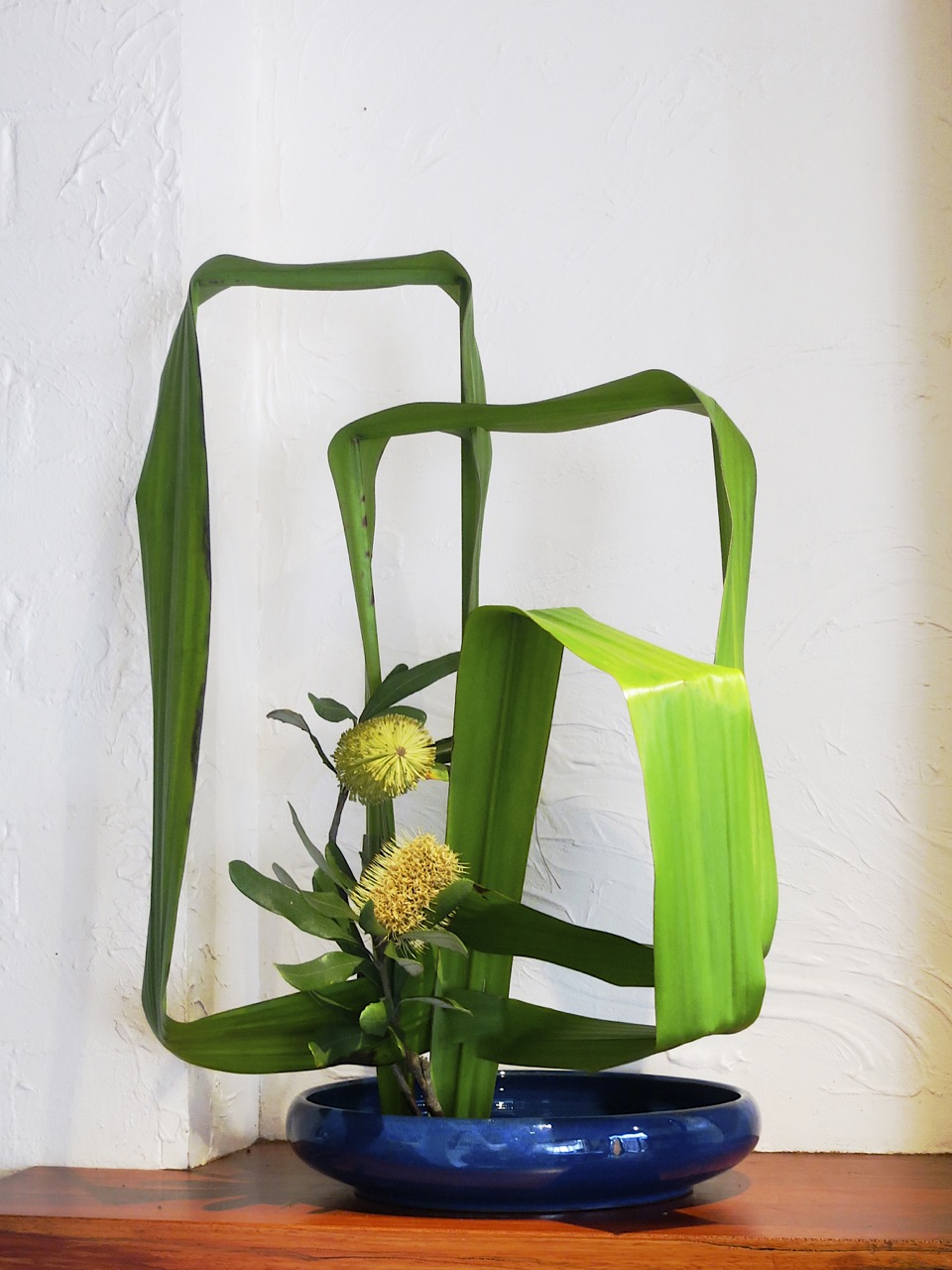
Last week I showed the arrangement I made at the workshop using the 'square' form. This arrangement, above, extends the idea more clearly into three dimensions than last weeks arrangement. Also, the shapes I have made with the leaves are obviously rectangles. The materials are gymea lily doryanthes excelsa leaves and banksia integrifolia, in a ceramic suiban.


Greetings from Christopher
28th July 2018


IKEBANA INTERNATIONAL SATURDAY WORKSHOP

On a cold winter's day with bright sunshine, surfing at Bell's Beach was the thing to do. We enjoyed the spectacle from the cliff top, rugged up in our coats with caps and gloves to keep us warm. 


This is for Kenichi Wada, who spent some time on the Gold Coast a few years ago.


In recent postings I have shown the progress of various wattles coming into bloom. Laurie caught me ducking my head under the Cootamundra wattle that cascades over the garden path. The weight of the blossom causes the branches to bend considerably lower at this time of year. It is almost in full bloom.

Yesterday, Ikebana International held its second weekend workshop for this year. The leader of the workshop was Mrs Yukako Braun, the head of the Ikenobo School in Melbourne. The theme for Yukako's workshop was 'Freestyle' ikebana focusing on shape. The participants were sent some photographs of arrangements demonstrating the following basic forms: Circle, triangle, square, vertical, horizontal, slanting, cascading and gathering.

I decided that the theme of a square shape would be interesting. It was an opportunity to contrast the geometric lines that can be made with 'umbrella grass' and the natural lines of Japanese Flowering Quince Chaenomeles, which is flowering in the garden at the moment.


As you can see my 'squares' are rather rectangular and a bit out of shape. I ran out of time and was not able to encourage the top left corner to make a 'right angle'. 

The photo was taken after the critique. At the critique Yukako commented that, from an Ikenobo perspective, the more naturalistic elements of an arrangement should harmonise with the 'creative' freestyle aspect. Therefore in this case the branches of the Flowering Quince should be bent at angles to harmonise with the shapes made by the umbrella grass. This has been done to some extent in the photographed work. I think the principal branch is altogether too stiff and straight and was therefore a poor choice of branch on my part. It was really interesting to participate in the workshop and listen to Yukako's introductory presentation as well as the critique. Next week I will provide a link to the Ikebana International blog when it is published.

In the mean time if you are in Melbourne between Tuesday next 24th and Sunday 30th visit the Ikebana International Exhibition at the  Level One foyer, Sofitel Melbourne on Collins.

Greetings from Christopher 
22nd July 2018