INDIGENOUS AND EXOTIC MATERIALS


Yesterday we walked in the bush near the Iron Bark Basin nature reserve in the morning. It was a glorious spring day after two days of cold, destructive winds and rain.


The peaceful view over the ocean from the high cliffs was beautiful and calm, such a change from the day before. 


The low angle of the morning sun illuminated this small patch of  moss with two Nodding Greenhood orchidsPterostylis nutans, and some Drosera.


Close up of Drosera aberrans.

To ikebana.

Last week I set my Torquay students the exercise of arranging endemic Australian materials with exotic materials. The idea of combining unlikely materials is one example of Sofu Teshigahara's thinking. Up to the late 19th century there were many rules constraining what was acceptable in ikebana. For example, the first book in English about ikebana, “The flowers of Japan and the art of ikebana” by Josiah Condor was published in 1891. It includes listings under the two headings:  "Appropriate Combinations" and "Objectionable Combinations” of flowers.


It was against just such strictures that Sofu sought to free ikebana. There certainly are combinations of materials that do not sit naturally well together. However, Sofu considered that any combination is possible. But it is up to the skills of the ikebanist to make the materials work together to create successful ikebana. 


Below are two examples by my students of the exercise I set. 


Val arranged two Western Australian flowers, a maroon Kangaroo paw and, I think, an Erica with two cymbidium orchids, in the Kabu Wake (two groups) style. She has used tonal variations of one colour to harmonise the ikebana.


Helen combined a Grevillea with two leaves and two daffodils. In her strong design the grevillea, which is arranged naturally links the principal elements.

I was interested in the various strategies that students used to achieve harmony. These have included: harmonising (or contrasting) with colour, texture or form. Also choosing one material to be the principal subject and the other subordinate. In Japan I remember seeing the colour-matching strategy to create harmony. However, there are obviously many other ways to solve this problem.


Having set this exercise I have come to realise that I quite often combine plants from different geographical locations and climates. The example above is a re-working from a few weeks ago. Native Clematis microphylla with a variegated aspidistra leaf. An example of using colour to harmonise the elements.


Last week my attention was caught by a wild growing prunus that was just starting to flower. It was in a very exposed position and was stunted with the branches leaning away from the prevailing winds. I decided to contrast this with a mass made with two stems and one flower of Banksia integrifolia, from the garden. In my own example I have made the native materials subordinate to the ‘main subject’, which was the flowering branches of prunus that were so expressive of early spring. 

The white porcelain vase is by the Castlemaine ceramic artist, Phil Elson

Greetings from Christopher
30th August 2020


ONE FLOWER AND ONE LEAF


In these days when face-to-face classes are not permitted, my students continue to practise their ikebana at home. I have the pleasure of receiving photos of their ikebana via email and commenting on their work. This however is not without its challenges. The first and most obvious thing is that I am commenting on a two-dimensional photo, not a three-dimensional ikebana seen in 'real life'.

When I photograph my own work I often close one eye to get a better idea of what the camera is seeing before I press the button. It is surprising how often this alerts me to the need to alter the ikebana slightly or make a small change in the angle of the camera. The other major difference from conducting a face-to-face class is that I do not get to see the work as it progresses and observe the student's problem-solving and manual skills. However, for all of us, this new mode of communication is certainly better than not having classes.


Recently Eugenia sent me this photo of her Kamon Hon'ami camellia arranged with a bare branch. She has arranged the materials in a traditionally-shaped bronze vase with very elegant lines that suit her pared-back ikebana.


Margaret told me that she had the good fortune of finding these Golden Ash, Fraxinus excelsior 'Aurea', branches while out for her daily walk. She has arranged them in a suiban without using a kenzan, adding two Aspidistra leaves and a mass of one of the Thryptomenes.

In the garden...


...I recently noticed that an Arum lilyZantedeschia aethiopica, planted a couple of years ago, was developing its first flower. I carefully monitored its development as I wanted to use it as an ikebana subject. My thought was to make an arrangement using one flower and one leaf.


I decided to use this vase by Pippin Drysdale because of its form and its strong colour. At a glance this vase looks purple. However, the surface is made of alternating fine lines of intense blue and red glaze. The interior of the vase is red only.


This photo of the interior shows that the stems have been gently and patiently curved. The curving of the stems allowed me to brace them against the wall of the vase to achieve the desired positions and particular angle of both the flower and the leaf.


The flower is placed in a relatively horizontal position with a left to right movement. The leaf sits mostly hidden behind the spathe with its tip projecting above the open space on the righthand side of the vase. Minimal materials with a strong presence.

Greetings from Christopher
22nd August 2020


JAPANESE FLOWERING QUINCE (Chaenomeles Japonica)


If you receive this blog by email you will have missed a correction I made to last week's blog after it was posted. The correct name of the maker of Michael's ikebana vessel (below) is 
William Baker, whose work can be seen by clicking on the link.


                +                    +                    +                    +

We have had a patch of welcome wet weather over the last week, some brief storms without being severely cold on the coast.


At times it looked rather like this, except that I took the photo of this dramatic-looking sky in the early morning at least a couple of months ago.


I have been delighted that a camellia that I acquired from a neighbour late last year has, A) survived repotting and B) rewarded me with these beautiful flowers.


Camellias are such a delight in winter and generous in their flowering. I now have this unnamed variety and a Kamo Hon'ami. Both are in pots as I don't think they will survive through summer in the dry soil of our garden.


In the late winter, early signs of spring are appearing. This is the transitional season that Dr Tim Entwisle, the Director of the Royal Botanic Gardens Melbourne, calls 'Sprinter". The link above is to his excellent blog.


In our garden I was pleased to see that this small shrub of Japanese Flowering Quince, Chaenomeles japonica, has survived the ravages of possums and is beginning to flower well.


It is such an intense colour that it looks extra bright on a cold winters day.


Beside the red Japonica is the variety called Apple Blossom, which has delicate pink and white flowers and was given to me by my friend and former colleague Shirley.

I was keen to make one more ikebana arrangement with the Flowering Quince before the season changes. 


The angular lines of the branches really seem to capture the feeling of winter. They are most dramatic in their leafless winter state which also shows off the flowers in their stark intensity. This ikebana is made with two Flowering Quince branches and one stem of camellia leaves. They are supported by a small forked branch braced across the mouth of the vase. I have carefully aligned all the stems so that they arise from the mouth of the vase in a single line that creates a cleanly defined point of connection with the vase. Because the main branch has such interesting angular lines, a space has been created on the left that emphasises the contrast between the freshness of the camellia leaves and the principal branch.

The vase is by the Victorian ceramic artist Owen Rye.

Greetings from Christopher
15th August 2020


CASCADING FLOWERS


One of the delights of sharing ikebana with friends via the internet is the relationships that are forged across the world. A month ago I showed photos of ikebana by Leonora who lives in Ottawa and Michael who lives in Florida. Here are two further ikebana arrangements, one by each of them. 


Leonora's small elegant arrangement is of her Magnolia in its second flowering, after the leaves have formed. The colours tone beautifully with the ceramic vase. Coincidentally in the same tonal range is...


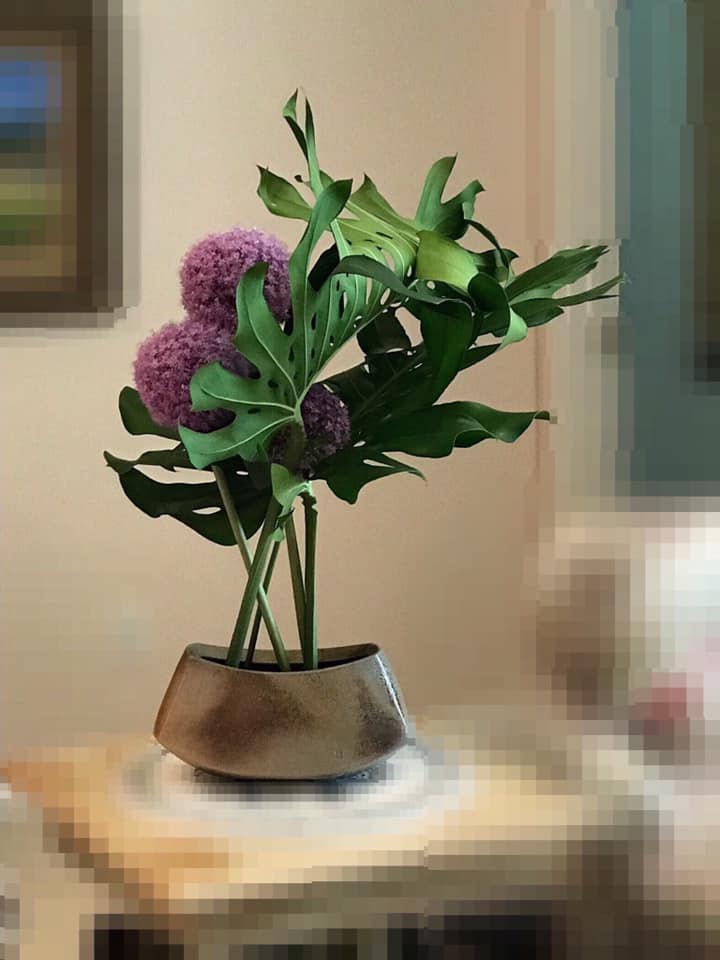
...Michael's arrangement of Allium and Monstera deliciosa. This is a classic example of the Sogetsu exercise of 'Showing (or emphasising) the Lines at the Base'. The ceramic vessel is by William Baker. (Also at: https://www.pinterest.com.au/baker2861/ )  
[This is a revised post as I had misattributed the name of the potter.]

These photos shared by friends make me more conscious of the northern hemisphere seasons being opposite to the southern hemisphere. This in turn heightens my consciousness of the seasonal nature of ikebana itself.

The Cootamundra Wattle in our garden, which I showed a couple of weeks ago, is now well passed the peak of its flowering. 

The latest spectacular flowering locally, is the Australian native Clematis, Clematis microphylla. The flowers are rather small but certainly abundant.

I took these photographs in the scrub on the leeward side of the sand dunes. This one has whiter flowers than the species which grows in our garden, which are a creamy-green. 

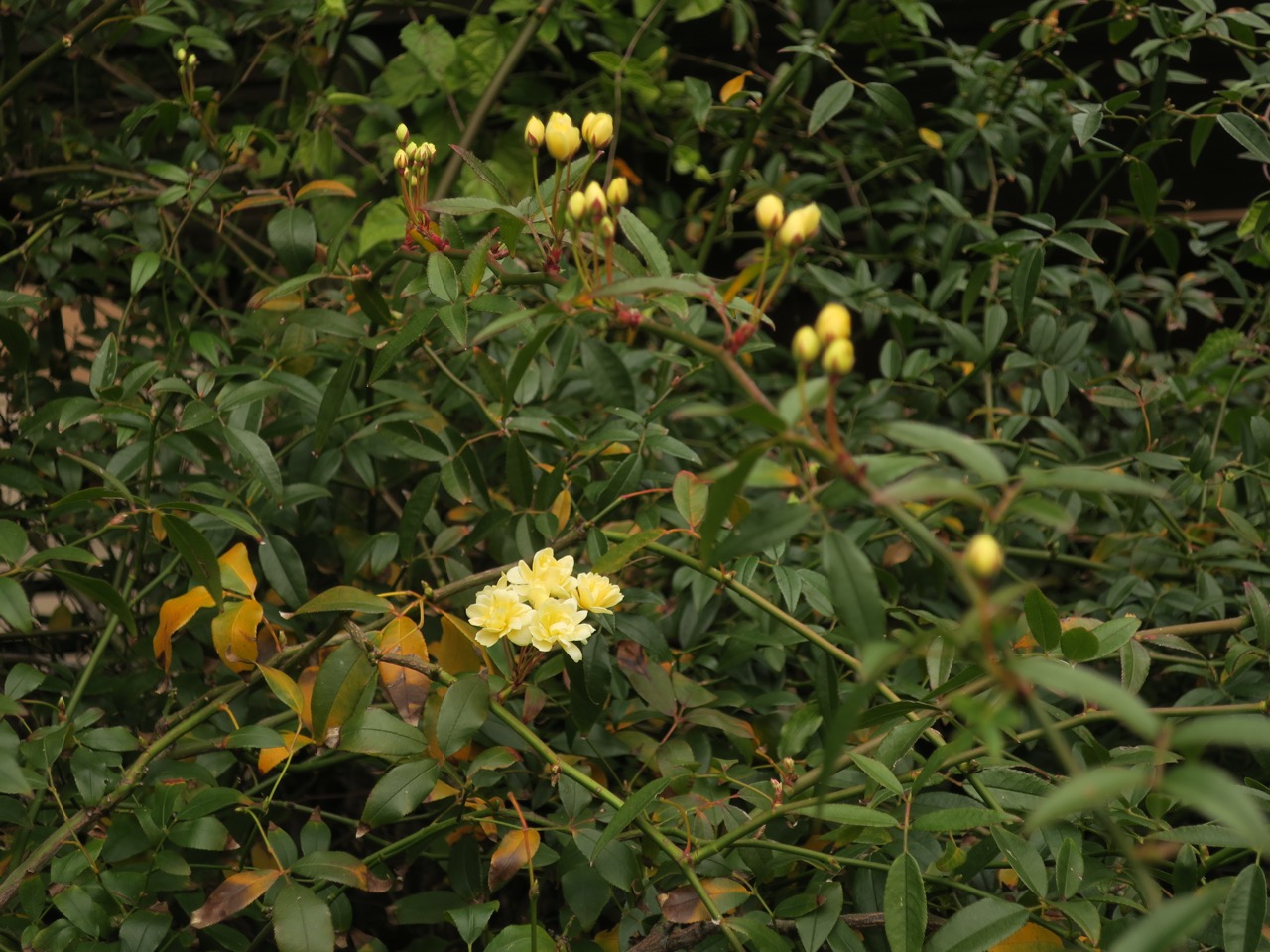
Also growing in our garden, and only just beginning to flower, is this Lady Banks Rose, Rosa banksiae. As both of these plants have a weeping habit I decided to use them in a cascading arrangement.

The tall yellow-tinted glass vase has sufficient height for the clematis to hang gracefully. I have partially stripped the lower part to emphasise its line. At the top I added the rose to create textural variety and a counter balancing mass. Although it is not apparent from the photograph the two rose stems project well forward. In the next photo this will be obvious.

This is the second version of the ikebana. I have added a leaf of variegated aspidistra, which provides additional textural variation. The leaf was too wide and one side was almost totally green so I split off the green side. Then I curled the leaf, creating the illusion that the branch materials cascade from within. 

Greetings from Christopher
9th August 2020


THE FEELING OF WINTER


On one of our daily walks recently I was delighted to see this small flock of Galahs perching in a Melaleuca lanceolata by the foreshore in Torquay. They had been tearing at the roots of some grasses before they were startled and flew into the tree.
 

On Thursday, in the Iron Bark Basin nature reserve...


...we saw this lone Kookaburra, perched on a branch. These birds are more commonly seen in forested areas and are now occasionally seen where we live because of the large number of native trees that were planted in the 1960s and 70s.

*          *          *          *          *

Two of my students recently created ikebana on the theme of a winter arrangement. 


Ellie said she was inspired by the idea that citrus are fruit that start to be harvested in winter. Her contemporary style ikebana includes a lime, lemon, tamarillo and a bare branch in a black vessel. The use of bold colours and the black vessel set me thinking of the De Stijl art movement.


Eugenia has created a classic winter arrangement using a single pale pink camellia and bare branch in a black suiban. The reduced colour palate and bare branches evoke the stark beauty that can be found in winter.

This winter in Victoria has been quite dry. Only yesterday I decided it was necessary to water some of the plants in the garden to prevent them from becoming stressed. At the same time, and perhaps unrelated, we have been visited at night by Brushtail Possums. They have been ravaging the large Lorraine Lee climbing rose and eating the petals on the Japanese Flowering Quince, Chaenomeles japonica.

The flowering quince is one of my favourite winter ikebana subjects and I was despairing of being able to pick any this year. Three weeks ago I noticed a plump bud that had not been eaten so I quickly cut a couple of branches.


This is the first version of the ikebana I arranged, using two branches in a black plastic suiban. You may just see a small intense red-pink bud on the lower left  of the main stem.


Here it is in close-up where, in the warmth of the living room overnight, the flower opened to a beautiful cup of pink containing a mass of yellow stamens.


Several days later the buds had begun to enlarge. I repositioned the two stems and added some white narcissus from a small clump to give an added feeling of freshness and new growth. Because the clump of narcissus was small I did not pick any leaves as that would have deprived the bulb of nutrients for the rest of the season. The green leaves I have added are from a Crocosmia.


Two weeks later the narcissus had finished but the quince had blossomed beautifully. As you can see the flowers that have opened after the branches had been cut and brought inside are progressively more pale.

Greetings from Christopher
1st August 2020


SOME AUSTRALIAN NATIVE PLANTS


Australia is blessed with many very unusual looking plants that make excellent material for ikebana. Most of the continent has low rainfall and many of our native plants have specific adaptations for such dryness. Perhaps the most obvious are the plants with tough leaves that do not wilt. One particularly striking plant is Eucalyptus Macrocarpa, indigenous to the south west of Western Australia. 


I first came across it in its native habitat in 2014 when Laurie and I drove across the country. This photo was taken at the side of the road near Albany on the south coast.


On another visit to the west I saw this example in the Botanic Gardens at Kings Park in Perth, with a large fully-opened flower on a fairly stiff stem. The leaves and stems are covered in a light grey downy powder giving the plant a silvery appearance. For these reasons and its longevity in a vase E. macrocarpa is  grown for the floristry market.


My student Ellie recently used a single stem of E. macrocarpa with unopened buds to make this arrangement. She has added the dry stem of another species of eucalyptus to create a space and a sense of movement that complements the fresh material.

Ellie told me of her frustration when, in the process of arranging, some of the flower buds dropped off the branch.


Creatively turning this situation into a positive one, Ellie arranged the buds in a glass vase. The four buds are arranged asymmetrically and one is carefully anchored to show its profile. She has also taken care to create space in the ikebana. Under water the powdery surface of the material has developed a silvery sheen.

In our garden another Australian native Acacia baileyana, which I used in my ikebana last week, is at its most prolific flowering. 


During the week I was removing a struggling helebore when I noticed that the semi-prostrate A. baileyana was also starting to flower. This plant is always a little slower to flower than the tree form. In the photo the semi-prostrate plant is in front of the Strelitzia Juncea, the straight stems of which are seen protruding behind. Behind them is the A. baileyana tree form.

I had wanted to use the acacia again as it is such a cheerful sight on a wintery day.


I used two long stems of branch material which also have a blue grey appearance, akin to the E. macrocarpa. These stretch to the right while a mass of blossom reaches forward and to the left among a structure of red painted sticks. I have deliberately chosen this shino-glazed vase by the Canadian potter Don Goddard, because of the bluish grey that complements the leaf colour.

Greetings from Christopher
26th July 2020


FURTHER RE-USING of MATERIALS


Three weeks ago I noted that the Cootamundra Wattle, Acacia Baileyana, in the garden had started to bloom. Now there are large masses of bright yellow blossom cascading from the branches. 


This small branch shows how the mass of blossom begins to weigh the branches down.


In close up each individual blossom is no more than a ball of fine filaments offering their load of pollen to the bees and other insects that can be heard humming among the branches.

About a week ago I decided to use the wattle blossom in an ikebana in such a way as to show its profusion and the cascading movement. This mean that I need to use a tall vase.


I decided to use this tapering vase by the New Zealand-born ceramic artist Arnaud Barraud, who now lives in Victoria. The tapering form makes securing the branches a little difficult.


My solution to this problem was to put a vertical fixture into a small kenzan that sits on the bottom of the vase then wire two cross bars at the top. Without being secured to the vertical fixture these cross bars would easily fall down inside the vase.


In the final ikebana I have massed the blossoms toward the right front so that they cascade below the level of the vase rim. To the left I have created a smaller mass of the blue-grey leaves of the wattle. A visual balance to the masses is created by two lines on the left-hand side. These are stems of Strelitzia juncea, which has a matte grey-green colour. The stems are formed into triangular shapes creating a more contemporary feel to the ikebana and picking up the shape of the vase.

I really enjoyed the exuberance of the wattle blossom for a few days until it started to fade. However the Strelitzia stems were still looking quite fresh so I decided to re-use them. I had noticed an out-of-season flower of Agapanthus and thought it would work well with the stems I had saved.


The single flower had a slight curve which I exaggerated a bit more so that it would make a contrasting line to the straight lines of the Strelitzia. Contrasting straight and curving lines is an exercise in the Sogetsu curriculum. I was pleased to be able to create the interesting space between the curving line and the straight line. The irregularly formed vase by Graeme Wilkie has a pale celadon glaze.

Greetings from Christopher 
19th July 2020


RE-USING MATERIALS

 
On Wednesday last there was bright sunshine even though the air temperature felt quite chilly to me.


Laurie and I decided to go to the Iron Bark Basin nature reserve for our routine walk. A
s usual, the understory around these trees was cleared last summer to reduce the bush fire risk. In the basin to the left of this photo the understory is reasonably dense.


One of the typical understory plants we saw was this beautiful Common Heath, Epacris impressa, which starts flowering in winter. It is the Victorian state floral emblem and has a colour range from red through shades of pink to white.


Also at this time of year many of the ground orchids start to flower. Above is a small colony of Greenhood orchids, Pterostylis.


Unfortunately this close up of one of them is more blurred than I realised at the time of taking the photo.


We also came across this Grass Tree, Xanthorrhoea, that had just started to send up a flower stalk. I will endeavour to track its growth over the next few weeks.

Two of my North American Sogetsu friends have sent me photos of their ikebana recently, which I thought I would share with you. It is interesting to see how they use the materials from their own gardens.


Michael, who lives in Florida, created this massed ikebana using Begonia leaves and two Chrysanthemum flowers. He has made a point of showing the front and backs of the leaves for their colour variation. His ceramic vessel is by Akira Satake.

   
Leonora, in Ottawa, has made a generous horizontally-spreading ikebana using Hosta leaves. She has placed the leaves to show their surfaces, which are emphasised by the contrast of the inflorescence from, I think, a Draecena. The modern metal vessel is a Sogetsu School design.

Two of my students in Covid isolation have sent me the following photos.


Ellie has made an ikebana 'using both native Australian and exotic materials'. Her ikebana features Banksia flowers and leaves, as the principal materials, and dwarf Nandina Domestica for the secondary material. These are arranged with driftwood to provide a textural contrast.


Eugenia's 'one kind of material' ikebana features two Haemanthus leaves and Clivia berries. She has used the leaves to create a sense of movement, as well as containment for the hikae of berries. The low position of the materials complements the unusual vessel.


This week my ikebana is an exercise of 're-using materials' and giving them a second (or third) life. The Acanthus leaves and Hydrangea were used in last week's large arrangement. In this smaller ikebana I have created a space by elevating the upper leaf thereby also showing the interesting pattern of the veins on the underside. The hydrangea provides a colour contrast to pick up colours in the Bizen style vase by Ian Jones.

Greetings from Christopher
11th July 2020

Additional information for flower arrangers.
Acanthus leaves are notoriously difficult to use in ikebana because they wilt very quickly. The photo was taken eight days after their initial use in the previous ikebana. The technique I have learnt is: after cutting the stems under water, stand them in warm water (40C) with 1% vinegar added (that is 10ml per litre). It is worthwhile keeping them for several hours in a cool dark place if you can. If possible do not use a kenzan as the stems are prone to splitting and becoming very soft. I tend to use this technique for any materials that are known to wilt quickly.