Marisha had two lengths of Wisteria vine that were too long to be supported from a single cylindrical vase, so a second one was brought into play. This meant that the vine could be extended and intertwined without the risk of it breaking. Two Asiatic Lilies were placed toward the back to maintain the focus on the vine.
AUTUMN TRANSITIONING INTO WINTER
Marisha had two lengths of Wisteria vine that were too long to be supported from a single cylindrical vase, so a second one was brought into play. This meant that the vine could be extended and intertwined without the risk of it breaking. Two Asiatic Lilies were placed toward the back to maintain the focus on the vine.
ITS NOT EASY BEING GREEN *
Maureen used green gumnuts and Leucadendron branches. She also used some dyed Mitsumata Edgeworthia, one of the plants commonly used in making Japanese paper. This plant is unusual in that it naturally forms three branches at nodal points. The unusual branches are processed and bleached or coloured for use in ikebana.
My own ikebana this week uses Hydrangeas from the garden at the end of their Autumn phase. In early summer they are white; they slowly become pink; before going green then red in Autumn. The single leaf is from our slow-growing Gymea Doryanthes palmeri, a gift from my colleague Emily Karanikolopoulos. Some mechanics were necessary to achieve the floating of the leaf across the vase opening. It is secured to a vertical stem that is anchored in a kenzan at the bottom of the vase.
The vase is by the Victorian ceramic artist Arnaud Barraud.
19th May 2024
AUTUMN COLOURING
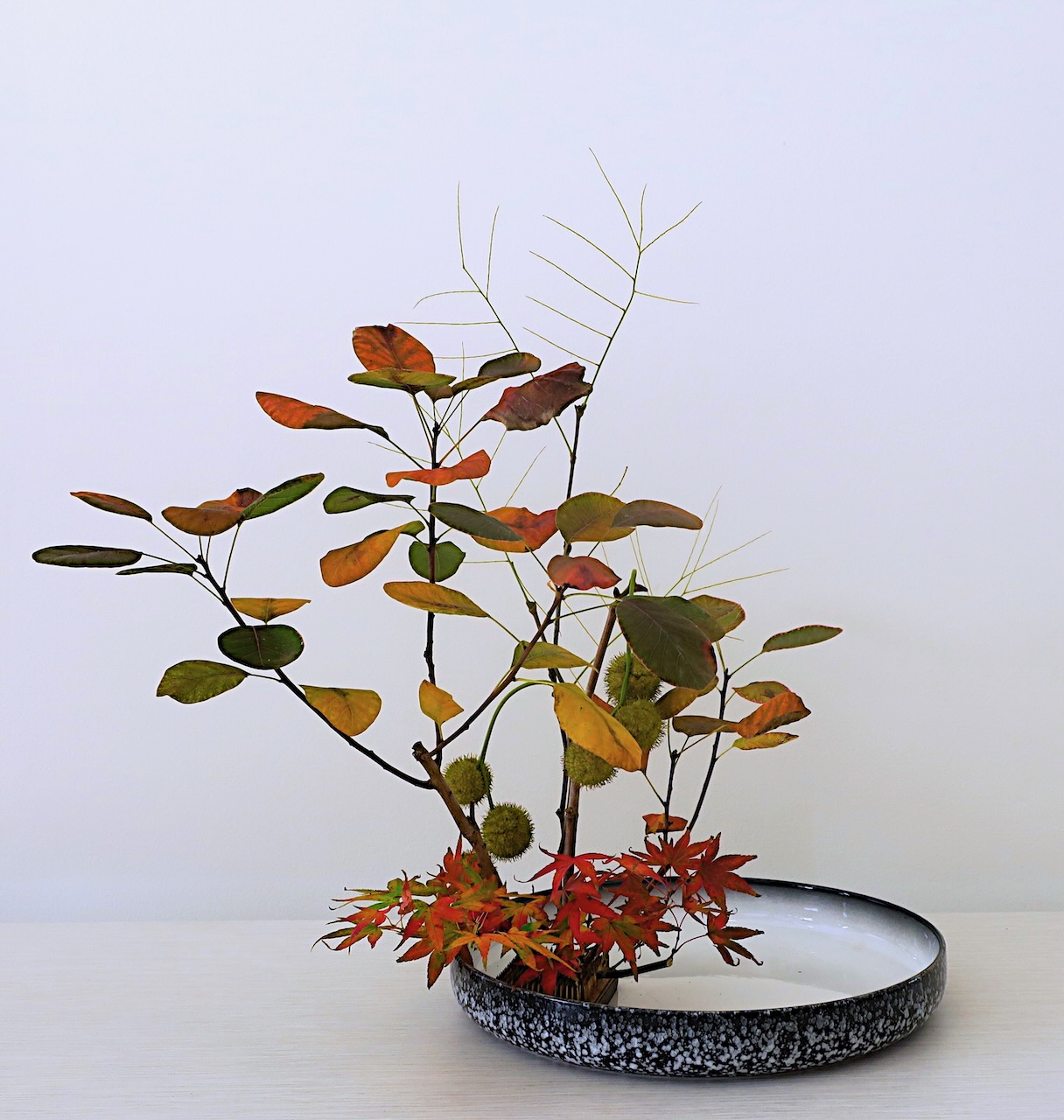
Marta's principal material was Smokebush Cotinus, Japanese maple Acer palmatum and fine lines from an unidentified branch that had been stripped of its leaves.
Pamela also used Manchurian pear, Japanese maple and some Cotoneaster providing a green contrast and the addition of red berries.
DEMONSTRATION
The next curriculum exercise was to make a "Composition of Curved lines". I have used Coast Sword Sedge Lepidosperma gladiatum, which has beautiful glossy green leaves that curve particularly well. The contrasting mass is made with two Hydrangea flowers from our garden, which have coloured to a rich red in the cool night air. The unglazed vase is by Don Jones, a South Australian ceramic artist.
This ikebana has the theme of using "Seasonal Plant Materials". In this case the autumnal materials left to right are: Nandina domestica leaves, Hydrangea leaves and a flower, orange Pittosporum P undulatum berries and Medlar Mespilus germanica. The box-shaped ikebana vessel is by the Canadian ceramic artist Leta Cromier
The theme of my final ikebama was "A composition of Mass and Line". In this case I created two knotted-looking masses using the stems of Strelitzia Juncea. I began by bundling four stems together and then randomly bending them across each other. The mass on the right is rather loose, while that on the left is tighter. The masses have been attached to the vertical line of the same material that arises from the centre of a tall narrow Japanese vase. A small mass of Nandina domestica Nana, leaves have been added to provide a colour focus.
NEW ZEALAND FLAX and RED "BOTTLEBRUSH"
The red of the Boston Ivy Parthenocissus tricuspidata, on the old Director's house, now called Gardens House, was quite intense. It is probably more eye-catching because in front of the old house is the Perennial Border, which is looking a bit dull now as most of the late summer flowers have finished blooming.
I also noticed that the ivy is climbing up a large tree to the west of the old building. This photo shows the bright red vine among the green leaves of the tree.
In a nearby Norfolk Island Pine some Sulphur Crested Cockatoos were chewing away at the bark of the highest branches.
Nearby there is the beginning of autumn colouring on this Pin Oak Quercus palustris, on the Oak Lawn; an early heralding of the cooler weather to come.
At my Melbourne class I had set a revision exercise for the advanced students, of making a slanting ikebana in the nageire style (that is, using a tall straight-sided vase).
A few weeks ago I made the ikebana below for our friends Heather and John who had invited us to dinner.
This photo shows the damaged leaves of the Flax that I mentioned in a posting recently. It is the result of three consecutive days in the high thirties while we were away, and the general dryness of our soil. I am trusting that the plant will recover over the winter when we will have more regular rain.
Once again I have used some of the heat-damaged leaves of the Flax in my ikebana. The leaves have developed areas of rust-brown surrounding straw-yellow patches on leaves that are mostly green. Some roadside-collected Red Bottlebrush Melaleuca citrina provides a harmonising colour focus. The use of such materials as these leaves is a reminder of one of the Wabi-sabi ideas. The recognition that beauty maybe found in the imperfect and transient.
The ceramic suiban comes from Seto city.
Greetings from Christopher
28th April 2024
KAMO HON'AMI
Eugenia arranged variegated Aspidistra leaves, creating a strong sense of lateral movement reaching outward. A single dark pink Chrysanthemum sits in the space between the two main lines.
Marcia used two branches of Japanese Maple. The longest branch stretches to the left front while the shorter one provides a counter-balancing movement. White Japanese Windflowers Eriocapitella hupehensis form a light mass in the centre.
Jacqueline's ikebana slowly evolved during the class. Originally, the large leaves stretched to the right and the left. This is the final version where two leaves reach toward the right side, one nestling in the other. Two Haemanthus coccineus flowers provide a strong accent at the base of the leaves. A single wandering line extends to the left.
Marisha used two stems of Protea "Pink Ice" which had a natural gentle curve that sat well in her oval-shaped bowl. Both stems seem to be reaching outward. In the centre is a small mass of pale blue-grey Eucalyptus leaves.
* * * * *
Earlier this week I noticed that the Firewheel tree Stenocarpus sinuatus, was flowering in the Royal Botanic Gardens Melbourne.
Greetings from Christopher
p. 108, Sparnon and Waterhouse. The Magic of Camellias. Ure Smith 1968