A SMALL MASS: TWO HYDRANGEAS and SOME LEAVES

 
Last week I posted a photo of the ikebana which I had re-set at home after the I.I. Melbourne workshop.  Other photos from the workshop are now available via this link: Ikebana International Melbourne, Chapter 29.

Two weeks ago I had set my senior Geelong students the task of making an ikebana 'emphasising the surface of the water' in a suiban. Given that we were then just over 2/3 of the way through summer, it seemed like a cooling idea. As usual, and very pleasingly, the students' work showed a variety of expressions of the idea.

Tess created a loose ikebana using bamboo stems and a pink Statice, Limonium. The open ikebana felt like a light breeze was blowing.


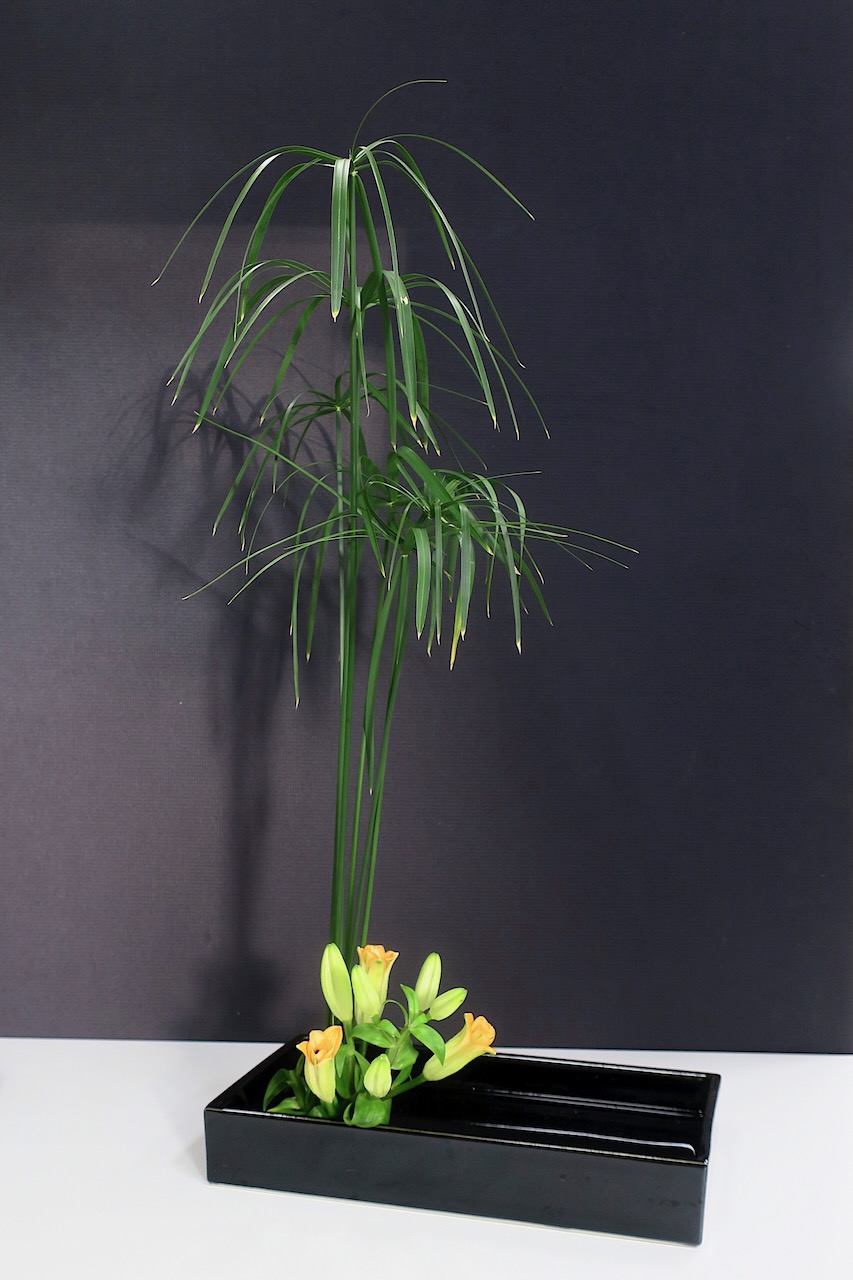
Maureen set five stems of Umbrella grassCyperus alternifolius, and a small group of Asiatic lily buds in a black suiban, creating reflections on the surface


Christine took a different approach by creating an abstract design with strong stems braced across the suiban. Small CrabappleMalus, fruit were contained between two of the lines. A third line was added to break-up the larger space on the right side of the suiban.


Ellie's ikebana featured three green Lotus 
podsNelumbo nucifera, two variegated Aspidistra leaves and a small mass of Sedum. Her ikebana was set to the right edge of the circular suiban to allow the reflection of the material to be seen in the water surface. 


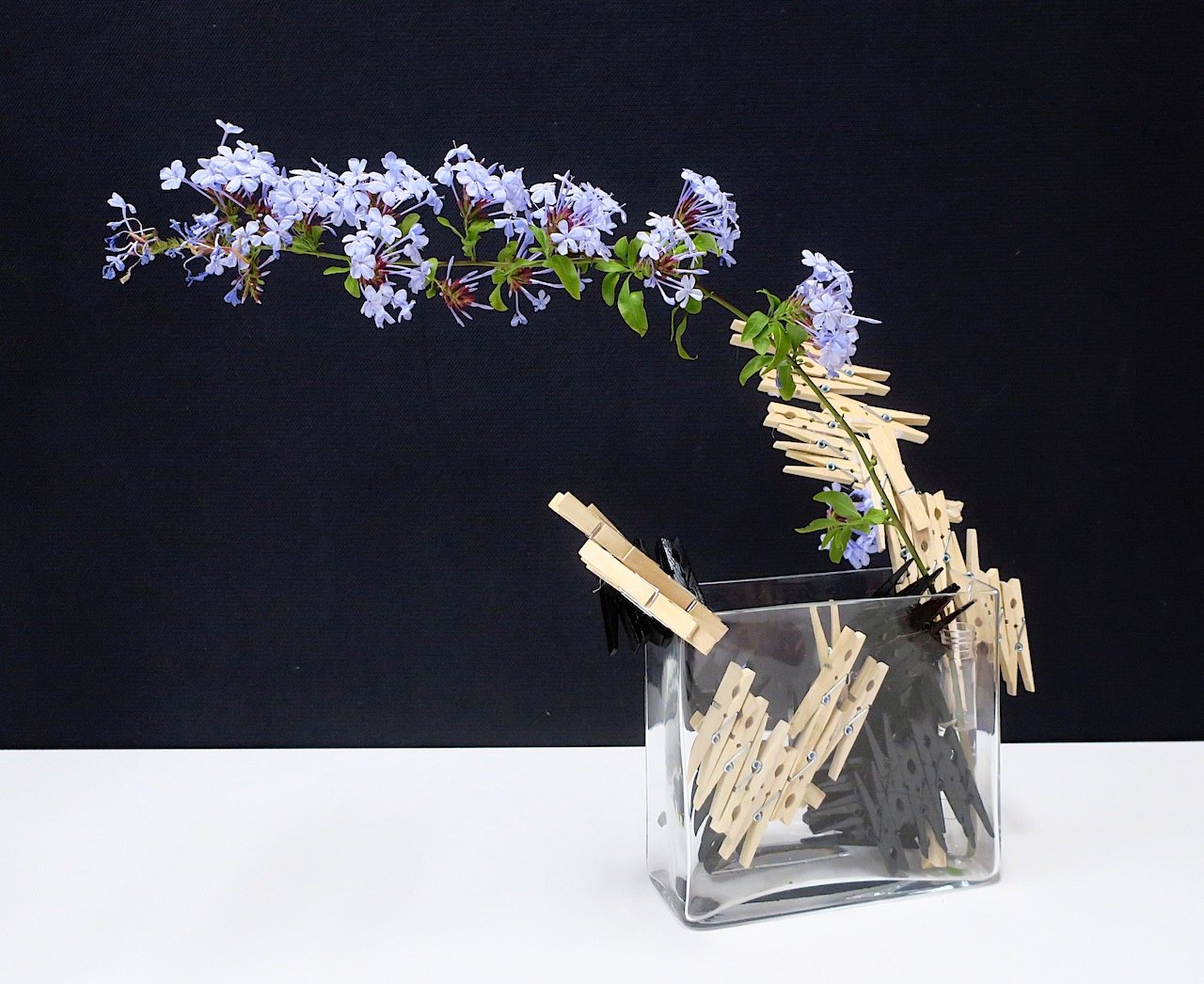
Maree's exercise was to create an ikebana "Using both Fresh and Unconventional (man-made) materials". In a flat-sided glass vessel she arranged masses of black and unpainted wooden pegs. These were contrasted with a single line of Plumbago auriculata.


Jo's exercise was to take the 'unconventional material' idea one further step. That is, she was to make a purely sculptural work using only man-made materials. She used black rope-like oval shapes, that reminded me of quoits, which she massed into a tall irregular structure. To create a focal point she added a small mass of blue plastic ties and some blue bubble-wrap.

This is a challenging exercise to which students, consciously or not, bring lessons that they have learnt from their ikebana studies. 

*          *          *          *          *
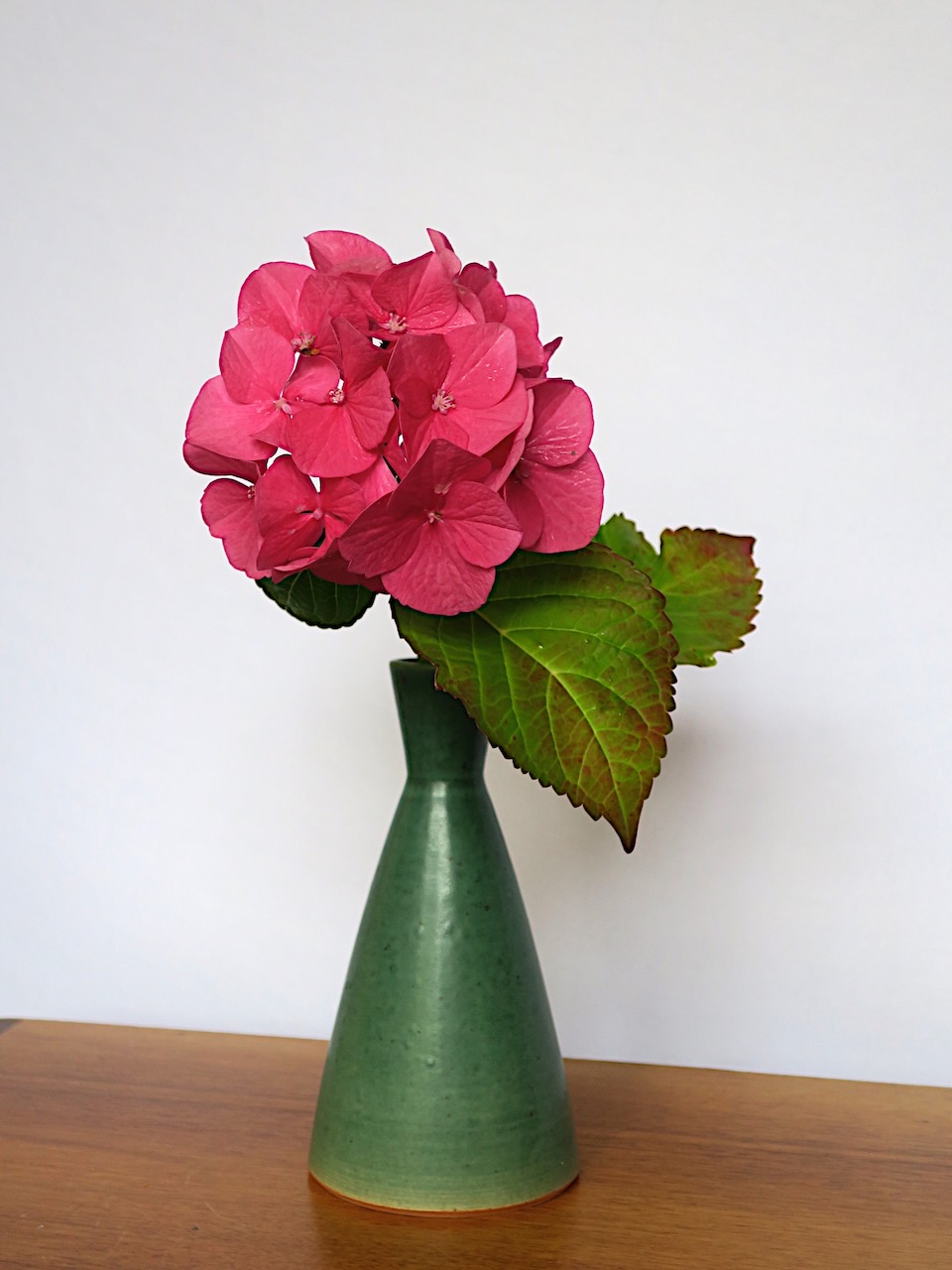
In the garden the pots of Hydrangeas have started to dry off. Their colours are fading and becoming more muted. I am hoping that some will survive into the autumn without being burnt by the sun. In that case, there is a good chance that they might develop rich red tones. I picked three small flower heads for my ikebana.


The colours in the flower heads are warm and muted. Some of the leaves are bright red at their tips and I wanted them to be seen also. However, this looks too busy...


...so I carefully removed two of the downward hanging leaves. This draws more attention to the the flower on the right and strengthens the asymmetry of the design. The botanical materials form the mass in this ikebana. 
In this instance the vase provides the line. The elegant six-sided Japanese vase has a very dark brown Temoku glaze.

Greetings from Christopher
17th February 2024
 

BACK TO CLASSES

 
Two weeks ago marked the end of the school holidays, with students returning to classes on 30th January. The following weekend, 3rd and 4th February must have been the most perfect beach weather. Sunny, but not too hot, with a cool light breeze.


The tide was low in the middle of the day and many people took the opportunity to enjoy themselves.


This photo shows the west end of Jan Juc beach.

Last week marked the return to classes for my students in Melbourne and Geelong. I had set my Melbourne students an exercise called "memories of summer (holidays?)". A topic that is wide open for interpretation.
  

Marcia's simple, somewhat stark, interpretation featured a forked branch of Cork Oak Quercus suber. The branch is part of a much larger one that came off her tree in a wind storm. She is particularly fond of the bark's colour and texture and was pleased this piece did not go into the mulch. The leaves on the branch had dried and fresh leaves were massed in the black vase.
 

Marisha chose roses which flower in this season. She selected some beautiful orange ones with petals that were a darker colour on the outside. These are contrasted with deep green leaves in the main lines, but harmonised with a mass of Dwarf Nandina leaves at the front which are beginning to colour yellow and red. 


Jacqueline's mind went to images of the setting sun colouring the clouds lit from behind in bright yellows and deep reds. She cut three leaves from her Canna Phasion thinking of their shape as well as the intense colours seen in a sunset. The roses which are just peeping from behind the leaves were yellow, orange and deep red.

Yesterday the Melbourne Chapter of Ikebana International held its first meeting of the year. The guest presenter was a Japanese born and trained potter, Naoko Coghlan, who now lives in Australia. Naoko gave a short overview of the history of pottery in Japan and demonstrated her own work. Members were asked to bring ceramic vessels to the meeting in which to arrange their ikebana.
 

I was pleased to have an opportunity to use this Bizen vase that I bought in Kurashiki last November. The unglazed clay body is a dark brown marked with irregular lighter blue-greys and tan that have occurred during the firing. I selected Miscanthus sinensis 'Zebrinus', Nandina and Hydrangea from the garden to make this naturalistic ikebana. This photo was taken at home, where I re-set the ikebana.

The Bizen vase is by Isezaki Jun.

Greetings from Christopher
11th February 2024

SOME EUCALYPTUS BARK


A few nights ago, as we were having our dinner in the conservatory, Laurie drew my attention to the shaft of late afternoon sunlight that was backlighting a Canna 'Phasion' leaf. This leaf is finely striped in red, yellow and bronze lines.  Who needs stained glass? Of course it was only a chance effect, which makes it all the more delightful.


Also this week, I was surprised that one of the buds on a Phalaenopsis orchid opened. I had bought the plant on a whim last year toward the end of its flowering season.


I really don't know much about these rather exotic orchids. However, when the flowers finally died I was fortunate to be advised by a friend that I should not prune off the old flower spike. A new spike branched off the previous one.


Now there are two open flowers and five more buds on the stem.

A week ago I noticed that the Bursaria spinosa in the garden was coming toward the end of its flowering.


I thought the small white flowers would go well in the new vase from the Kutani Kosen Kiln in Kanazawa. A simple line and mass ikebana.

Earlier in the week while walking along the creek path I came across some Eucalyptus bark. It had evidently come off a smallish branch and retained its cylindrical form. The inside was a warm soft orange colour while the outside was pale grey. The contrast between the inner and outer surfaces looked like an interesting ikebana subject.


This is the first version I made adding the fresh green of some more Bursaria. The flowers were not as green as in the photo. Unfortunately, I could not correct the colour. The Chun-glazed vase is by the Castlemaine ceramic artist Barry Singleton
I was not particularly happy with the ikebana as the interior of the bark did not show well.


This is my re-working of the idea in a vessel by the ceramic artist Graeme Wilkie of Qdos gallery, Lorne. I think it works a little bit better with the harmonising colours of the Crasula arborescens flowers. I also was able to re-position the bark to show the inside a bit more. I will keep my eyes open for some more bark to show the lovely interior colour. It has such a rich warm colour and soft texture which I find very attractive.

Greetings from Christopher
4th February 2024
 

SUMMER FLOWERS FROM THE GARDEN


Beside a nearby road, for the second time recently we saw a relative of Spike.


The Echidna was feasting on what must have been an extensive ant nest or other ground living insects. 


Of course Laurie and I kept very still and quiet while we watched as it worked its way along the bank by the side of the road. 


When it got to my shoes and started inspecting my socks for ants I had to suppress my impulse to laugh. The Echidna soon concluded my socks did not harbour ants and continued its foraging.

*          *          *          *          *

Meanwhile in the garden...


...the Spanish Broom Spartium junceum, is having a second flowering this season. I assume this is because of the rainy days we had in the last weeks of December.
 

The Red Valerian (actually pink) Centranthus ruber is flowering in smaller numbers this year, as I pulled out a number of the self-seeded plants. 

I used these Summer flowers as the materials for my first ikebana this week.
  

I arranged three branches of the Broom and added two flower heads of the Valerian in the centre toward the back and partially hidden. This fairly simple ikebana is arranged in a formal-looking style because I have kept all the fine stems in a single line arising from the centre. The vessel is a cup that Laurie bought from the New Zealand ceramicist Elena Renka when we visited in March last year.

Also to my delight the Bromeliad Aechmea gamosepala, has produced three flowers. My internet browsing has taught me that this variety is called "Lucky stripe". This plant was a gift from my sister-in-law Helen, and has only been in our rather dry ground for a couple of years.


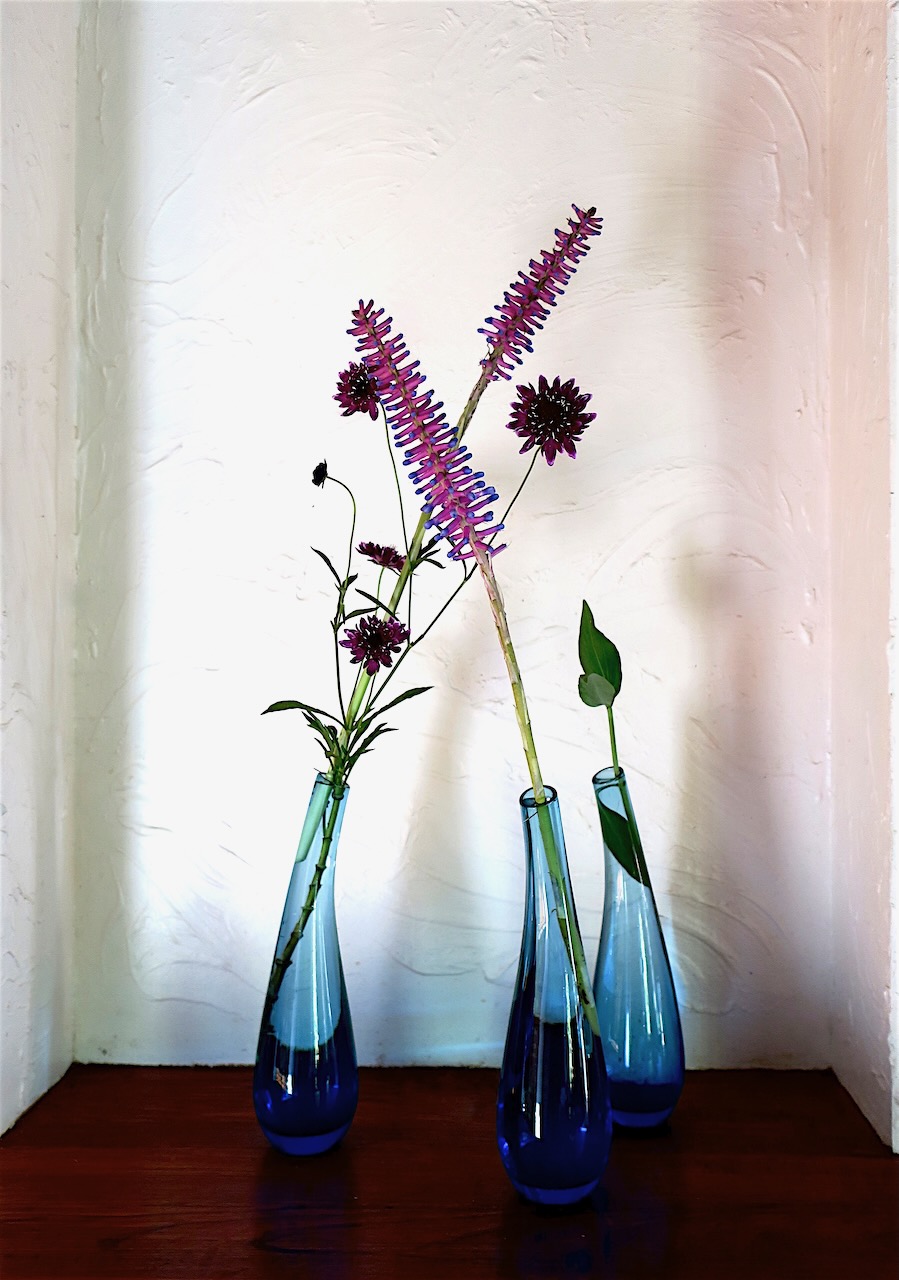
There is also slightly less Scabiosa atropurpurea flowering this year, as I removed quite a lot of it in winter as well. I am hoping that I did not pull out the white ones as they are rare in our garden. I used these two materials in my second ikebana.


Because of the blue tips on the Bromeliad flowers and the fineness of the Scabiosa, I decided to use these three glass bottle-shaped vases. The flowers and vases are placed so that their movement is toward the centre. My first teacher Carlynne would have said the materials are talking to each other. I also added a stem of leaves only, from the Red Valerian in the third vase. My aim was to keep the ikebana feeling light and summery with the water in the glass to be an important element.

Greetings from Christopher
28th January 2023


CORYMBIA FICIFOLIA


The summer weather on the Surfcoast has continued to be variable, but most of the last week was pleasantly warm and stable.


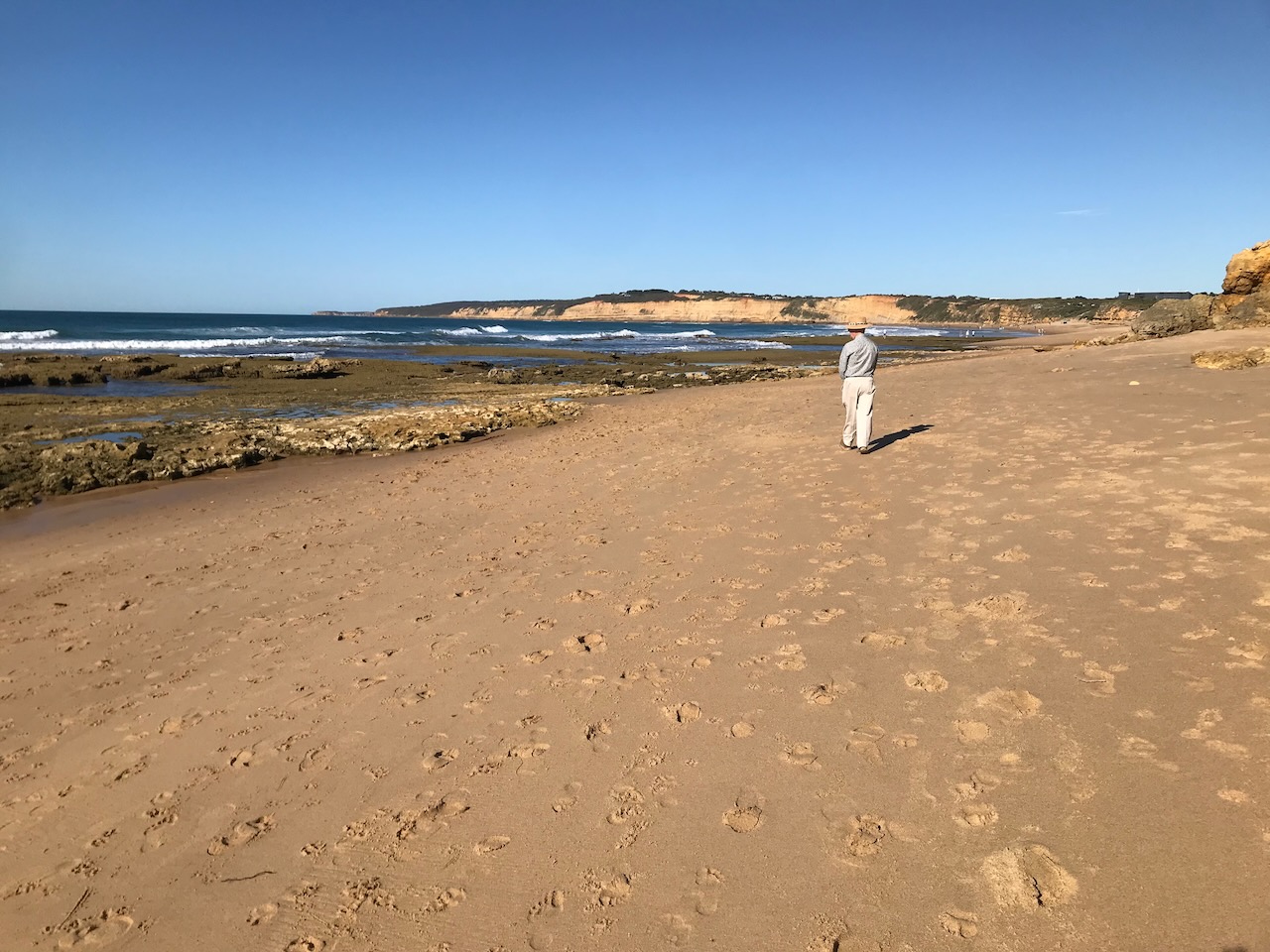
On Tuesday we had an early walk on the beach. However, the tracks in the sand reveal that quite a few people got there before us. The following day we were in Melbourne for a couple of catch-up events with friends. It also gave us the opportunity to visit the National Gallery of Victoria and see some of the installation work in the Triennial exhibition.
 

I was captivated by this wonderful installation: Mun Dirra (Manigrida Fish Fence), a beautiful work of dyed and hand-woven Pandanus fibre. The work is in several suspended panels that form curving screens which invite the viewer to immerse themselves in a richly-textured, warm-coloured space. The sensation of floating in flowing water was quite strong for me.


For several weeks now I have been enjoying the brilliant colours of some nearby Flowering gums Corymbia ficifolia. This bright red one is in our garden.


Not so far away is this vivid orange one that looms over a fence.


Also close by is another orange one that has passed its peak. The recent rain has knocked many of the fine stamens onto the footpath making a very fine, red carpet. 
I have been thinking of using these flowers as an ikebana subject for a while.
 

I gathered two clusters of the orange flower as I wanted it to be the principal subject. Then I picked a tight bunch of red flowers from our tree. These were fairly easy to arrange into two masses with the colours separated. I set the orange flowers to the front and left side. The red flowers were set behind and to the right of the orange flowers with a clear space between the two groups. On the window sill in the kitchen I had some Kangaroo fern Zealandia pustulata, that I had pruned from beside the path. It had been threatening to take over the path. The green of the fern made a good strong colour contrast to the red and provided a clear asymmetry to the design.


The vase is by Graeme Wilkie and has two broad vertical, brush-stroke like lines, that are very close in tone to the orange flowers.

Greetings from Christopher
21st January 2024


SUMMER COLOUR


The weather on the Surf Coast has been quite fickle; typical of Victoria, is the common view. On Christmas day and the week following, it was cool and wet. However, in the last week it seemed like summer had arrived. A welcome change for the holiday visitors who have come to Torquay to enjoy the beach.


The gardener's pleasure is to see the summer flowers. I recently replaced my possum barrier beneath the frame that supports the climbing Lorraine Lee rose. The new barrier is corrugated colour-bond edging and seems to be working well.


This is the most prolific flowering of this plant to date. Of course the rain has helped.  The potted Hydrangeas are also doing well.


This vivid pink one has only produced small flowers this year. 


Small flower size was not a problem for this particular vase/vessel. Laurie bought it for me when we visited the Kutani Kosen Kiln in Kanazawa last November. His specific comment was, "...this will be both your Christmas present and your next birthday present...". We both really liked the elegance of the design of this vessel. The kiln is a family-owned business. Interestingly, the current head of the family commented that his father made a number of these vessels about thirty years ago. This being one of the last remaining from that time. He also said that he could not reproduce the exact colour of this glaze as the recipe and details of the firing process were lost.
Vase or sake carafe?
Both!


I was happy with the colour contrast between the glaze and the Hydrangea. The small size of the vessel required a simple arrangement.


Also in the garden a couple of patches of Crassula arborescens, ...

...are looking their best. This one is partially shaded by the Apricot tree. Consequently, some of the flower stems are growing at a low angle.


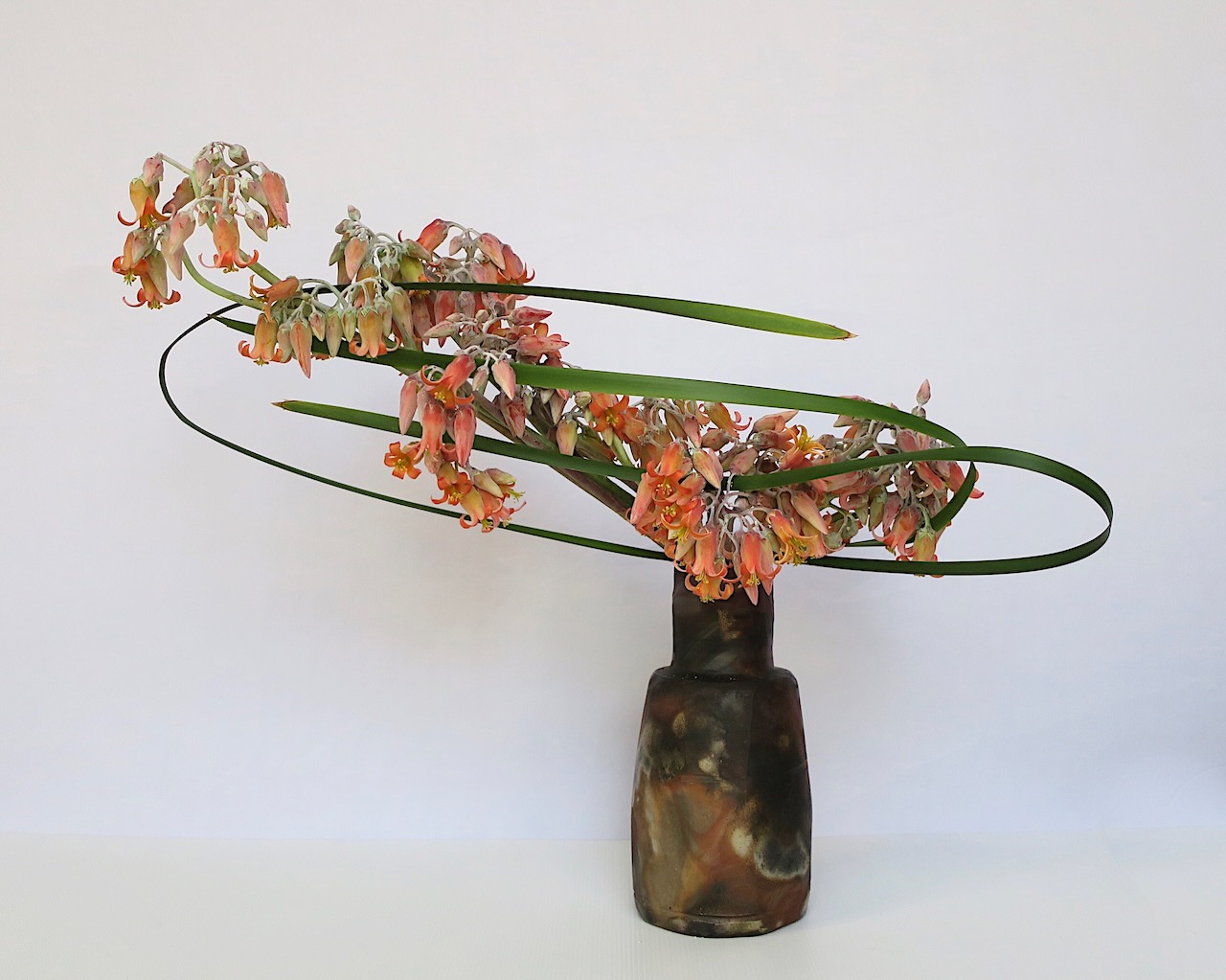
When I brought some of the flowers inside I noticed how their orange matched some of the rather orange-ish tones in this Bizen vase. This was the other ceramic purchase by Laurie last November. This time at the Yakimono-World Fair and Exhibition in the grounds of Nagoya castle. It was made at 
the Gorobee Kiln in Okayama.


This was the start of my arranging the materials in the Bizen vase. The overall darkness of the vase makes it dominant and the flower mass look small.


I have made a loose mass with the flowers, trying to maximise the visibility of their orange colour. I then added some lines with the green strap-like leaves of Lomandra lingifolia. The leaves gave the ikebana some movement and created spaces which allowed the flowers to "breathe".

Greetings from Christopher
14th January 2024


A SECOND LOOK


By the end of last Spring, the end of November, the Strelitzia juncea in the garden had more than 25 flower stems. As I noted back then, it was the best flowering this clump has produced. Now however, the flowers have faded and the petals shrivelled to a dry, dark-brown state. This is the way of things, of course; and one of the joys of the plant world is the seasonal change we observe.


I took this photo of one of the last two flower stems, showing the drying petals as well as the final coloured petals for this season. I have previously been struck by the extraordinary colour that remains in the stem and spathe in this phase. I had pruned all of the other finished flower stems last week. After throwing several into the compost I felt I should not waste those that remained. Their colour and shape demanded the attention of my ikebana eye. I felt this material provided a challenge to my ikebana mind. 

Once before I had been struck by the colours that remained in the flower stems after flowering. In March 2020 I created the ikebana below.


In this instance the focus is on the pink at the back of the "neck", if the flowers were indeed "birds".


Last week I first focused on the shapes of three double-headed Strelitzia flower stems. For preparation I used olive oil to clean some of the sticky substance exuded from the flower spathe. Then I wiped the oil off with a paper towel, leaving a soft sheen to the surface.
 

This is the final ikebana. I re-used the fading leaves from a bunch, with flowers included, that were given to us four weeks ago. Unfortunately the flattening effect of the photograph removes the feeling of depth and the way the secondary flowers interact with each other.

The suiban is by the New Zealand ceramic artist Elena Renka.

Yesterday I decided I had to use the rest of the flowers I had set aside. To start with I used the same cleaning process described above. Then I observed that the spathes of the flower heads presented different angles to the main stem. Many were almost at right angles. But a couple "looked down" and a few more were "looking up".


I have used the spent flowers to make an ikebana in which the lines are closely placed to create a very structured arrangement of lines and angles. None of the flower heads actually touch each other and all of them face inwards toward the midline. The one downward facing flower I used is at the back. The right angle flowers were placed next then the upward looking flowers were placed highest. This placement gave a certain logic to the ikebana and an over-all coherence of design.

The following three quarter and side views shows the depth of the arrangement.


The vessel is by the Victorian ceramic artist Isabella Wang.
 

Greetings from Christopher
7th January 2024