ONE-HANDED IKEBANA


When I came to Nagoya for the first time in January 1992 I attended ikebana classes. My teacher was Noriko Ishigaki, who was recommended by one of Laurie's friends. As Noriko did not speak English and I did not speak Japanese, Laurie accompanied me to the class as a translation assistant. We were joined by Junko "June" Kimura who spoke some English. In addition to the classes, the four of us met socially on a number of occasions to go to exhibitions or have a meal together. Thus June became my first ikebana friend.

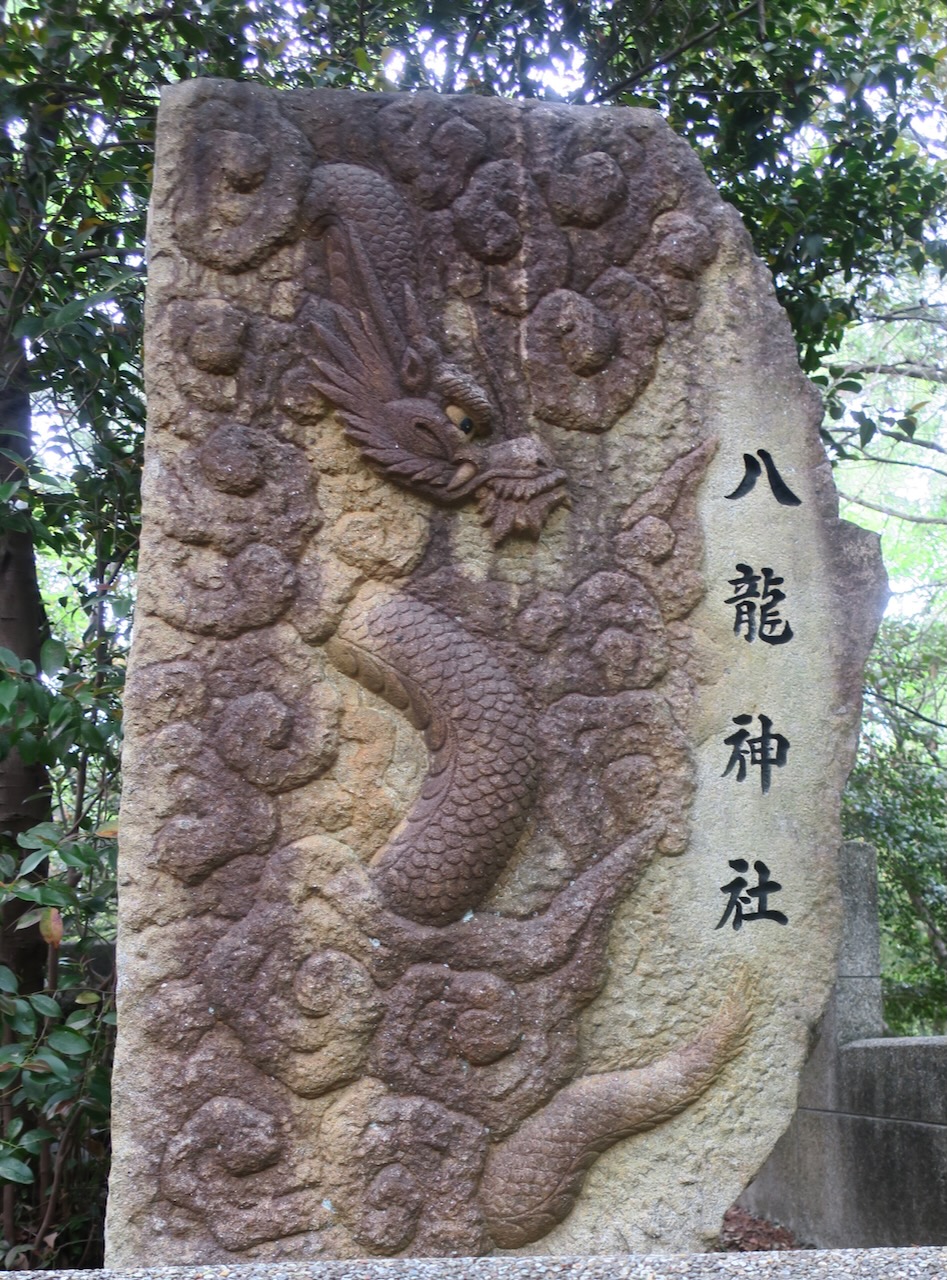
Laurie and I visited June and her husband last week and were taken to visit the small Hachiryu (Eight Dragons) Shrine near their house. The photo above was taken at the entrance to the shrine, which is set in a small quiet grove that conceals it from the nearby houses. 

This is the path in the grove that leads to the hidden shrine.

The shrine is entered through a Torii gate...

... and has this dragon image carved on a large standing stone.

Behind the shrine is a large sacred tree.

I noticed some beautiful lichen on a piece of wood in the ground nearby.

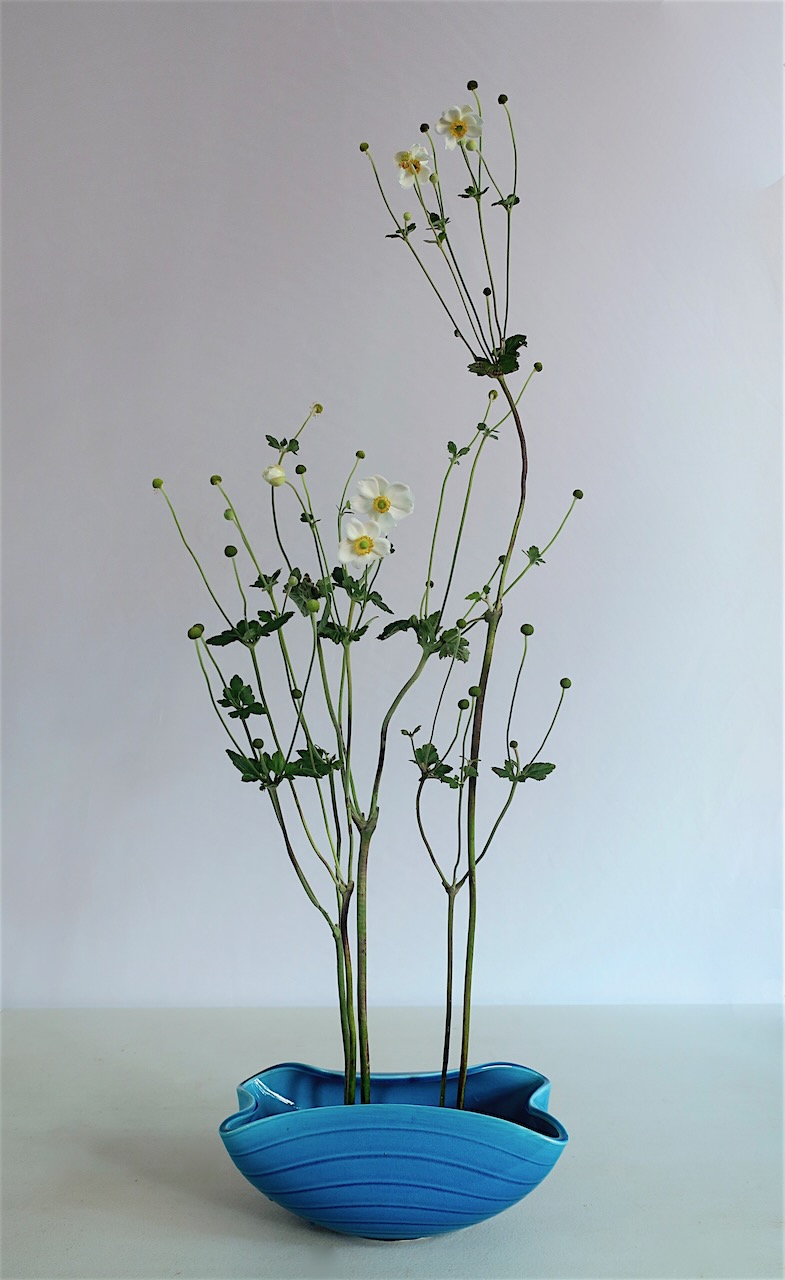
When we arrived at the house June immediately gathered a handful of small flowers from the garden and offered them for me to arrange.


This was no small challenge because I had to do so with my left hand only, having broken my right wrist two weeks earlier. With difficulty I could hold the stems with my right fingers while I removed leaves from the bottom of the stems. I was quite delighted with the graceful lines that I could show in the Jasmine vine.

Greetings from Christopher
18th May 2025
-

WOLLEMI PINE SPOTTED IN YOKOHAMA


This week Roadside Ikebana comes to you from Japan, where - to our surprise - Laurie noticed a rare Australian Wollemi Pine Wollemia nobilis. Prior to 1994 this plant was only known in the fossil record and thought to be an extinct species.

It was outside the apartment building of Yukiko, the daughter of one of Laurie's former English conversation students.

In the last class for Term One...

...Kerryn's exercise was to make a Variation No 1 of the Basic Upright style. She was not not able to procure suitable branch material so she managed with Lisianthus Eustoma flowers only.

I asked my Geelong students to make an ikebana using "Leaves only in a nageire (tall)vessel.


The main subject of Ellie's ikebana is the pair of Monstera leaves in the centre front that are interlocked. On the left are leaves with yellow colouring, including some New Zealand Flax Phormium, that has been arranged into angular lines. 


Helen has used Gymea  Doryanthes palmeri, leaves only in a large angular arrangement.
 

Maureen used variegated Aspidistra leaves which she manipulated into zig-zagging shapes as well as variegated Canna Lily Canna, leaves.

Christine used leaves from a large orchid plant that had suffered heat damage in one of the very hot days of summer. She commented that this was the first time for her to see the beauty in these damaged leaves. It is so disappointing when one of our precious plants are damaged that it is easy to only see the "damage".

Once more I am re-using some materials and a vase. 

The Gymea leaf at the front of the ikebana above, which I first  posted on 27th April, continued to change colour; so I needed to re-position it in the new arrangement below.

The new placement of the leaf is in the middle and toward the back of the work. I also added some small flowers and leaves of Coastal Banksia B.integrifolia. The pale yellow of the flowers picks up the yellowing of the Gymea leaf.

The vessel is by the Australian ceramicist Therese Rasanen


Greetings from Christopher
11th May 2025


HIROE SWEN


In preparing photos for my weekly posting I usually crop and colour-correct as best I can. I also remove distracting elements from the background of ikebana photos where possible. Unfortunately I cannot do so at the moment...


...owing to the plaster cast on my right fractured arm. I am restricted to the use of my left hand for tasks requiring fine movements. The muddy path was very slippery a week ago! I apologise for the reduction in the quality of the photos.

Last week I set my Melbourne students the task of making an ikebana in three non-matching vessels. I did not impose any additional criteria. 


Two of Marcia’s vessels had an arched top. She echoed this feature by arranging three diabetes leaves in a similar curve. Doing so also gave additional height to the Ikebana. In the right-hand vessel she added a single Hellebore flower, and in the left-hand, shallow vessel she added a white Camellia

Marisha arranged three vessels in unusual positions. A tall white vase at the front was placed almost completely horizontally. At the back, a traditional-looking vase, rested on the lip of a Bizen vase made from two slabs. She used Alstroemeria flowers in two of the vases only. 

Jacqueline arranged a single stem of Asiatic lilies Lilium in an unusual curved white vessel. Asparagus fern Asparagus setaceus, fixed in a small black bowl cascades forward over a narrow-mouthed white vase with white Alstroemeria flowers. (The background is a section of an ochre painting Moon and Star Dreaming by the indigenous artist Mabel Juli).


Eugenia arranged small bare branches in a tall vessel on the right and in a small bottle-shaped vessel on the left. To the rear and between the two is a narrow-mouthed bowl with a branch of Banksia which has three flowers clustered closely together.

The photo below is of a newly-acquired vessel from the last exhibition by the Japanese-Australian ceramic artist, Hiroe Swen.


The exhibition catalogue quotes her as saying; "In March 2024 I turned 90 and by May my life as a ceramicist had come to an end. My ageing hands and fingers would no longer function properly."

Her ceramic life began when she was 23 and started studying at the Kyoto City Crafts Institute. "The challenge of ceramics, “Born out of fire", is an endless attraction to artists, but for me after years of working on flat surfaces (oil painting and Batik textile dying) the combination of three-dimensional form and surface design was thrilling."

The vessel is from her 1984-1985  The Beach, series. The catalogue notes say: "This is one of my most representative pieces of freehand brushwork design, over multiple layers of applied glazes.'.

My ikebana this week again features re-used material.


I have re-set the "Last Hydrangea of Autumn" with a branch of Moonah Melaleuca lanceolata. I find the contrast of the soft appearance of the flowerhead with the solidity of the curving driftwood-branch particularly satisfying.

Greetings from Christopher
4th May 2025


THE LAST HYDRANGEA OF AUTUMN


In the garden this week:


Two of the Hydrangeas, which can only survive in pots in our garden, have developed a rather lovely autumn colouring. Both of these produce a fairly deep pink flower. 


The second type of hydrangea produces a larger pale pink flower with smaller petals. It is this second Hydrangea that produced the "Last Hydrangea of Autumn".


In my ikebana this week, I have re-used the Gymea Doryanthes palmeri leaves from the arrangement I showed last week. One of the leaves had started to colour, developing some olive-green towards the tip of the leaf. I angled that leaf forward and across the front of the vessel to show the colours more clearly. The floral focus is the "last hydrangea of autumn". Its large mass complements the mass created by folding the Gymea leaves into rectangular box shapes. 

The vertically-faceted sloping vessel was made by the Australian Capital Territory ceramicist Therese Rasanen; an active artist at Strathnairn Arts


Greetings from Christopher
27th April 2025 

RED PAPER


In late March, Laurie noticed a flower spike on the Dracaena fragrans in the conservatory.


When I came closer to investigate I was really surprised to see 
the spike. I had never never thought about the possibility of this variegated Dracaena flowering in the conservatory.  

A week later...

...the small spherical groups of flowers had opened.


I discovered the botanical name of the plant, Dracaena fragrans is most appropriate, as it refers to the sweet scent which became very apparent in the evening. I found that I started to notice the fragrance twelve or more metres away in the corridor that leads to the conservatory. The fragrance must be of the kind that has evolved to attract nocturnal pollinating insects. 

In my Melbourne class last week, I set the students the exercise of making an Ikebana on the curriculum exercise "Showing the lines at the base". The focus of this exercise is to draw attention to the way the stems rise strongly from the vessel without any side branches or leaves causing distraction.


Eugenia used "Lucky bamboo" which is actually Dracaena sanderiana (not a bamboo) and three stems of white Haemanthus, possibly H. pauculifolius. The stems are arranged in a shallow trough and placed so that the materials all face toward the centre of the arrangement.


Jacqueline used three Strelitzia reginae leaves, altering their appearance by removing sections between some secondary veins. Two are placed upright and the one on the left at an angle. Three Gerbera flowers, one all but completely hidden, are set at around half the height of the leaves. This placement ensures that the leaves are the principal subject of the ikebana.


Marisha used Chrysanthemum flowers only in three different colours. She has stripped the leaves from the lower parts of the stems so that they are emphasised.


Marcia used only, Dwarf Japanese anemone Eriocapitella hupehensis. She has set the stems in two groups to create a space in the centre of the ikebana. The upward movement draws the eye toward the four small open flowers.

My own ikebana is a re-working of my thwarted plans for the Melbourne International Flower and Garden Show. I was intending to participate as a member of Ikebana International Melbourne. Unfortunately I came down with Covid after my visit to Sydney and had to isolate at home. All of the arrangements were to feature the use of an Obi within the ikebana as a uniting feature. 

I was able to re-work the idea without the Obi for the Sogetsu School's Victorian Branch AGM on Monday two weeks ago. The theme we had set for members was to use their favourite material and/or vessel. I chose a large wood-fired ceramic vessel by Ian Jones as being representative of my passion for hand-made ceramics. My favourite material is the twisted branches of Moonah Melaleuca lanceolata, a very wind and salt-hardy tree, commonly found on the cliffs near our home. The vertical lines are three Gymea Doryanthes palmeri leaves. In the absence of suitable flowers I added a colour focus made with two masses of red tissue-paper.

Greetings from Christopher
19th April 2025


EXPERIMENTING WITH PAPYRUS


Two weeks ago I set my senior Melbourne students the fairly traditional exercise of making an ikebana using Autumn grasses, arranged in a basket.
 

Eugenia collected all the materials from her garden, which has quite a number of Australian native species. However, her ikebana also has exotics including variegated New Zealand Flax Phormium.

Jacqueline collected her materials from the wayside. The grass with the plume-like flowers on the right looks like Fountain grass Cenchrus setaceus, a native of Africa, the Middle East and South-western Asia. Her 'basket' is woven from Pandanus leaves and can sit flat, or the edges can be lifted and held by toggles at the corners.

In the garden, the Haemanthus coccineus recently produced five flowers. I decided I could afford to pick three. I justified this to myself as it would encourage the relatively young plants to put more energy into root and leaf development instead of making seeds.


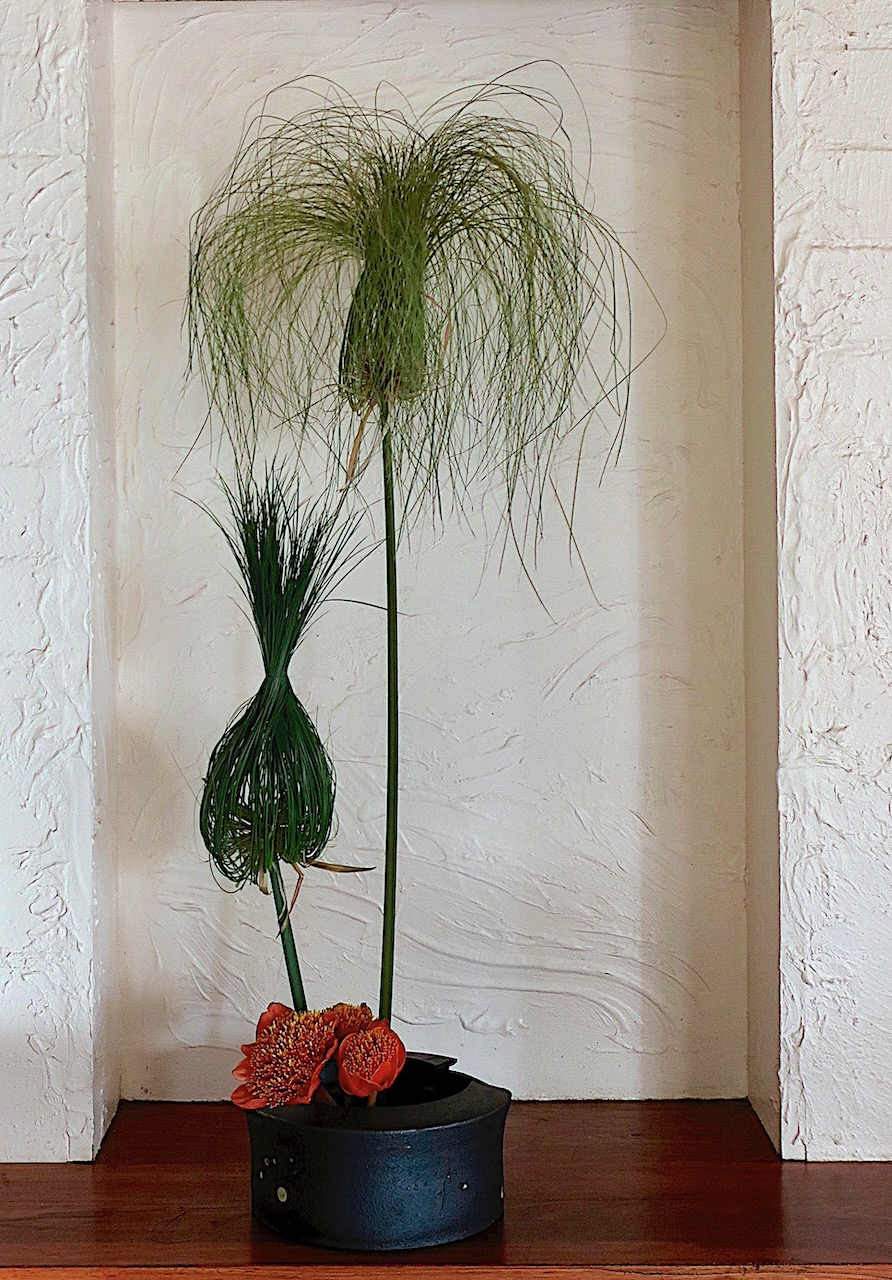
I placed three flowers in a black ceramic vessel from Seto, in Japan, which looks to me rather like a strange cast-iron cooking pot. The flowers needed some green materials, so I used two Papyrus flower heads. 


Earlier in the year I had transplanted the Papyrus into a small 90cm diameter garden pond in the conservatory. By the early summer the tallest stems were 3.5m long, touching the ceiling glass. Two of the stems had bent and collapsed, so I used them in my ikebana. 


This was the first version of the ikebana. I had to tie up the rays (the fine filaments) at the top of the smaller stem on the  left because they hid the flowers completely. Having done that, the papyrus stems looked too different to each other.

I then loosely tied the rays on the taller stem to create a more coherent appearance in the arrangement. Standing back, I felt the idea of using the Papyrus made an "interesting" experiment but not a successful ikebana. 

Since then I made another ikebana arrangement where I was happy to let the rays of a drying Papyrus flowerhead cascade over other elements.


This is my third version using a Papyrus flowerhead in this way. I made the arrangement for an Ikebana International Melbourne workshop last Saturday. The workshop theme was "Using roses in ikebana". I find hot-house grown roses a very difficult material because of the stiffness of the stems and the weakness of the leaves. In the ikebana above I used roses bought from a florist with which I created a mass in the centre. The fine rays of Papyrus cascade over the three pale pink roses. The dried parts in the centre of the Papyrus closely matched the soft pink of the roses. I placed a dried, sun-bleached branch of Moonah Melaleuca lanceolata curling around the vessel and extending to the left. The roses have become a small colour focus that contrasts with the strong line of the dried branch.

The vessel is by the Victorian ceramicist Terunobu Hirata.

Greetings from Christopher
12th April 2025


GOLDEN ROD (The Canadian weed)

In my Melbourne class recently ...

...my student Chen has advanced from Moribana ikebana arrangements in a Suiban (shallow vessel) to the next stage in the Sogetsu curriculum. That is, arranging materials in a tall straight-sided vessel. This requires the mastering of fixing techniques so that the materials remain in place and at the correct angles for the particular exercise. In the photo above he has used only one kind of material, Crepe myrtle Lagerstroemia. Technically, the flowers should be a different kind of material to the branch lines at this stage.

The exercise I set for the advanced students was to make an ikebana using "summer flowers and unconventional (artificial) material". 


Jacqueline arranged three Sunflowers Helianthus, and  two Camellia branches so that they protruded from a picture frame.

Marisha arranged Eucalyptus branches and Alstroemeria flowers in a shallow boat-shaped vessel. The "unconventional" material she used was white mizuhiki *.

Eugenia, arranged a single, cerise Dahlia flower in a flat-fronted vessel. The unconventional material is a wide ribbon of thick, malleable metal that has been painted black.

In the garden at Torquay I have been growing Golden Rod Solidago canadensis, in an old concrete laundry trough. 


This year I started watering it with a full bucket of water on most days. It has survived the few very hot days and grown shoulder high, as the above photo shows. Interestingly, when I was in Japan in November 2023 I saw that it had indeed become a significant environmental weed; true to my Canadian ikebana friend Leonora's description of it as 'the Canadian weed'. As a result I am taking care to remove dead flowers before they set seed.


I made this ikebana to express the strong upward movement of the Golden Rod. A mass of pink Bella Donna flowers anchors the vertical line and connects it to the vase made by Mark Bell from Maine USA.

Greetings from Christopher

6th April 2025 


* Mizuhiki are strings made from rolled Japanese Washi paper

"FLOATING" LEAF


In my Geelong class, Maree's exercise was a continuation of the fixing practice necessary when using a Tsubo (spherical) vase. 

In this case, the very long branch on the left side has been stabilised by securing it with a screw to the branch on the right side of the vase. The main branches are Banksia, a mass of Nandina is placed at the front, and the flowers are Gladiolus.

I had given my senior students the task of making a slanting ikebana in a tall vessel and asked them to then make a complementary moribana (literally, heaped flowers) arrangement in a low vessel.

Eugenia used two stems of Banksia and some Everlasting daisies Xerochrysum bracteatum, for her Slanting ikebana. In a low black trough she then arranged branches of semi-prostrate Cootamundra Wattle Acacia baileyana and more Everlasting daisies.


Marisha used Camellia branches in both vessels,  Chrysanthemum and Asiatic lilies Lilium in the tall vessel, and  only Chrysanthemum flowers in the low vessel.

Jacqueline set two Clivia leaves and a stem of Alstromeria in her "tall' vessel. In the lower vessel she used Carnation Dianthus caryophyllus, and Alstromeria flowers.The mass volume was increased with Nandina leaves. 


Maureen used a tall vessel in the centre behind the small suiban at the front. The tall vessel 
is hard to see against the background because it is very dark. She has used Pin oak Quercus palustris branches and Asiatic lily flowers in both vessels.


Christine has used branches of Manchurian Pear Pyrus ussuriensis, with Nerine sarniensis flowers. The autumnal red in the leaves harmonises closely with the Nerines. 

My own ikebana this week was inspired by the bright yellow of a fading leaf from our Tree Philodrendon Thaumatophyllum bipinnatifidum. The plant is growing in a pot close to the table where we usually have our lunch. 


Because of 
the angle of its stem, the leaf would have leant forward if I had set it upright in a vase. My solution was to place it across a shallow bowl by Phil Elson which has a golden brown inner surface and a black underside. The leaf almost appeared to float across the vessel as it extended over the rim on all sides. B
ecause it was dying and would soon start to wither and become brown I felt that I was justified in showing the stem out of water. The addition of a single white incurve Chrysanthemum makes this a bold ikebana in the "One leaf one flower" style

Greetings from Christopher
30th March 2025